Cameroonian coffee is a declining sector that better crop management can turn around. According to the campaign report published by ONCC, Cameroon marketed 10,953 tonnes of coffee in 2023/2024, compared with 13,704 tonnes a year earlier, a fall of 24 %. Robusta accounted for 10,091 tonnes and arabica for only 502 tonnes. Over the same period, the farm-gate price of robusta ranged from 900 to 2,100 FCFA per kilogram and that of arabica from 2,000 to 2,750 FCFA. Cameroon’s problem is therefore not price but agronomy: planting density, orchard age and fertilisation. This guide sets out the official figures, then the crop management practices validated by research.
Where Cameroon’s coffee sector stands
The country profile published by the International Coffee Organization gives the structure of the sector: 70,000 hectares planted, including 60,000 ha of robusta and 10,000 ha of arabica. Seven regions grow coffee: Centre, East, Littoral, North-West, West, South and South-West. Two of them account for most of the activity: the Littoral with 41 % and the West with 36 % of production, about three quarters of the total. The ONCC 2023/2024 report confirms this concentration: the Littoral and the West accounted for 91.83 % of robusta marketed.
The sector supports 423,000 households, about 2.96 million people according to the ICO. It remains highly fragmented: 75 % of farms are smaller than 3 hectares, with an average size of 0.5 hectare for robusta and 1.9 hectares for arabica.
Downstream, the ONCC report lists 25 exporters (18 in robusta only, 4 in arabica only, 3 in both), 10 quality control companies and 32 identified roasters. Exports for the 2023/2024 campaign amounted to 10,161,776 kg of robusta and 286,246 kg of arabica, for a total FOB value of 26.69 billion FCFA.
These figures should be set against the targets of the revival plan adopted in 2014, which aimed for 125,000 tonnes of robusta and 35,000 tonnes of arabica by 2020. The gap between target and outcome shows up first in yields. For an overview of the sector as a whole, see our overview of agriculture in Cameroon.
Yield, the main bottleneck in Cameroonian coffee farming
The ICO profile is unambiguous about the cause of the decline. Average yield is about 300 kg per hectare on farms that apply no fertiliser, compared with about 1,000 kg per hectare on farms that fertilise. Organic coffee sits below the 1,000 kg/ha mark. Regional gaps recorded in 2015/2016 are of the same order: 543.3 kg/ha in the Littoral against 144 kg/ha in the North-West.
Work carried out by IRAD and CIRAD in the village of Ngat, in east-central Cameroon, between 2000 and 2003, gives the real starting point: the six growers monitored produced an average of 114.3 kg of marketable coffee per year in a traditional system under mixed shade from forest and fruit trees. By comparison, the technical sheet from Côte d’Ivoire’s CNRA gives an average productivity of 2.5 to 3 tonnes per hectare for well-managed hybrid robusta varieties.
In other words, the gap between traditional coffee farming and the potential of the species is measured as a factor of ten, not in percentages. Three levers explain this gap: planting material, density and fertilisation.
Planting material: the fastest gain
The IRAD and CIRAD trial at Ngat compared selected clones (B5, M5, B11, J32 and J21) with ordinary seedlings. The result is clear: the selected clones proved 2.4 times more productive than ordinary plants.
This is the least costly lever to pull when replanting, but it only pays off if the other two follow. A high-performing clone planted at low density without fertiliser ends up with the same poor yield as ordinary material, simply with a higher initial investment.
Density and planting layout
Traditional Cameroonian coffee farming as described by IRAD ranges from 1,550 to 1,650 coffee trees per hectare. The improved layout tested at Ngat is based on double hedgerows at 1,960 trees per hectare, with a spacing of (1.5 m + 4.5 m) by 1.7 m. The 4.5 m alley between the double rows is not wasted: it allows access, harvesting and intercropping during the first years.
The CNRA technical sheet from Côte d’Ivoire proposes two reference layouts for robusta:
| Layout | Spacing | Density | Training |
|---|---|---|---|
| Wide rectangle | 3 m by 2.5 m | 1,333 trees/ha | 4 stems per tree |
| Narrow rectangle | 3 m by 1.70 m | 1,960 trees/ha | 3 stems per tree |
In both cases, the planting hole measures 40 cm by 40 cm by 40 cm. The rule to remember: the higher the density, the fewer stems you leave per tree, so as not to close the canopy and trigger competition for light that strips the lower fruiting branches.
The choice of shade deserves to be made explicitly. The traditional Cameroonian system keeps mixed shade; the improved system tested by IRAD and CIRAD removes it. Without shade, the potential is higher but water and fertiliser requirements become strict: a coffee tree in full sun that is poorly fed exhausts itself in two seasons.
Fertilising coffee trees
The protocol applied at Ngat by IRAD and CIRAD was 400 kg of NPK per hectare per year, in two applications, in April and October, that is at the start of each of the two rainy seasons.
The CNRA sheet works per tree rather than per hectare, which is more practical on a variable plot:
- Years 1 to 7: urea, 2 applications of 80 g per tree.
- After 7 years: 20-10-5 compound fertiliser, 150 g per tree.
- Timing: in March and April, then in September.
The logic is consistent: nitrogen dominates while the tree builds its framework, then a complete formula once it reaches full production, with two applications timed to the rains. For details of the formulations available in Central Africa, see our guide to NPK, foliar and organic fertilisers. Our fertilisation and plant nutrition teams build the fertiliser plan from a soil test or leaf analysis.
Pruning, coppicing and orchard maintenance
The robusta pruning calendar proposed by CNRA shapes the whole life of the orchard:
- Years 1 and 2: formative pruning, selecting 3 to 4 main stems per tree.
- From year 3: maintenance pruning every 3 to 4 months, removing suckers and dead wood.
- Around year 7: rejuvenation pruning, or coppicing, which brings the tree back into production.
Coppicing is the step that ageing Cameroonian orchards neglect most. A coffee tree that is not coppiced keeps flowering, but on increasingly exhausted wood, and yield collapses long before the tree dies. Pest scouting goes hand in hand with this: CNRA notably lists the black twig borer, the coffee berry borer, the rat-tail caterpillar, the stinking grasshopper and the weevil. Our crop protection team helps with diagnosis and the choice of locally registered products.
Harvest and post-harvest processing
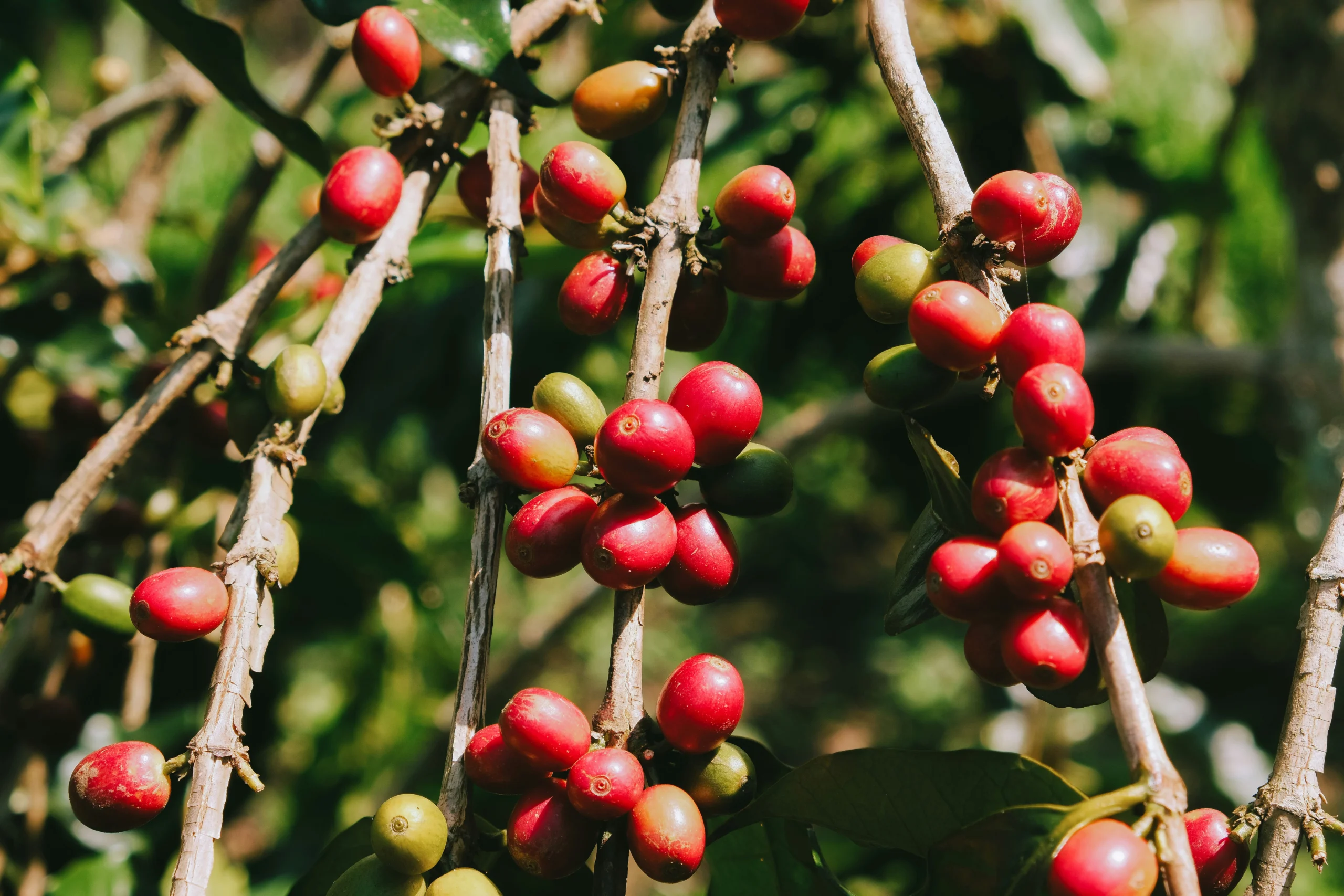
Robusta coffee starts producing from the second year after planting according to CNRA, with full production coming later. Harvesting is done by selective picking of fully ripe, bright red cherries. Picking green cherries lowers both the yield of marketable coffee and the quality grade, and therefore the price paid.
Dry processing, the most common method for robusta, involves three steps:
- Drying: 3 to 4 weeks, in thin layers of 3 to 4 cm turned regularly, to bring moisture down from 60 % to 12 %.
- Hulling of the dried cherries.
- Storage in a dry place, protected from mould and insects.
This is the stage that decides the price gap recorded by ONCC between 900 and 2,100 FCFA per kilogram for robusta. Drying done too quickly, on a tarpaulin laid on the ground or interrupted by rain, produces defects that downgrade the entire lot.
Robusta or arabica: which to choose
ONCC figures for the 2023/2024 campaign put the choice in concrete terms. Arabica sells for considerably more, 2,000 to 2,750 FCFA per kilogram against 900 to 2,100 FCFA for robusta. But arabica volume is marginal, 502 tonnes against 10,091 tonnes of robusta, and it fell faster, by 42.75 % against 22.75 % over the campaign.
Cameroonian arabica is grown at altitude, mainly in the West and North-West, on farms averaging 1.9 hectares, compared with 0.5 hectare for robusta. Robusta remains the default option in the lowland forest zone, with a structured export outlet. Arabica makes sense in the highlands when the quality chain is accessible, with the price premium then offsetting the lower yield and greater susceptibility to disease.
In both cases, the logic is the same as for cocoa in Cameroon: a dense, rejuvenated and fertilised orchard beats a large, neglected one on the same budget. Our agricultural consulting and engineering teams cost replanting or rehabilitation plans block by block.
Sources and references
- ONCC (Office National du Cacao et du Café, Cameroon). Bilan de la campagne caféière 2023/2024. View the report
- International Coffee Organization. Profil sur le café : Cameroun, ICC 120-5f. View the profile
- IRAD and CIRAD, Biotechnologie Agronomie Société et Environnement. Amélioration du système traditionnel de caféiculture au Cameroun par l’introduction de trois innovations techniques. View the article
- CNRA (Centre National de Recherche Agronomique, Côte d’Ivoire). Bien cultiver le caféier Robusta en Côte d’Ivoire. View the technical sheet
Article by the JOGOO Agriculture agronomy team. Rates and products should be adapted to your zone and to the products registered in your country.
Frequently asked questions
How much coffee does Cameroon produce?
According to the ONCC campaign report, Cameroon marketed 10,953 tonnes of coffee in 2023/2024, compared with 13,704 tonnes in 2022/2023, a fall of 24 %. Robusta accounted for 10,091 tonnes and arabica for 502 tonnes.
What is the coffee yield in Cameroon?
The International Coffee Organization country profile reports about 300 kg per hectare on farms that apply no fertiliser and about 1,000 kg per hectare on farms that fertilise. In 2015/2016, the Littoral reached 543.3 kg/ha and the North-West 144 kg/ha.
What is the farm-gate price of coffee in Cameroon?
For the 2023/2024 campaign, ONCC recorded a farm-gate price of 900 to 2,100 FCFA per kilogram for robusta, and 2,000 to 2,750 FCFA per kilogram for arabica.
How many coffee trees should you plant per hectare?
Traditional Cameroonian coffee farming ranges from 1,550 to 1,650 coffee trees per hectare. The improved layout tested by IRAD and CIRAD rises to 1,960 trees per hectare in double hedgerows. CNRA recommends 1,333 trees/ha at 3 m by 2.5 m or 1,960 trees/ha at 3 m by 1.70 m.
What fertiliser should you apply to coffee trees?
The IRAD and CIRAD trial at Ngat applied 400 kg of NPK per hectare per year, in two applications in April and October. The CNRA sheet recommends 2 applications of 80 g of urea per tree for the first seven years, then 150 g of 20-10-5 compound fertiliser per tree, in March and April and then in September.
How long does a coffee tree take to produce?
Robusta coffee starts producing from the second year after planting according to the CNRA technical sheet. Formative pruning takes up the first two years, maintenance pruning follows every 3 to 4 months, and rejuvenation pruning is carried out around the seventh year.
Further reading
- Cocoa farming in Cameroon: a complete guide from soil to bean: Cameroon’s other perennial cash crop, facing the same problem of ageing orchards.
- Agriculture in Cameroon: figures, value chains and challenges: where coffee stands among the major national value chains.
- Agriculture in Cameroon, Senegal and Côte d’Ivoire: a regional comparison of cash and food crop value chains.