
Download the technical sheet (PDF)
Walk into any market in Lagos, Douala, Kingston or Mumbai and you’ll see them side by side, long green plantains and yellow-ripe bananas. They look almost identical. They come from closely related plants. Yet they are treated as completely different foods across the world. Here is what actually separates plantain from banana, why the distinction matters in the kitchen and on the farm, and how to know which is which at a glance.
1. Are plantains and bananas the same plant?
Almost. Both plantains and bananas belong to the genus Musa. Botanists no longer separate them into different species, they are all cultivars of the same species complex, mainly hybrids of Musa acuminata and Musa balbisiana.
The everyday distinction is culinary and cultural, not strictly botanical:
- Bananas: sweet, eaten raw when ripe. Most common variety worldwide is the Cavendish.
- Plantains: starchy, always cooked before eating. Most common varieties include Horn plantain, French plantain, and Dominico.
In many countries, especially across sub-Saharan Africa, Latin America, and the Caribbean, the two are separate market categories with separate names, separate prices, and separate seasons.
2. How to tell them apart at a glance
Size and shape
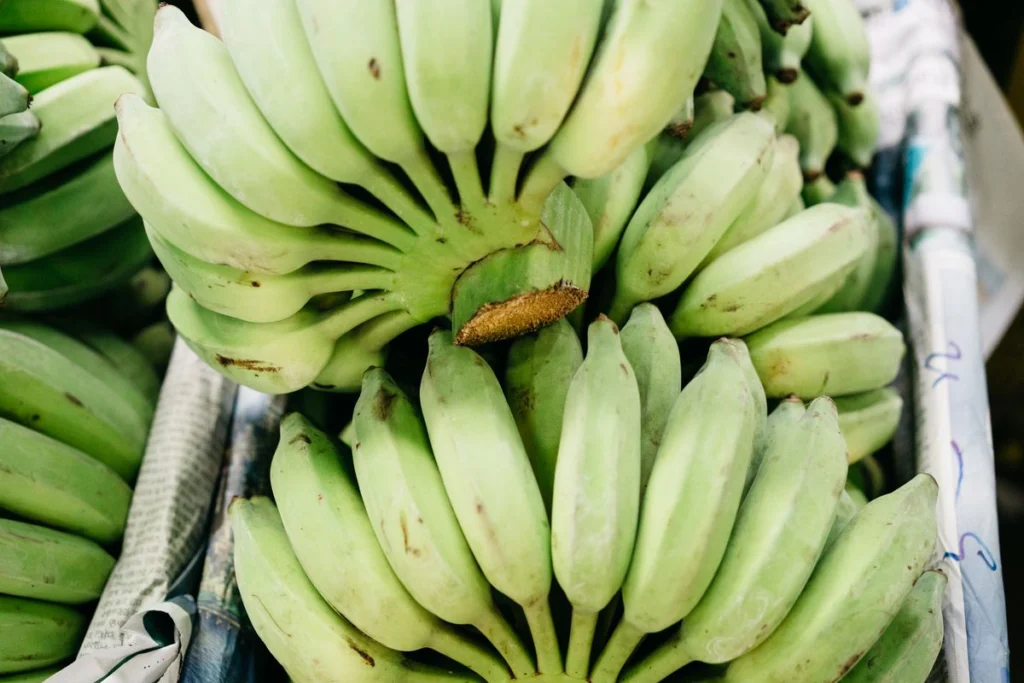
- Plantains are generally larger, longer, and more angular,often 20 to 35 cm long with visible ridges.
- Bananas are typically smaller and rounder,15 to 20 cm with a smoother curve.
Skin
- Plantain skin is thicker and tougher. Even ripe, it can be difficult to peel, often needs a knife.
- Banana skin is thin and easy to peel by hand.
Color at ripeness
- Green plantains → yellow → brown/black spotted → deep black. Fully black plantains are ripest and sweetest.
- Green bananas → yellow → light brown spotted. Black bananas are overripe.
Flesh texture
- Plantain flesh is firm, dry, and starchy, even when ripe.
- Banana flesh is soft, moist, and sweet when ripe.
3. Nutritional comparison (per 100 g raw)
| Nutrient | Plantain | Banana |
|---|---|---|
| Calories | 122 kcal | 89 kcal |
| Carbohydrates | 32 g | 23 g |
| Sugar | 15 g (ripe) | 12 g |
| Starch | 15 g (ripe) / 32 g (green) | 5 g |
| Fiber | 2.3 g | 2.6 g |
| Vitamin C | 18 mg | 9 mg |
| Potassium | 499 mg | 358 mg |
| Vitamin A | 1127 IU | 64 IU |
| Vitamin B6 | 0.30 mg | 0.37 mg |
Takeaways: plantain is higher in calories, potassium, and vitamin A. Banana is slightly higher in vitamin B6. Both are excellent potassium sources, but plantain contains around 40 % more.
4. Culinary uses
Plantain, always cooked
- Green plantain: fried in slices for tostones (Puerto Rico, Cuba), boiled and mashed for fufu (West Africa) or mofongo (Puerto Rico), fried as chips.
- Yellow plantain: fried sweet plantains (dodo in Nigeria, maduros in Latin America, aloco in Côte d’Ivoire).
- Black plantain: sweetest, baked whole, grilled, used in desserts.
Banana, usually eaten raw
- Eaten fresh, blended into smoothies, sliced onto cereal, baked into breads and muffins, dried into chips.
- Cooking bananas (a separate category) exist in East Africa (matoke in Uganda) but are technically distinct varieties.
5. Cultivation differences
From a grower’s perspective, plantain and banana are very similar:
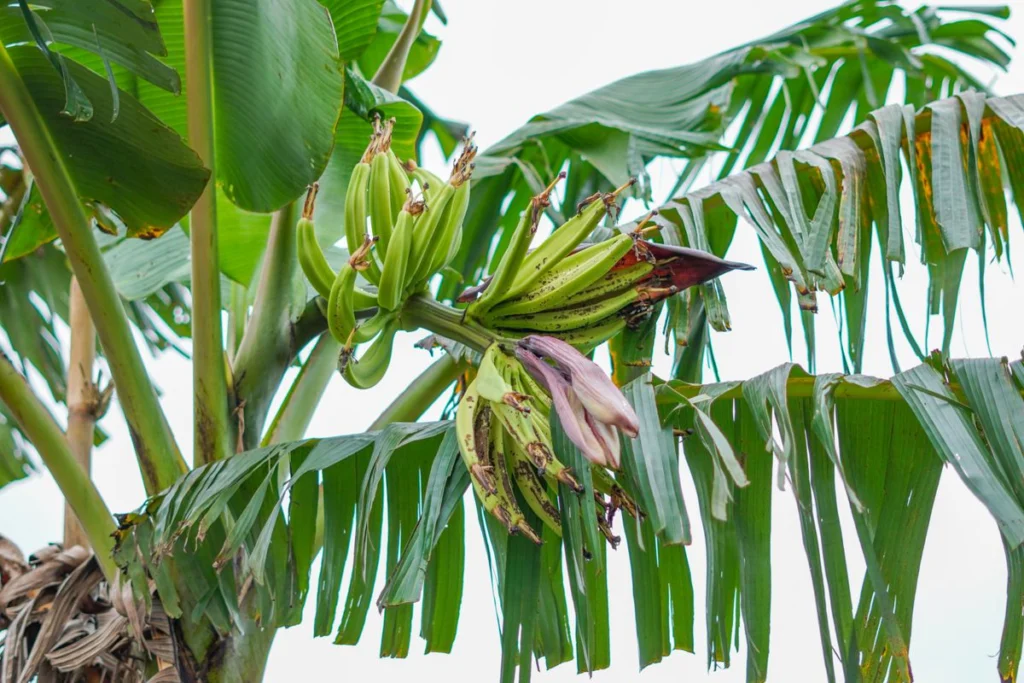
- Both are tropical perennials, both grown from suckers (not seeds).
- Both prefer well-drained fertile soil, pH 5.5 to 7.0.
- Both need 25 to 30 °C and 1,500 to 2,500 mm rainfall well distributed across the year.
- Plantain cycles are slightly longer, 10 to 15 months to first bunch versus 9 to 12 for Cavendish banana.
- Plantains generally show higher tolerance to disease like Panama Disease Tropical Race 4, though not immunity.
Plantain remains a smallholder crop in most of Africa and Latin America, while banana is heavily industrialized (Ecuador, Guatemala, the Philippines dominate exports). Africa produces more than 70 % of the world’s plantains, led by Cameroon, Nigeria, Ghana, Côte d’Ivoire, and DR Congo.
For growers considering plantain as a commercial crop, our agricultural consulting team helps design plantations and manage phytosanitary risk.
6. Which should you buy?
- Want a sweet fruit to eat raw: banana.
- Want a starchy vegetable to cook: plantain.
- Want more potassium and vitamin A: plantain.
- On a low-calorie diet: banana (about 30 % fewer calories).
- Making West African, Caribbean, or Latin American dishes: plantain is almost always the correct choice.
7. Common preparation methods and their nutritional impact
How you prepare plantains and bananas has a bigger effect on the nutrition than the small differences between the raw fruits.
Frying (dodo, tostones, maduros)
Fried plantains gain 50 to 100 kcal per 100 g from absorbed oil. This is the most common preparation across West Africa and the Caribbean, and the reason plantain is often considered less healthy than banana in Western dietary contexts. Sweet fried plantains (yellow to black) absorb slightly less oil than green tostones because sugar caramelization creates a natural barrier.
Boiling (fufu, matoke, mofongo base)
Boiling loses about 20% of the vitamin C but preserves potassium and starch content. Boiled plantain is one of the most affordable, filling staple carbohydrates in tropical diets, and forms the base of countless traditional dishes.
Baking or roasting
Whole baked ripe plantain is one of the most nutritionally intact preparations, no added fat, minimal vitamin loss, and the natural sugars caramelize beautifully. Increasingly popular in Africa as a healthier alternative to frying.
Blending (smoothies, plantain flour)
Frozen ripe banana blends into ice-cream-like textures for healthier desserts. Green plantain flour is one of the fastest-growing gluten-free flour categories, sitting alongside cassava flour in health-food markets.
8. Storage and ripening at home
- Green bananas: ripen at room temperature over 3 to 7 days. Speed up by putting in a paper bag with an apple.
- Yellow bananas: eat within 3 days at room temperature, or refrigerate to slow ripening. Skin will blacken in the fridge but flesh stays firm.
- Green plantains: keep well at room temperature for 1 to 2 weeks, ripening slowly.
- Yellow to black plantains: use within a few days once ripe. For long storage, peel and freeze in slices.
- Both: never store below 12 °C for extended periods, cold damages the flesh (“chill injury”) of these tropical fruits.
9. Cultivation as a smallholder crop
For farmers, plantain is one of the most reliable smallholder crops in humid tropical Africa. A single healthy stool (mother plant plus suckers) yields 20 to 40 kg per year for 5 to 10 years with minimal input, provided the soil is fertile and moisture is adequate. Because plantain also produces continuous suckers, one initial planting establishes a permanent stand. This makes it particularly attractive as a low-labor crop for farmers with land but limited cash for annual replanting.
For commercial-scale cultivation, our team at JOGOO advises growers on plantation layout, disease management (particularly against Panama Disease Tropical Race 4), and market access, see our agricultural consulting service for details.
Article by the JOGOO Agriculture team. Nutrition values are typical figures from published food composition tables and vary slightly with variety and ripeness.
Frequently asked questions
What is the main difference between a plantain and a banana?
Plantains are starchy and always cooked before eating; bananas are sweet and usually eaten raw. Plantains are typically larger, more angular, with thicker skin. Both belong to the genus Musa and are botanically very similar, but they are treated as distinct foods in kitchens and markets across Africa, Latin America, and the Caribbean.
Can you eat a plantain like a banana?
Not really. Green or yellow plantains are starchy and unpleasantly dry when raw. Fully ripe (black-skinned) plantains can be eaten raw and taste like a very sweet, dense banana, but this is uncommon. Almost all plantain worldwide is cooked, fried, boiled, grilled, or baked.
Is a plantain healthier than a banana?
Neither is universally healthier. Plantain has more calories, more potassium (about 40 % more), more vitamin A, and more vitamin C. Banana has slightly more vitamin B6 and less starch when ripe. For potassium and vitamin A intake, plantain wins. For low-calorie snacking, banana is better.
Are plantains just unripe bananas?
No. Plantains and bananas are different cultivars of closely related Musa plants. Even fully ripe (black) plantain never turns as soft or sweet as a ripe Cavendish banana, its flesh stays firm and starchy. An unripe Cavendish banana is still a banana, not a plantain, and vice versa.
Where are plantains mainly grown?
Africa produces more than 70 % of the world’s plantains. The top producers are Cameroon, Nigeria, Ghana, Côte d’Ivoire, and DR Congo. Uganda’s cooking banana (matoke) is a related but distinct category. Latin America, mainly Colombia, Peru, and Ecuador, is the second-largest producing region, mostly for domestic consumption.
Related articles

Get the full guide offline. Enter your details below.