Cashew farming in Côte d’Ivoire rests on an orchard area of around 1,400,000 hectares managed by nearly 450,000 growers, with an average yield of only 590 kg of raw nuts per hectare according to the Conseil International Consultatif du Cajou (International Cashew Advisory Council). The country has been the world’s leading producer and exporter of cashew nuts since 2015. The farm-gate price for the 2026 season has been set at 400 FCFA per kilogram. The challenge is therefore no longer to plant more, but to make existing orchards produce: controlled density, well-structured trees and balanced fertilization make it possible to aim for 1 to 2 tonnes per hectare instead of 350 to 500 kg.
The Ivorian cashew sector in figures
The Conseil International Consultatif du Cajou recorded 968,676 tonnes of raw nuts marketed in 2021, an orchard area estimated at 1,400,000 hectares and about 450,000 growers, 17% of them women. The national average yield remains low, at 590 kg per hectare.
Local processing is growing but remains a minority: 224,036 tonnes of raw nuts were processed in the country in 2023, across 46 installed units. The same year, 719,900 tonnes of raw nuts were exported, at an average farm-gate price of 353 FCFA per kilogram.
The growth in area has been spectacular. The Chambre d’Agriculture de Côte d’Ivoire notes that orchards covered 8,220 hectares in 1970, 265,650 hectares in 2000, 420,000 hectares in 2005 and 450,000 hectares in 2008/2009. This expansion came from extending the planted area, rarely from intensification, which explains today’s average yield.
Production zones cover the centre, north, north-east and north-west: Béré, Denguélé, Savanes, Worodougou, Vallée du Bandama, Zanzan, Haut Sassandra and Bafing. There, the cashew tree plays the same structuring role as cocoa in the southern forest zone, whose management we cover in our guide to cocoa farming.
Climate, soil and suitable zones
Cashew is a savanna species. It tolerates a pronounced dry season, which makes it suited to the central and northern regions where cocoa and rubber cannot be grown. It does, however, need deep, well-drained soils: the tree develops a strong taproot, and any compacted or waterlogged layer permanently limits its growth.
Flowering and fruit set are the most sensitive stages. Work by Sanoko and colleagues in the Poro region shows that moderate rainfall before flowering favours productivity, while heavy rain during flowering disrupts fertilization. This explains a large part of the variability observed from one year to the next.
To assess the real suitability of a plot before planting, our team provides agricultural consulting and engineering, from soil diagnosis to the planting plan.
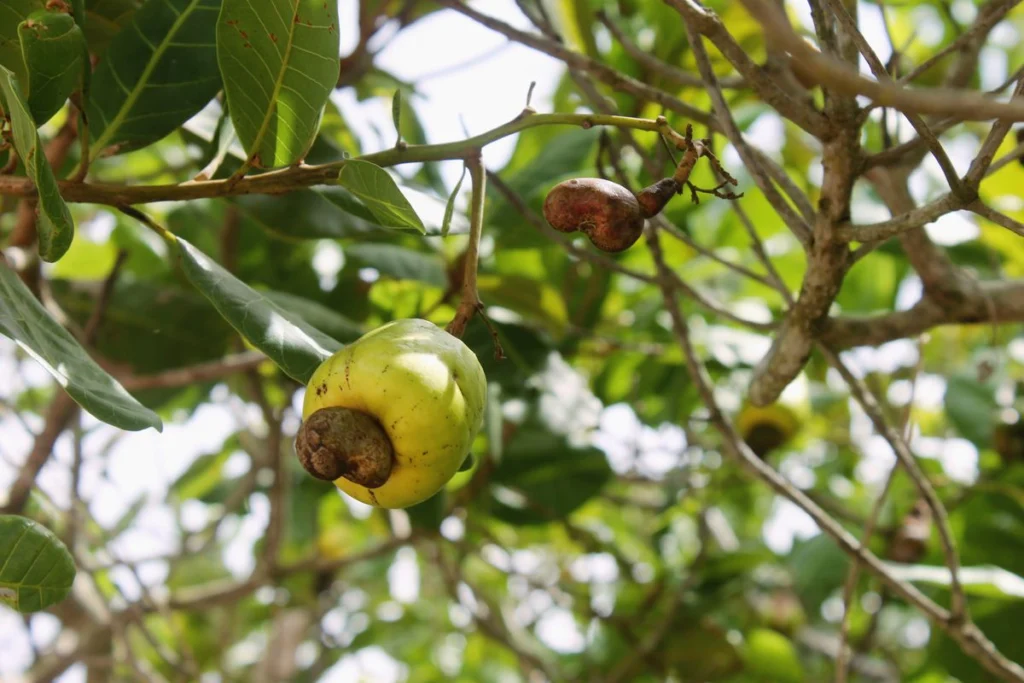
Establishing the orchard: planting material, density and spacing
The reference density adopted by the Chambre d’Agriculture de Côte d’Ivoire is 100 trees per hectare, which corresponds to a spacing of 10 metres by 10 metres. This density may seem low, but it matches the area a well-managed mature cashew tree actually occupies.
This point is essential and too often overlooked. The study carried out in Poro on 476 trees across 12 orchards established that planting density is negatively correlated with yield per tree, while canopy spread is positively correlated with it, with a coefficient of determination of 0.48 in 2023. In other words, an orchard that is too dense produces less: the canopies compete, become spindly and only bear fruit on their outer edges.
Three practical rules follow:
- keep to 10 metres by 10 metres from planting, even if the young plants look lost in the plot during the first years;
- use selected planting material rather than ungraded nuts, since the variability between trees grown from unselected seed is considerable;
- plan to thin the orchard if it was planted too close, rather than letting competition set in.
In orchards that are already dense, removing every other tree in a staggered pattern remains the most effective correction, even if it is psychologically hard to accept.
Maintenance: weeding, pruning and fertilization
Routine maintenance consists of keeping a clean ring under the canopy, clearing the rows before harvest to make nut collection easier, and formative pruning in the early years to obtain a single trunk and a balanced framework.
Fertilization is the most profitable and least practised lever. The Institut National des Recherches Agricoles du Bénin (INRAB) published a technical sheet on cashew fertilization in March 2018 that gives precise rates by age class.
For trees aged 7 to 9 years, the recommended formula is N12P12K25 at 1 kg per tree per year. Each kilogram is made up of 544 g of urea at 46% nitrogen, 544 g of triple superphosphate at 46% P2O5 and 1,000 g of potassium sulphate at 50% K2O.
For trees aged 3 to 5 years, the formula is N15P15K17 at 0.80 kg per tree per year, that is 580 g of urea, 580 g of triple superphosphate and 533 g of potassium sulphate per kilogram.
Fertilizer is applied as soon as the rains are properly established, in June and July, in shallow 5 cm furrows dug under the edge of the canopy and then closed. The yield gains measured by INRAB reach 39 to 160% on trees aged 7 to 9 years and 11 to 82% on trees aged 3 to 5 years.
These formulas can be made up from straight fertilizers available on the regional market. Our guide to NPK, foliar and organic fertilizers sets out the equivalents, and our fertilization and plant nutrition service supports the implementation of orchard fertilizer plans.
Yield: why 590 kg per hectare, and how to do better
The national average yield of 590 kg per hectare should be compared with the potential. The Chambre d’Agriculture puts the potential at 1.1 to 2 kg of nuts per tree, or 1.1 to 2 tonnes per hectare at 100 trees per hectare. The gap between actual and potential yield is therefore a factor of two to three.
Measurements taken in Poro in 2022 and 2023 shed light on this gap. Production per tree ranged from 0 to 14.21 kg in 2022, with an average of 2.87 kg, and from 0 to 20.88 kg in 2023, with an average of 5.78 kg. The spread between trees in the same orchard is therefore enormous, which confirms that unselected planting material weighs heavily.
Age also plays a part. Again in Poro, trees aged 3 to 10 years produced 2.6 kg per tree in 2022 and 4.51 kg in 2023, those aged 11 to 15 years 2.9 then 5.94 kg, and those over 15 years 3.05 then 6.75 kg. Full production therefore comes late, and a young orchard should not be judged on its first seasons.
The authors put Ivorian orchard yields at 350 to 500 kg per hectare, compared with about 1,000 kg per hectare in India, Brazil and Vietnam. The gap owes less to climate than to management: selection of planting material, density, pruning and fertilization.
Harvest, drying and nut quality
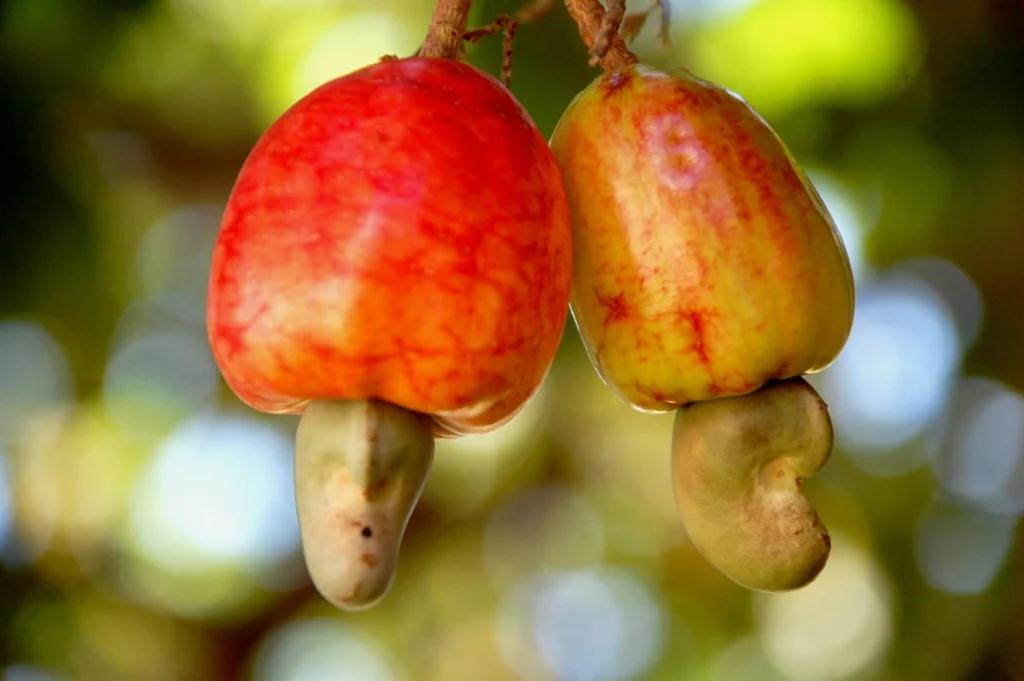
Harvesting consists of collecting the nuts that have fallen to the ground, separating them from the cashew apple, then drying them to a moisture content that allows storage. Collection must be frequent: a nut left on the ground in the rain deteriorates quickly.
Quality is measured mainly by the outturn, the shelling yield indicator used by buyers. The Chambre d’Agriculture de Côte d’Ivoire puts the outturn of Ivorian cashew at 44 to 49. It is this parameter, much more than the volume delivered, that determines the grower’s negotiating position.
Post-harvest losses remain significant, estimated at 10 to 15% of production by the same source. They depend on three points: how often nuts are collected, the quality of drying and storage conditions. A ventilated store, with bags on pallets and protected from rising damp, is enough to eliminate a good share of these losses.
Season economics and markets
The farm-gate price is set each year by the State. For the 2026 season, the Minister of Agriculture, Rural Development and Food Production, Koné Nabagné Bruno, announced on 6 February 2026 a farm-gate price of 400 FCFA per kilogram, down 25 FCFA on the previous season. In November 2025, the Conseil du coton, de l’anacarde et du karité (Cotton, Cashew and Shea Council) had reminded all players that a floor of 350 FCFA per kilogram must be respected.
At 400 FCFA per kilogram, the arithmetic is simple. An orchard yielding 500 kg per hectare generates 200,000 FCFA of gross output per hectare. The same orchard managed to 1.2 tonnes per hectare generates 480,000 FCFA. The extra cost of fertilization, of the order of 1 kg of blended fertilizer per tree per year on 100 trees, remains far below this difference, which explains the high returns recorded by INRAB.
Local processing is the other source of value. With 224,036 tonnes processed in the country in 2023 against 719,900 tonnes exported raw, there is still plenty of room for growth, and shelling plants are looking for regular supplies of consistent quality.
To place cashew within the country’s value chains as a whole, see our overview of agriculture in Côte d’Ivoire and our feature on oil palm farming, another long-cycle perennial crop.
Frequently asked questions
What is the average cashew yield in Côte d’Ivoire?
The Conseil International Consultatif du Cajou gives a national average yield of 590 kg of raw nuts per hectare. Studies in the Poro region put orchards at 350 to 500 kg per hectare, compared with about 1,000 kg per hectare in India, Brazil and Vietnam.
What planting density should be used for cashew trees?
The reference density is 100 trees per hectare, a spacing of 10 metres by 10 metres. Measurements in Poro show that density is negatively correlated with yield per tree: planting closer reduces production.
At what age does a cashew tree reach full production?
Production increases with the age of the tree. In the Poro region, trees aged 3 to 10 years produced 4.51 kg per tree in 2023, those aged 11 to 15 years 5.94 kg and those over 15 years 6.75 kg. An orchard should therefore not be judged on its first seasons.
Which fertilizer should be applied to a cashew tree, and at what rate?
According to the INRAB technical sheet of March 2018, trees aged 7 to 9 years receive 1 kg per tree per year of the N12P12K25 formula, and trees aged 3 to 5 years 0.80 kg per tree per year of the N15P15K17 formula. Fertilizer is applied in June and July, as soon as the rains are established, in 5 cm furrows under the edge of the canopy.
What is the farm-gate price of cashew nuts in 2026?
The farm-gate price for the 2026 season was set at 400 FCFA per kilogram, announced on 6 February 2026 by the Minister of Agriculture. This is a drop of 25 FCFA compared with the previous season.
How many growers make a living from cashew in Côte d’Ivoire?
About 450,000 growers farm the national orchard, 17% of them women, over an area estimated at 1,400,000 hectares.
Sources
- Conseil International Consultatif du Cajou (CICC), Côte d’Ivoire country profile
- Agence Ivoirienne de Presse, cashew farm-gate price set at 400 FCFA/kg for the 2026 season, 6 February 2026
- Agence Ivoirienne de Presse, the Conseil du coton, de l’anacarde et du karité guarantees compliance with the farm-gate price, 26 November 2025
- Chambre d’Agriculture de Côte d’Ivoire, filière anacarde (PDF)
- Sanoko F. K. et al., Variabilité du rendement de l’anacardier, Int. J. Biol. Chem. Sci. 19(2), 2025, via CIRAD Agritrop (PDF)
- INRAB, fiche technique de fertilisation des anacardiers, March 2018 (PDF)