
In the middle Senegal River valley, cool dry-season onion nurseries are sown between 15 October and 15 November, for transplanting from 1 December to 1 January. The pumping equipment, however, is decided in October, not December. Two numbers are enough to choose: the flow rate imposed by your peak demand, and the total dynamic head the pump must deliver against. For one hectare of onion, the Centre de Gestion et d’Économie Rurale de la Vallée uses 428 mm over the cycle, or 5,000 to 7,000 cubic metres per hectare over four months. All the sizing starts from there.
What one hectare of dry-season onion uses
Total demand is not enough: it is the peak that sizes a pump. The irrigation benchmarks for onion published by the Direction générale de l’agriculture and RECA in Niger give the breakdown by phase:
- From establishment to bulking, days 0 to 75: one irrigation per week of about 32 mm, or 320 m³ per hectare.
- Days 75 to 115: about 30 mm every five days, or 300 m³ per hectare.
- Maturation phase: 25 mm per week, or 250 m³ per hectare.
The most demanding phase is therefore days 75 to 115: 30 mm every five days amounts to 6 mm per day. It is this figure, not the cycle average, that sets the pump’s flow rate. The same sources put the cycle at 100 to 150 days depending on variety, with 90 to 100 days of field occupation in the dry season. Dry-season densities range from 444,000 to 500,000 plants per hectare at spacings of 15 to 20 cm between rows and 10 to 15 cm between plants. For the Senegal River valley, CGER-Vallée uses densities of 200,000 to 250,000 plants per hectare, with 4 to 5 kg of seed per transplanted hectare and a nursery of 30 to 45 days.
One last management benchmark that matters for pumping: irrigation stops 10 days before harvest. Your installation therefore works for about a hundred days, not the whole season.
From water demand to installed flow rate
The calculation can be redone in three lines for any plot.
- Net peak demand. 6 mm per day over 1 hectare is 60 cubic metres per day.
- Gross demand. For a surface or sprinkler network, allow for an application efficiency well below 100%. At 80%, gross demand rises to 75 cubic metres per day. Under localised irrigation, efficiency is better and the gross volume falls.
- Hourly flow rate. Divide the gross volume by the actual hours of operation. Over 8 hours, 75 m³ gives 9.4 m³/h. Over 6 hours, 12.5 m³/h.
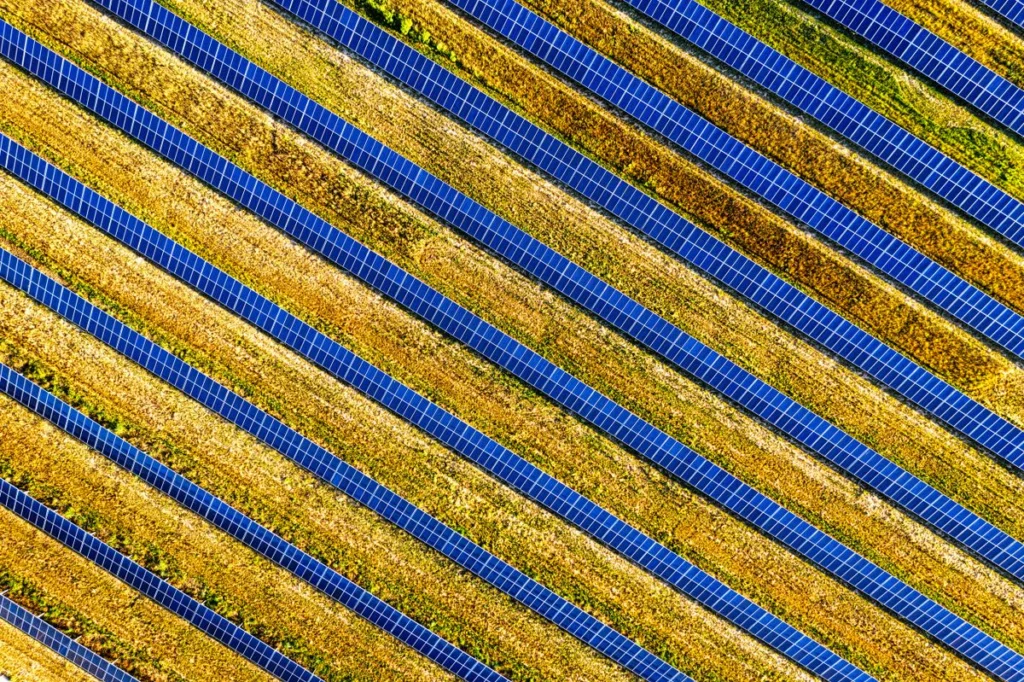
This last point is the real difference between a fuel pump and a solar pump. A motor pump runs when you decide, so you can extend the operating window and reduce the installed flow rate. A direct solar pump only delivers in daytime, and its flow follows the sunlight of the moment. The GIZ guide on solar-powered irrigation systems, published in 2020, notes that the operating window of a photovoltaic pump is up to 60% narrower than that of a conventional pump, and that a photovoltaic pump is therefore always sized larger than its fuel-powered equivalent.
Total dynamic head, item by item
Module 5 of the FAO irrigation manual, published in 2001, defines total dynamic head as the head the pump must impart to the fluid to satisfy the whole system. It is added up item by item:
- Static suction head: vertical distance between the water surface and the axis of the pump impeller.
- Static delivery head: height difference between the pump and the outlet point, buffer tank or network inlet.
- Friction losses: friction in the suction and delivery pipes and in fittings.
- Operating pressure: the pressure required by the watering equipment at the end of the chain, for example a sprinkler or a drip network.
- Velocity head: a small term, calculated as V²/2g, with V the water velocity in m/s and g equal to 9.81 m/s².
FAO specifies the sign of the static term: if the water surface is below the pump, total static head is the sum of delivery and suction heads. If the water surface is above the pump, it is a difference. On a borehole or riverbank well in the dry season, the water level drops as the season goes on: use the worst case of the season, not the level on the day of the site visit.
Calculating power with the FAO formula
The same module gives the relationship to use for shaft power:
BP = (Q × HMT) / (C × Epump)
where Q is the flow rate, HMT the total dynamic head in metres, E the pump efficiency, and C a constant: C is 102 if Q is in litres per second, and 360 if Q is in cubic metres per hour.
A worked example for a one-hectare onion plot, with the following head items: 8 m of suction from a riverbank well, 4 m of delivery to a raised tank, 3 m of friction losses, and 10 m of operating pressure at the network inlet, giving an HMT of 25 m. With a flow rate of 12.5 m³/h and a pump efficiency of 0.65:
BP = (12.5 × 25) / (360 × 0.65) = 1.34 kW
In its own sizing example, the FAO manual applies a 20% safety factor to this value, to cover ageing and shifts in the operating point. That brings the requirement to about 1.6 kW at the shaft. On the motor side, FAO gives efficiencies of 0.88 to 0.92, with motors of 7.5 kW and below generally staying under 0.88. These two corrections explain why an installation sized too tightly disappoints from the second season onwards.
Solar pump or motor pump: what decides
| Criterion | What favours solar | What favours a fuel pump |
|---|---|---|
| Operating hours | Demand can be met in daytime, with a buffer tank | Need to irrigate early morning, at night, or in several free passes |
| Total dynamic head | Moderate HMT, stable over the season | High HMT or a water level that drops sharply in the dry season |
| Area | A plot that can be fully irrigated at least once a day | Large areas served by tight sector rotation |
| Logistics | Remote site, difficult fuel supply | Easy access to fuel and mechanical servicing |
| Maintenance | Few wearing parts, panel cleaning to plan for | Regular mechanical servicing, oil changes, filters |
The GIZ guide adds a design rule useful for small farms: a drip network fed directly by a solar pump should only be considered if the entire area can be irrigated at least once a day. If not, a buffer tank is needed between the pump and the network, and it is this tank that restores flexibility in operating hours.
The choice of irrigation method also affects the energy bill. The comparison table in FAO Module 5, drawn up for a lift of 20 m, puts annual energy demand at 2,741 kWh per hectare for localised irrigation, against 3,743 kWh for surface irrigation and 4,485 kWh for sprinkler irrigation. The difference comes from drip irrigation’s better application efficiency and lower operating pressure. In other words, the choice of watering network determines pump size as much as the area does.
Suction, cavitation and buffer tank
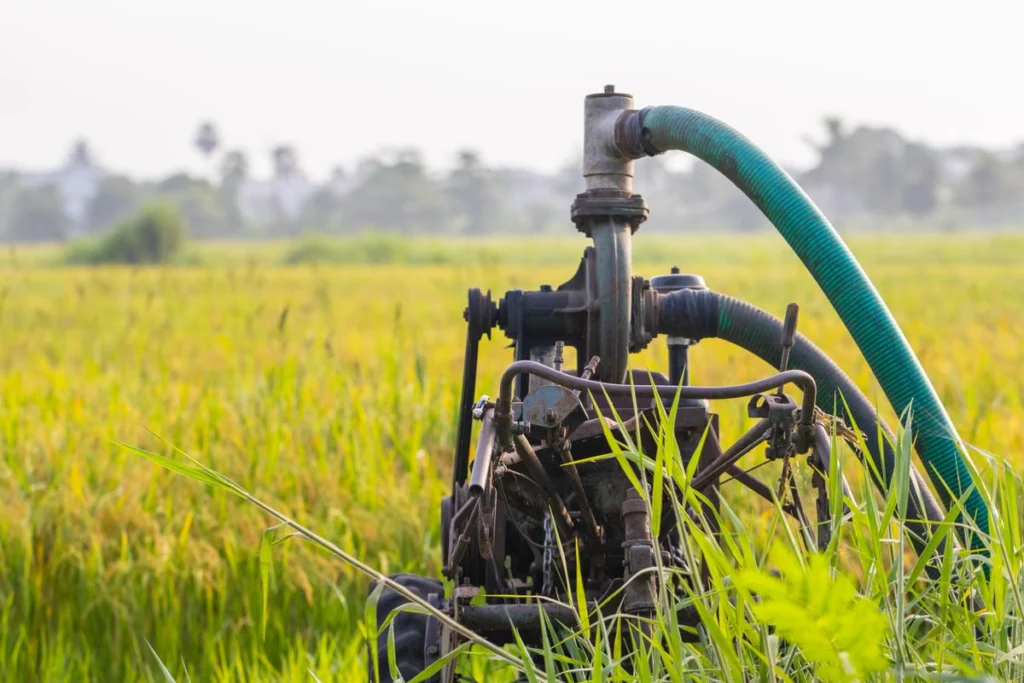
A surface pump set too high cavitates, gets noisy and destroys its impeller in a few weeks. FAO gives the check to make before installing: net positive suction head available is calculated by subtracting the suction head, suction friction losses and the vapour pressure of water from barometric pressure. Barometric pressure follows altitude according to Pb = 10.33 − 0.00108 Z, with Z the altitude in metres. In the manual’s example, at 2,000 m altitude and 35 °C, with 2 m of suction and 0.7 m of losses, the available head falls to 4.89 m. On a plain, as in the river valley, the margin is more comfortable, but the rule stands: the warmer the water and the greater the suction head, the higher the risk.
The buffer tank is sized from the peak daily volume. For one hectare of onion at 60 m³ of net demand per day, a tank of 60 to 80 m³ gives one day of autonomy, enough to absorb an overcast morning. It also lets the water settle before filtration, which extends emitter life.
Maintaining a pumping installation
- Dry-run protection. On a riverbank well or borehole whose level drops in the dry season, this is the first safety device to install, before any convenience accessory.
- Head-end filtration. For borehole water where sand is the problem, a 200 mesh screen filter is suitable according to Virginia Cooperative Extension. Backflush at 3 to 5 psi of pressure loss on a screen, about 10 psi on a sand filter.
- Flushing the lines. A flush valve at the end of each submain, flushing until the water runs clear for two minutes.
- Cleaning the photovoltaic panels. In the Sahelian dry season, settled dust reduces output long before the installation breaks down. Scheduled cleaning beats a late diagnosis.
- Monitoring the operating point. A pressure gauge at the pump outlet and a water meter are enough to spot wear coming. If rotation speed changes, FAO points out that flow varies with speed, head with its square, and power with its cube.
The decision timeline, from October to January
| Period | Crop work | Equipment decision |
|---|---|---|
| 15 October to 15 November | Nursery sowing, cool dry season | Measure suction head and water level, have the water analysed, fix flow rate and HMT |
| November | Nursery management, 30 to 45 days | Order the pump and filtration unit, prepare the buffer tank |
| 1 December to 1 January | Transplanting at 10 to 20 cm, basal dressing | Commissioning, pressure checks at the network inlet and at the far end |
| December to March | Fertilisation in 4 applications, at transplanting then at 20, 40 and 60 days | Meter readings, backflushing, panel cleaning |
| Mid-March to end of April | Harvest, irrigation stopped 10 days before | Draining, off-season storage of equipment, consumption review |
The fertilisation recommended by SAED and adopted by CGER-Vallée is 1 kg of organic matter per square metre, plus a 100 N, 100 P, 200 K formula spread in four applications: at transplanting, then at 20, 40 and 60 days after transplanting. Our rate guidelines for NPK formulas are detailed in our article on NPK 15 15 15 fertiliser.
What recorded yields show
CGER-Vallée records 32 tonnes per hectare in the 2011/2012 season and 24.36 t/ha in 2012/2013, against a reference of 30 t/ha used to calculate nutrient removal. The Nigerien benchmarks give a wider range, from 30 to 70 t/ha depending on variety and management, with 50 to 55 t/ha for Violet de Galmi. The gap between two successive seasons on the same scheme is not down to variety: it comes from how regular the water supply is during days 75 to 115, when the bulb forms. An undersized installation shows up directly in that dip.
For the context of the national horticulture sector, see our overview of agriculture in Senegal. For onion’s place among cash crops, our feature on vegetable farming in Africa gives the useful comparisons, and the components of a localised network are detailed in our article on drip irrigation systems.
Have your pumping system sized
JOGOO Agriculture sizes, supplies and installs solar and fuel-powered pumping stations, boreholes, tanks and the networks they feed. Sizing starts from four on-site measurements: the area, the suction head at the lowest point of the season, the delivery height difference and the water analysis. See our Irrigation & Pumping page, or our Turnkey Agricultural Projects page if the installation is part of a complete development. Write to us from the Contact page to receive a quote based on your measurements.
Sources
- FAO, Irrigation Manual, Module 5 : Irrigation Pumping Plant, A. P. Savva et K. Frenken, 2001
- CGER-Vallée, Analyse économique sur la filière oignon au Sénégal
- Direction générale de l’agriculture, RECA, CRA Zinder et CRA Tahoua, Culture de l’oignon (Allium cepa), Niger
- GIZ, Solar Powered Irrigation Systems : Technology, Economy, Impacts, 2020
- Virginia Cooperative Extension, Filtration, Treatment and Maintenance Considerations for Micro-Irrigation Systems, publication 442-757
Frequently asked questions
What flow rate is needed to irrigate one hectare of onion?
Start from the peak, not the average. The Nigerien benchmarks give 30 mm every five days during bulb enlargement, or 6 mm per day, so 60 m³ per day on one hectare. Adding a margin for application efficiency and dividing by the actual hours of operation gives about 9 to 13 m³/h depending on the operating window available.
How do you calculate pump power?
Module 5 of the FAO irrigation manual gives BP = (Q × HMT) / (C × pump efficiency), with C equal to 360 when Q is in m³/h and 102 when Q is in l/s. For 12.5 m³/h, 25 m of total dynamic head and an efficiency of 0.65, the result is 1.34 kW at the shaft, to be increased by about 20% as FAO does in its own example.
Do you need a buffer tank with a solar pump?
The 2020 GIZ guide states that feeding a localised network directly from a solar pump only works if the entire area can be irrigated at least once a day. In other cases, a buffer tank is needed, sized on the peak daily volume, or 60 to 80 m³ for one hectare of onion.
When should the equipment decision be made for a dry-season crop?
In October, during nursery sowing. CGER-Vallée puts cool dry-season sowing from 15 October to 15 November and transplanting from 1 December to 1 January. Suction and height measurements and the water analysis must be done before ordering equipment.
How long does the installation run during an onion season?
About a hundred days. The cycle runs 100 to 150 days depending on variety, with 90 to 100 days of field occupation in the dry season, and irrigation stops 10 days before harvest.
Once the station is installed, routine maintenance is covered in a separate article: solar pump maintenance, week by week, with panel cleaning intervals, strainer and filter checks, and flow monitoring.


