
Télécharger la fiche technique (PDF)
This technical sheet sets out the complete crop management sequence for watermelon (Citrullus lanatus) under tropical conditions, from choosing a variety to storing the fruit. The key reference points: a cycle of 80 to 110 days, direct sowing in planting holes, a water requirement of 400 to 600 mm and a commercial yield of 20 to 35 tonnes per hectare under well-managed irrigation. Every figure comes from a source listed at the end of the sheet: FAO, CNRADA, the University of Abomey-Calavi, the University of Yaoundé I and university extension services.
Hardier than melon, watermelon is still an off-season crop. It performs best in a hot, dry climate, with carefully controlled water and pollination by bees.
Technical sheet at a glance
| Parameter | Reference value |
|---|---|
| Total cycle | 80 to 110 days depending on climate and variety |
| Air temperature | 22 to 30 °C mean daily temperature, 18 °C minimum, 35 °C maximum |
| Germination | Soil at about 16 °C minimum, optimum 21 to 35 °C |
| Soil | Sandy loam, deep, well drained, pH 5.8 to 7.2 |
| Establishment | Direct sowing, 3 seeds per hole at 1 to 2 cm |
| Spacing | 1 m by 1 m, or 2 m between rows and 1 m within the row |
| Density | 5,000 to 10,000 planting holes per hectare |
| Water requirement | 400 to 600 mm over the cycle, about 6,000 m³/ha |
| Pollination | Bees, 2.5 to 4.5 hives per hectare |
| Yield | 20 to 35 t/ha under irrigation |
| Storage | 10 to 15 °C, 85 to 90% humidity, about 2 weeks |
Climate and growing season
Watermelon originates from the dry areas of tropical Africa. According to FAO, it needs a mean daily temperature of 22 to 30 °C, with a maximum for growth of about 35 °C and a minimum of about 18 °C. The full cycle lasts 80 to 110 days depending on climate.
Climate has a direct effect on quality: fruit grown in hot, dry conditions reaches about 11% sugar, against 8% in cool, humid conditions (FAO). A marked rainy season also favours foliage and fruit diseases. In West and Central Africa, the safest window is therefore the dry season, under irrigation. The CNRADA sheet states that sowing is possible all year round wherever irrigation is available.
Choosing a variety
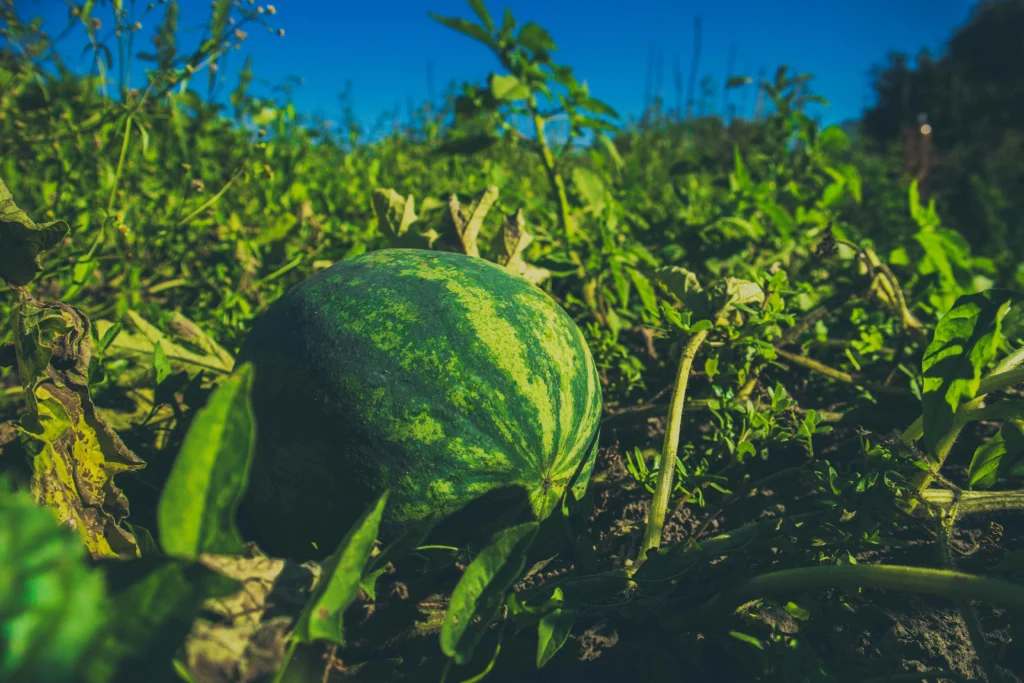
For local markets, varieties with small to medium fruit are easier to handle and sell. The references available for West and Central Africa give these benchmarks:
| Variety | Published benchmark | Source |
|---|---|---|
| Koloss | 24.7 t/ha, 7.5 °Brix, suited to all of Benin | University of Abomey-Calavi, 2018 |
| Logone | 20.6 t/ha, 7.8 °Brix, recommended for northern Benin | University of Abomey-Calavi, 2018 |
| Gray-belle | 20.3 t/ha, 7.6 °Brix, suited to all of Benin | University of Abomey-Calavi, 2018 |
| Kaolack | 19.4 t/ha in Benin; cycle of about 80 days in Cameroon | University of Abomey-Calavi, 2018; University of Yaoundé I, 2022 |
| Crimson Sweet | One of the two best market varieties evaluated in Cameroon | University of Yaoundé I, 2022 |
| Sugar Baby | Dark red flesh, small fruit, 20 to 35 t/ha; cycle of about 110 days in Cameroon | CNRADA; University of Yaoundé I, 2022 |
In the University of Yaoundé I trial of five market varieties, Kaolack and Crimson Sweet gave the best results and the highest emergence rates (about 90%). Kaolack carried close to 4 fruits per plant on average in the control group. Always buy certified seed, in sealed packets, from a recognised supplier.
Soil and land preparation
Watermelon prefers a sandy loam that is loose, deep, well drained and rich in organic matter. FAO gives a pH range of 5.8 to 7.2; the University of Abomey-Calavi sheet recommends 5.8 to 6.5. Heavy soils slow development and encourage fruit cracking. Roots can reach 1.5 to 2 m, so a plough pan or compacted soil limits the crop from the start.
Plough to 30 cm, level the field, then work in the organic manure together with the basal mineral fertilizer. On sandy soils, grow on the flat; on heavy soils, grow on high ridges spaced one metre apart (CNRADA).
Watermelon is moderately sensitive to salinity. FAO gives the following yield losses by electrical conductivity of the soil extract: no loss at 2.5 dS/m, 10% at 3.3 dS/m, 25% at 4.4 dS/m and 50% at 6.3 dS/m. Have the irrigation water tested before starting a project in a Sahelian or coastal area.
Sowing and planting density
Watermelon is sown directly in the field. Germination needs a soil temperature of about 16 °C at least, with an optimum of 21 to 35 °C (Oregon State University), a condition easily met in the tropics. Place 3 seeds per hole at a depth of 1 to 2 cm (CNRADA). FAO puts thinning at 15 to 25 days after sowing; the Benin sheet advises keeping no more than one or two plants per hole after emergence.
Two planting patterns are published for West Africa:
- 1 m by 1 m, about 10,000 plants per hectare, with 3 to 5 kg of seed per hectare (CNRADA, Mauritania).
- 2 m between rows and 1 m within the row, 5,000 planting holes per hectare, with about 500 g of seed per hectare (University of Abomey-Calavi, Benin).
The difference in seed rate reflects density and seed type. Large varieties with heavy fruit are spaced wider: FAO cites spacings of up to 1.8 m by 2.4 m.
Irrigation
FAO puts the requirement at 400 to 600 mm for a 100-day crop; the CNRADA sheet uses about 6,000 m³ per hectare. FAO crop coefficients let you match irrigation to reference evapotranspiration:
| Stage | Duration | Crop coefficient (Kc) |
|---|---|---|
| Initial | 10 to 20 days | 0.4 to 0.5 |
| Development | 15 to 20 days | 0.7 to 0.8 |
| Mid-season | 35 to 50 days | 0.95 to 1.05 |
| Late season | 10 to 15 days | 0.8 to 0.9 |
| At harvest | 70 to 105 days after sowing | 0.65 to 0.75 |
Three periods are highly sensitive to water shortage: vine development, flowering and fruit filling. During these stages, FAO advises never letting the soil lose more than half of its available water. As the fruit approaches maturity, relatively dry soil raises sugar content, while excess water gives bland fruit. Severe stress at the end of the cycle, however, causes cracked and misshapen fruit.
Drip irrigation is the reference solution on light soils: it reduces water use, keeps the foliage dry and makes fertigation possible. The Benin sheet advises against sprinkler irrigation from flowering onwards, as it causes flower drop. Our irrigation and pumping solutions cover the design of the network, pump and filtration.
Fertilization
For high production, FAO puts the crop’s needs at 80 to 100 kg of nitrogen, 25 to 60 kg of phosphorus and 35 to 80 kg of potassium per hectare. Two programmes published in West Africa turn these needs into practical rates:
| Timing | CNRADA (Mauritania) | University of Abomey-Calavi (Benin) |
|---|---|---|
| Land preparation | 30 t/ha of manure and 300 kg/ha of 10-10-20 | 10 t/ha of organic matter and 100 kg/ha of NPK 15-15-15 |
| 3 weeks after sowing | 100 kg/ha of NPK 15-15-15 | |
| 40 days after sowing | 250 kg/ha of 10-10-20 | |
| 6 weeks after sowing | 50 kg/ha of urea and 50 kg/ha of potassium sulphate |
Both programmes boost potassium as the plant enters flowering and fruit filling: potassium governs fruit filling and sugar content. Base the rates on a soil analysis, using our NPK fertilizer guide. See also our fertilization and plant nutrition services.
Crop management
Weeding and hoeing must be regular, especially early in the cycle and after rain, until the vines cover the ground (CNRADA). Mulching limits evaporation, controls weeds and keeps the fruit off damp soil. The Benin sheet recommends slipping plant residues under developing fruit to prevent contact rots.
A plant usually carries 4 fruits (FAO). The number of fruits kept, controlled by pruning and thinning, determines final fruit size and the uniformity of the harvest.
Pollination
Watermelon carries separate male and female flowers: without pollinating insects, there is no fruit. University of Florida references indicate that fruit set is better when each flower receives at least 8 bee visits, and that about 1,000 pollen grains evenly spread on the stigma are needed for a uniform fruit. Too little pollen gives misshapen fruit.
On larger areas, bring in hives during flowering: at least one colony per acre, or about 2.5 per hectare, according to Oregon State University; the literature average cited by the University of Florida is 4.5 hives per hectare. No insecticide should be applied while bees are foraging. Under a greenhouse, open the netting during flowering or bring in pollinators.
Pests
- Fruit flies (Dacus ciliatus, Atherigona spp.): they tunnel through the flesh, and the outside of the fruit shows small holes with drops of exudate (CNRADA). In Benin, they are the main pest from fruit set until the fruit reaches the size of an orange. Remove and bury stung or rotting fruit, do not delay harvest and trap the adults.
- Cucurbit ladybird (Epilachna chrysomelina): orange to red with 12 black spots, it eats the underside of the leaves until only the veins remain (CNRADA).
- Aphids: they weaken plants and transmit mosaic viruses. Pull out heavily infested plants and clear crop debris.
- Caterpillars and mites: treat only when an attack is confirmed, with a registered product.
The Benin sheet lists neem-based products among the control options for fruit flies, aphids and caterpillars.
Diseases
| Disease | Signs | Favouring conditions | Prevention |
|---|---|---|---|
| Powdery mildew (Podosphaera xanthii) | White felt on leaves, which yellow then dry out | Warm, overcast weather; infection possible from 46% humidity, without rain | Scouting after flowering, sulphur, alternating fungicides |
| Downy mildew (Pseudoperonospora cubensis) | Yellow patches on older leaves that turn brown; leaves curl | High humidity, wet foliage | Localized irrigation, preventive treatments |
| Anthracnose (Colletotrichum) | Brown leaf spots, elongated stem lesions, sunken fruit spots | Warm, rainy weather, splashing, sprinklers | Healthy seed, rotation, drip irrigation |
| Gummy stem blight (Stagonosporopsis cucurbitacearum) | Dark brown to black spots at leaf margins | Rain, humidity, wet soils | Rotation of at least 2 years, keep new fields away from old ones |
| Fusarium wilt (Fusarium oxysporum f. sp. niveum) | Wilting on one side of the vine, internal browning at the crown | Soil-borne fungus that persists for many years | Resistant varieties, grafting, long rotation |
| Viruses (mosaics) | Young leaves misshapen and mottled, stunted plants | Spread by aphids, late plantings | Early sowing, weeding, distance from infected fields |
Source: Oklahoma State University Extension, which recommends a 3 to 4 year rotation away from cucurbits as a general practice. For the products registered in your country, see our crop protection solutions.
Harvest
According to CNRADA, harvest begins around 70 days after sowing for early varieties and between 85 and 100 days for the others. In Cameroon, the University of Yaoundé I trial recorded about 80 days for Kaolack and 110 days for Sugar Baby.
Watermelon gains neither sugar nor colour after cutting (University of California, Davis): harvesting too early cannot be undone. Check these signs of ripeness together:
- the ground spot turns from pale white to creamy yellow;
- the tendril nearest the fruit stalk is withered or dry;
- the fruit sounds hollow when tapped;
- on a test fruit, sugar content reaches at least 10% at the centre.
Harvest early in the morning, cut the stalk rather than pulling it, and handle the fruit without knocks: bruising and cracking cause more losses than post-harvest diseases.
Post-harvest storage
The University of California, Davis recommends storing watermelons at 10 to 15 °C with 85 to 90% relative humidity. Storage life is about 14 days at 15 °C and can reach 21 days at 7 to 10 °C. Below 7 °C for several days, fruit suffers chilling injury: pitting, faded flesh and loss of flavour. Watermelon is also sensitive to ethylene: exposure to 5 ppm for 7 days is enough to soften the flesh. Store it away from fruit that gives off ethylene, such as ripening bananas.
Expected yield
- 20 to 35 t/ha under irrigation with full fertilization (CNRADA).
- 25 to 35 t/ha for a good irrigated commercial crop (FAO).
- 19.4 to 24.7 t/ha depending on the variety in the University of Abomey-Calavi references.
The gap between these figures comes mainly from how well water, fertilization and pollination are managed, far more than from the variety alone.
Frequently asked questions
How long is the watermelon growing cycle?
From 80 to 110 days depending on climate and variety. In Cameroon, Kaolack was harvested at about 80 days and Sugar Baby at about 110 days in a University of Yaoundé I trial.
What planting density should be used for watermelon?
From 5,000 to 10,000 planting holes per hectare: 2 m by 1 m according to the University of Abomey-Calavi sheet, or 1 m by 1 m according to CNRADA.
How much water does one hectare of watermelon need?
From 400 to 600 mm over the cycle according to FAO, about 6,000 m³ per hectare. Demand peaks during flowering and fruit filling.
What fertilizer should be applied to watermelon?
A basal organic dressing, then split mineral applications rich in potassium. CNRADA recommends 30 t/ha of manure, 300 kg/ha of 10-10-20 as a basal dressing and 250 kg/ha of the same fertilizer 40 days after sowing.
Why are my watermelons not setting fruit or misshapen?
The most common cause is poor pollination. Each female flower needs several bee visits. Avoid any insecticide while bees are foraging and bring in hives on larger areas.
How can I tell when a watermelon is ripe?
The ground spot turns creamy yellow, the tendril nearest the fruit stalk dries and the fruit sounds hollow. Watermelon does not ripen further after harvest.
How long does a watermelon keep?
About 2 weeks at 15 °C and up to 3 weeks at 7 to 10 °C, with 85 to 90% humidity. Below 7 °C, fruit suffers chilling injury.
Starting a commercial watermelon project? Our engineers design the irrigation, fertilization and cropping calendar. Contact our teams.
Sources
- FAO, Land and Water Division. Crop Information: Watermelon. View the sheet
- CNRADA, Mauritania. Fiche technique du melon et de la pastèque. View the sheet
- Aglinglo L. A. et al. (2018). Fiche technique synthétique pour la production de la pastèque. GBioS Laboratory, University of Abomey-Calavi, Benin. View the document
- Fokam P. E. (2022). Radiosensibilité de quelques variétés de pastèque (Citrullus lanatus) à la mutagenèse induite aux rayons gamma. Thesis, University of Yaoundé I. View the record
- Oregon State University. Watermelon, Oregon Vegetables. View the sheet
- Sanford M. T. and Ellis J. D. Beekeeping: Watermelon Pollination (ENY-154). UF/IFAS Extension. View the publication
- UC Davis Postharvest Research and Extension Center. Watermelon. View the sheet
- Oklahoma State University Extension. Watermelon Diseases. View the sheet
Further reading
- Watermelon farming: sowing, irrigation and yield per hectare: the detailed guide, with variety trials and a real farm budget.
- Melon farming guide: watermelon’s close cucurbit relative, with the same pests and the same reliance on pollinators.
Articles similaires

Obtenez le guide complet hors ligne. Renseignez vos coordonnées ci-dessous.