
Télécharger la fiche technique (PDF)
This eggplant farming guide covers the growing of eggplant (Solanum melongena) and African eggplant or bitter garden egg (Solanum aethiopicum) in West and Central Africa. Key benchmarks: 4 to 6 weeks in the nursery, 20,000 to 40,000 plants per hectare depending on spacing, first harvest about 2 months after transplanting, then weekly picking for several months. In Côte d’Ivoire, a trial on the Kalenda F1 variety went from 20 t/ha without fertiliser to 49 t/ha with a full mineral programme. Every figure links to a source listed at the end.
Eggplant sells all year round in urban markets, keeps producing on the same plant for months and handles heat better than most fruiting vegetables. It is a steady cash crop, provided you control water, potassium and bacterial wilt.
Eggplant farming at a glance
| Parameter | Reference value |
|---|---|
| Temperature | 25–32 °C by day, 21–27 °C at night; growth limited below 16 °C (COLEACP) |
| Soil | Fertile, well-drained sandy loam; pH 6.0–6.5 (COLEACP), 5.5–7 accepted |
| Nursery | 4–6 weeks, seedlings with 4–6 leaves (World Vegetable Center) |
| Spacing | 50 × 50 cm to 80 × 60 cm, about 20,000–40,000 plants/ha |
| Fertiliser (40 t/ha target) | 170 kg N, 100 kg P, 240 kg K per hectare (CIRAD, via DAG French Polynesia) |
| First harvest | About 2 months after transplanting (World Vegetable Center) |
| Harvest period | Weekly picking; 6–7 months for African eggplant |
| Yield | 20–49 t/ha depending on fertilisation (Kalenda F1, Côte d’Ivoire, 2018) |
Purple eggplant or African eggplant?
Two product types share the market. Purple eggplant (S. melongena), long or round, targets supermarkets, restaurants and export. African eggplant (S. aethiopicum), white, green or orange and often bitter, is the one most cooked in everyday sauces. Both are grown the same way: nursery, transplanting, light staking, repeated picking. African eggplant is usually hardier and harvested for longer. Start from your market: check what wholesalers and restaurants ask for before you order seed.
Climate and season
The COLEACP good-practice guide puts the optimum at 25–32 °C by day and 21–27 °C at night; below 16 °C, growth and germination slow down. Eggplant likes heat and can be grown year-round where water is available. It tolerates neither drought nor flooding well (World Vegetable Center). Two periods need attention: the rainy season, which favours bacterial wilt and waterlogged roots, and the hot dry season, when spider mites explode. The World Vegetable Center advises transplanting before the peak of the hot dry season to limit mite attacks.
Soil, rotation and land preparation
Choose a deep, sandy-loam soil, rich in organic matter and quick to drain. The French Polynesia agriculture department sheet accepts pH 5.5–7 and limes acidic soil up to pH 6. Use raised beds whenever drainage is doubtful.
Rotation is the first defence against bacterial wilt (Ralstonia solanacearum): do not replant eggplant after another solanaceous crop (tomato, chilli, sweet pepper, potato) for 3 to 4 years. As a base dressing, the same sheet recommends 30–50 t/ha of well-decomposed compost worked in during bed preparation.
Nursery
The World Vegetable Center recommends a nursery bed enriched with 3–5 kg of manure or compost per m², rows 15–20 cm apart and sowing 0.5–1 cm deep. In seedling trays, sow one seed per cell. Seedlings are ready in 4–6 weeks at 4–6 true leaves; COLEACP counts 35–40 days in the nursery. One week before transplanting, harden seedlings by gradually exposing them to full sun and watering less often.
- Protection: an insect net over the nursery keeps out whiteflies, aphids and thrips, which spread viruses.
- Hygiene: clean substrate and no overwatering, to avoid damping-off (Pythium, Rhizoctonia).
- Selection: transplant only sturdy seedlings with no flowers or spots.
Transplanting and eggplant spacing
| Layout | Spacing | Indicative density | Source |
|---|---|---|---|
| Bed, close planting | 50 × 50 cm | ≈ 40,000 plants/ha | World Vegetable Center |
| Single rows | 1 m × 0.5 m | ≈ 20,000 plants/ha | Kalenda F1 trial, Bingerville |
| African eggplant | 75 × 50 cm | ≈ 26,700 plants/ha | World Vegetable Center |
| Staggered, long staked crop | 80 × 60 cm | 2 plants/m² | DAG French Polynesia |
Densities here are calculated and exclude paths. The longer the crop will run, the wider the spacing: an eggplant grown for 6 months becomes a shrub. Transplant in the late afternoon and water immediately. Mulching, natural or plastic, is strongly recommended.
Eggplant irrigation
Flowering is the critical stage: water shortage makes flowers drop and cuts the harvest (World Vegetable Center). The French Polynesia sheet waters lightly every day after transplanting, then every 2–4 days after flowering depending on soil and weather, always at the base without wetting the leaves. Irregular watering causes flower drop. COLEACP recommends drip irrigation and morning watering so leaves dry quickly.
Drip irrigation is the best tool: it gives steady moisture over months of harvest, keeps foliage dry against disease and lets you feed the crop through fertigation.
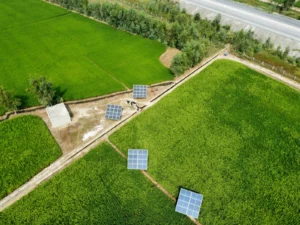
Planning an irrigated eggplant plot? Our engineers size the drip system, the pump (solar or diesel) and the fertiliser programme from your area and water source. Get a free quote
Fertiliser for eggplant
Eggplant is a heavy feeder, especially for potassium, because it carries fruit for months. For a yield of 4 kg/m² (40 t/ha), CIRAD, as cited by the French Polynesia agriculture department, estimates needs at 170 kg nitrogen, 100 kg phosphorus and 240 kg potassium per hectare. On fertile soil these rates come down; a soil test lets you adjust them.
- Base: 30–50 t/ha of compost, or 0.2–0.5 kg of manure per planting hole (World Vegetable Center).
- Maintenance: split applications of nitrogen and potassium. The Bingerville trial applied a base dose then three top-dressings at 30, 60 and 90 days after transplanting.
- Boost: the World Vegetable Center advises a top-dressing after the third harvest to support later pickings.
Organic matter pays. In Côte d’Ivoire, the Kalenda F1 trial (Alla et al., 2018) yielded 20.1 t/ha without fertiliser, 31.0 t/ha with poultry manure alone, 43.5 t/ha with poultry manure plus plantain-peel potash, and 49.1 t/ha with NPK, urea and potassium sulphate. The last two did not differ significantly. In Senegal’s Niayes, the African eggplant Keur Mbir Plus rose from 46 to 59.5 t/ha with 20 t/ha of casuarina compost on top of NPK 15-15-15 (Baldé et al., 2024; yields extrapolated from small plots). See also our guide NPK 15-15-15 fertiliser rates by crop.
Avoid excess nitrogen, which produces leaves, attracts pests and delays fruiting (COLEACP).
Staking, pruning and ratooning
An eggplant loaded with fruit breaks easily. The French Polynesia sheet runs a wire at 1 m height between posts 3 m apart, or uses one stake per plant. Remove low suckers, old leaves and diseased leaves to open up the base.
When plants age, you can ratoon them: cut the stem at the base (World Vegetable Center) or cut back plants taller than 2 m to 1 m (DAG French Polynesia). New shoots fruit again in 2–3 months. Stagger the beds you cut back so deliveries never stop.
Eggplant pests and diseases
| Problem | Signs | Integrated control |
|---|---|---|
| Bacterial wilt (Ralstonia solanacearum) | Plant wilts suddenly, often fatal | 3–4 year rotation away from solanaceae, tolerant varieties (Kalenda F1), remove affected plants, disinfect tools |
| Fruit and shoot borer | Wilted shoots, tunnels in fruit | Cut and destroy attacked shoots and fruit, regular scouting |
| Spider mites | Speckled leaves, webbing, deformed fruit | Monitor in hot dry season, regular irrigation, registered miticide if needed |
| Whiteflies, aphids, thrips, leafhoppers | Honeydew, curled leaves, scarred fruit | Nursery netting, weeding, sticky traps, rotate modes of action |
| Powdery mildew, early blight, root-knot nematodes | White felt, ringed spots, galled roots | Resistant varieties, rotation, remove affected parts |
Sources: COLEACP, World Vegetable Center, DAG French Polynesia. Scout beds at least once a week, spray only when needed with products registered in your country, and respect pre-harvest intervals: eggplant is picked every week, so this matters twice as much.
Harvest and storage
The first fruit comes about 2 months after transplanting (World Vegetable Center). Pick glossy, firm fruit before the seeds harden: dull fruit is overripe and sells poorly. Cut with secateurs or a knife every week, and remove damaged or oversized fruit so the plant is not exhausted. According to COLEACP, each plant is usually picked weekly for 6–8 weeks; the World Vegetable Center counts 6–7 months of harvest for well-managed African eggplant, and the French Polynesia sheet up to 5 months, without exceeding 8 months of cropping in tropical conditions.
Eggplant yield per hectare and profitability
- 20.1–49.1 t/ha for Kalenda F1 in Bingerville, depending on fertilisation (Alla et al., 2018).
- 46–59.5 t/ha for African eggplant Keur Mbir Plus in the Niayes (Baldé et al., 2024).
- 14–24 t/ha for the Ivorian varieties Klongbo and N’drowa (Fondio et al., cited by Baldé et al.).
- 40 t/ha: target used to calculate fertiliser needs (CIRAD).
The gaps come from variety, fertiliser, water and above all harvest length. Work out profitability on your own plot: marketable yield times real price, minus seed, fertiliser, crop protection, water, energy and picking labour. Our article on profitable market gardening in Africa explains the method.
Frequently asked questions
How long does an eggplant crop last?
Allow 4–6 weeks in the nursery, about 2 months to first harvest, then several months of weekly picking. A well-managed crop produces for 5–7 months.
What spacing for eggplant?
From 50 × 50 cm for a short crop to 80 × 60 cm for a long staked crop. For African eggplant, the World Vegetable Center advises 75 cm between rows and 50 cm in the row.
What fertiliser for eggplant?
An organic base dressing, then split applications of nitrogen and especially potassium. For 40 t/ha, needs are estimated at 170 kg N, 100 kg P and 240 kg K per hectare.
Why are my eggplant flowers dropping?
Most often because of water shortage or irregular watering at flowering. Drip irrigation solves most cases.
How do I prevent bacterial wilt?
With a 3–4 year rotation away from solanaceae, tolerant varieties such as Kalenda F1, well-drained beds and immediate removal of affected plants. No treatment cures an infected plant.
What yield per hectare of eggplant?
From 20 t/ha without fertiliser to nearly 50 t/ha with a full programme, according to an Ivorian trial on Kalenda F1.
Turn this guide into a productive plot. Drip kit, solar pump, fertiliser and agronomic follow-up: JOGOO Agriculture equips eggplant growers in Cameroon, Côte d’Ivoire and Senegal. Request your quote.
Sources
- COLEACP / PIP (2015). Good phytosanitary practice guide for eggplant (in French). View document
- World Vegetable Center. Eggplant: Home Gardening Guide. View document
- World Vegetable Center. How to Grow African Eggplant. View document
- French Polynesia Agriculture Department, INTEGRE network. Organic eggplant growing (in French). View sheet
- Alla K. T. et al. (2018). Plantain-peel by-product fertilisation on Kalenda F1 eggplant in Bingerville. Journal of Animal & Plant Sciences 38(3). View article
- Baldé I. et al. (2024). Improved casuarina compost on African eggplant in the Niayes. Journal of Animal & Plant Sciences 59(1). View article
Further reading
- Tomato farming guide: never plant it just before eggplant on the same plot.
- Chilli pepper farming guide: another solanaceous crop with similar management.
- Fertigation with drip irrigation: feeding eggplant through months of harvest.
Articles similaires


Obtenez le guide complet hors ligne. Renseignez vos coordonnées ci-dessous.