
Download the technical sheet (PDF)
Cassava (Manihot esculenta Crantz) is far more than a food crop: it is now one of the few African agricultural value chains where demand, both local and industrial, is growing faster than supply. Flour, starch, ethanol, gari, attiéké, fufu, animal feed: every root harvested supplies at least six distinct commercial outlets. According to FAO, Central and West Africa alone account for more than a third of world production, led by Nigeria, the DRC, Ghana, Cameroon and Côte d’Ivoire.
This guide covers everything a grower, cooperative or project promoter needs to know before, during and after the crop, from choosing the stem cuttings to sizing a processing unit equipped with a grinder or a press. It follows the approach of the technical guides published by public institutes (IITA, CNRA in Côte d’Ivoire, IRAD in Cameroon, ISF Cameroun) but is updated to the realities of 2026.
1. Cassava in two minutes
- Species: Manihot esculenta, Euphorbiaceae family, native to South America.
- Harvested organ: the root (tuberous root), but also the leaves, widely eaten in Cameroon, Congo and the DRC.
- Cycle: 10 to 15 months depending on the variety.
- Traditional yield: 8 to 12 t/ha. With improved crop management: 25 to 40 t/ha, or even more in intensive irrigated systems.
- Markets: fresh consumption, gari, attiéké, fufu, composite flour, industrial starch, ethanol, animal feed, cosmetics.
- Main constraint: extremely rapid post-harvest deterioration (48 to 72 hours for fresh roots).
2. Cassava cuttings: your seed, your yield
The final yield of a cassava field depends 60% on the planting material. A poor batch of cassava cuttings (badly selected, badly stored or carrying a virus) caps the farm’s potential before the crop has even emerged.
Sourcing: where to find certified cuttings
For planting densities, cutting length and calculating requirements per area, see our dedicated guide: how many cassava cuttings per hectare.
Reliable channels in Central and West Africa are:
- National research centres: CNRA (Côte d’Ivoire), IRAD (Cameroon), ISRA (Senegal), NRCRI (Nigeria).
- IITA and its regional stations.
- Licensed private multipliers and cooperatives certified by the plant protection services.
Refuse any cutting from an unknown area or from an informal market heap: the risk of introducing cassava mosaic disease (CMD) or cassava brown streak disease (CBSD) is real, and a single infected cutting can ruin several hectares.
Improved varieties to prioritise
| Variety | Origin | Cycle | CMD resistance | Potential yield |
|---|---|---|---|---|
| TME 419 | IITA | 10 to 12 months | High | 25 to 35 t/ha |
| TMS 30572 | IITA / Nigeria | 12 months | High | 30 to 40 t/ha |
| TMS 98/0505 | IITA | 10 to 12 months | High | 25 to 35 t/ha |
| Clone 8034 | IRAD / IITA / PNDRT (Cameroon) | 10 to 12 months | High | Suited to processing |
| UMUCASS 42 / 43 | IITA / NRCRI | 12 months | High | Vitamin A enriched |
What makes a good cutting
- Taken from the middle section of a healthy mother stem at least 8 months old.
- Diameter 2 to 4 cm, length 20 to 25 cm, with at least 5 to 7 nodes.
- Free of mosaic, anthracnose and bacterial blight.
- Cut cleanly with disinfected secateurs (never with a machete).
- Base marked before packing to avoid planting upside down, a classic mistake that compromises root bulking.
Store in the shade, upright, with the base against moist soil: 5 to 10 days at most without loss of vigour.
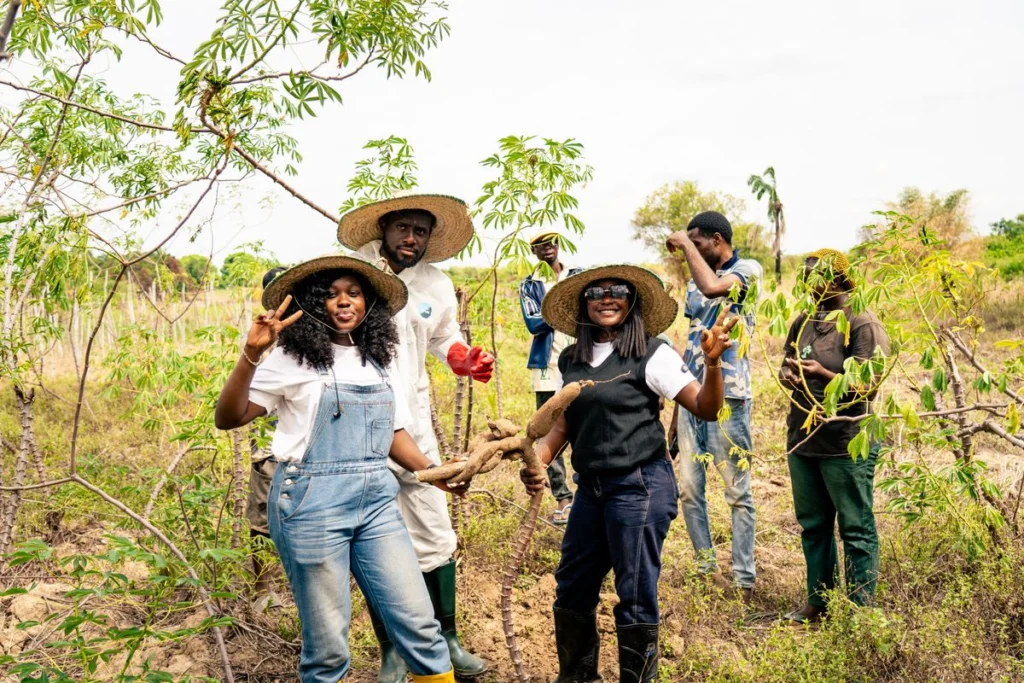
3. The crop management guide, from land preparation to harvest
This section summarises the converging recommendations of CNRA (Côte d’Ivoire), IITA and IRAD. It serves as an operational technical guide for a project of 1 to 100 hectares in the forest zone or humid savannah.
3.1 Choosing the land
- Soil: sandy loam to clay loam, deep (≥ 40 cm), well drained, pH 5.5 to 7.0. Avoid waterlogged soils: root rot is guaranteed.
- Previous crop: improved fallow, groundnut, cowpea, mucuna. Avoid continuous cassava after cassava.
- Effective rainfall: 800 to 1500 mm well distributed during the active root bulking phase.
3.2 Land preparation
- Deep ploughing to 25 to 30 cm at the end of the dry season, followed by harrowing.
- In wet areas or where erosion is a risk: ridging or planting on individual spaced mounds.
3.3 Planting
- Commercial density: 1 m × 1 m = 10,000 plants/ha.
- Intensive density: 1 m × 0.80 m = 12,500 plants/ha.
- Cutting position: vertical, inserted to two thirds of its length (recommended), or inclined at 45° in heavy soil.
- Planting window: at the start of the rainy season, after 100 to 150 mm of cumulative rainfall.
- Check at 4 weeks: immediately replace missing plants or cuttings planted upside down.
3.4 Fertilisation
Contrary to its reputation as a “hardy crop”, cassava removes large amounts of nutrients. A yield of 30 t/ha removes about 120 kg of N, 30 kg of P₂O₅ and 150 kg of K₂O per hectare.
- Basal dressing (on poor soil or an exhausted plot): 2 to 5 t/ha of mature compost.
- First mineral application at the first weeding (4 to 6 weeks after planting): NPK 14-23-14 or 15-15-15 at 200 to 300 kg/ha, in a furrow 10 to 15 cm from the plant.
- Second application at 3 to 4 months: urea 46% at 100 kg/ha + KCl 60% at 100 kg/ha.
Field experience, confirmed by IITA trials in Central Africa, shows that combining compost + NPK can increase root yield by 35%, against 24% for NPK alone. Our range of farm supplies and inputs is calibrated for this crop management sequence.
3.5 Crop maintenance
- First weeding: 2 to 4 weeks after planting.
- Second weeding + earthing up: 2 months after planting. Earthing up strengthens anchorage and promotes root bulking.
- Third light weeding: 3 to 4 months. After that, the canopy takes over.
3.6 Pests and diseases to watch
- Cassava mosaic disease (CMD): a virus transmitted by Bemisia tabaci and infected cuttings. Losses of 20 to 90%. Prevention = resistant varieties.
- Cassava mealybug (Phenacoccus manihoti): controlled by the parasitoid Anagyrus lopezi, but still to be monitored.
- Anthracnose, green mite, emerging brown streak: diagnosis by our crop protection team.
4. Crop duration: when to harvest?
The crop duration varies with the variety:
- Short-cycle IITA varieties (TME 419, TMS 98/0505): 10 to 12 months.
- Long-cycle varieties (traditional varieties, some commercial clones): 12 to 15 months.
- Staggered harvesting possible on suitable varieties up to 18 months.
Signs of maturity: yellowing and shedding of the lower leaves, cracks at the stem base, firm roots when tested by hand.
Optimal window: dry season, soil drained, never in heavy rain (roots rot in heaps). Once lifted, fresh cassava deteriorates within 48 to 72 hours, so post-harvest logistics must be sized around this constraint.
5. Yield and profitability: example for 1 hectare
Before looking at costs, it is important to understand why two neighbouring plots can range from 8 to 25 tonnes. Our analysis of the cassava yield gap per hectare quantifies the four levers involved and the production cost per kilo.
A typical budget for one hectare of cassava grown with improved management (IITA variety, NPK + urea fertilisation, two weedings) gives the following order of magnitude, in CFA francs:
| Item | Indicative cost (FCFA/ha) |
|---|---|
| Land preparation (ploughing + harrowing) | 90,000 to 130,000 |
| Certified cuttings (10,000 plants) | 100,000 to 200,000 |
| Basal dressing (2 t compost + application) | 60,000 to 100,000 |
| NPK 14-23-14 (200 kg) + application | 90,000 to 130,000 |
| Urea + KCl (100 kg each) + application | 90,000 to 130,000 |
| Weeding (3 manual passes) | 100,000 to 150,000 |
| Occasional crop protection treatments | 20,000 to 50,000 |
| Manual harvest | 150,000 to 250,000 |
| Total variable costs | 700,000 to 1,140,000 |
Expected revenue: 25 t/ha × average farm-gate price of 60 to 100 FCFA/kg = 1,500,000 to 2,500,000 FCFA/ha. Indicative net margin: 500,000 to 1,400,000 FCFA/ha depending on the year and the marketing channel.
This financial framework must be adapted to your country, your zone and your scale. Our teams prepare detailed costed budgets (equipment, labour, schedule) as part of our turnkey agricultural projects. A sample PDF budget for one hectare is available on request through our agricultural consulting and engineering service.
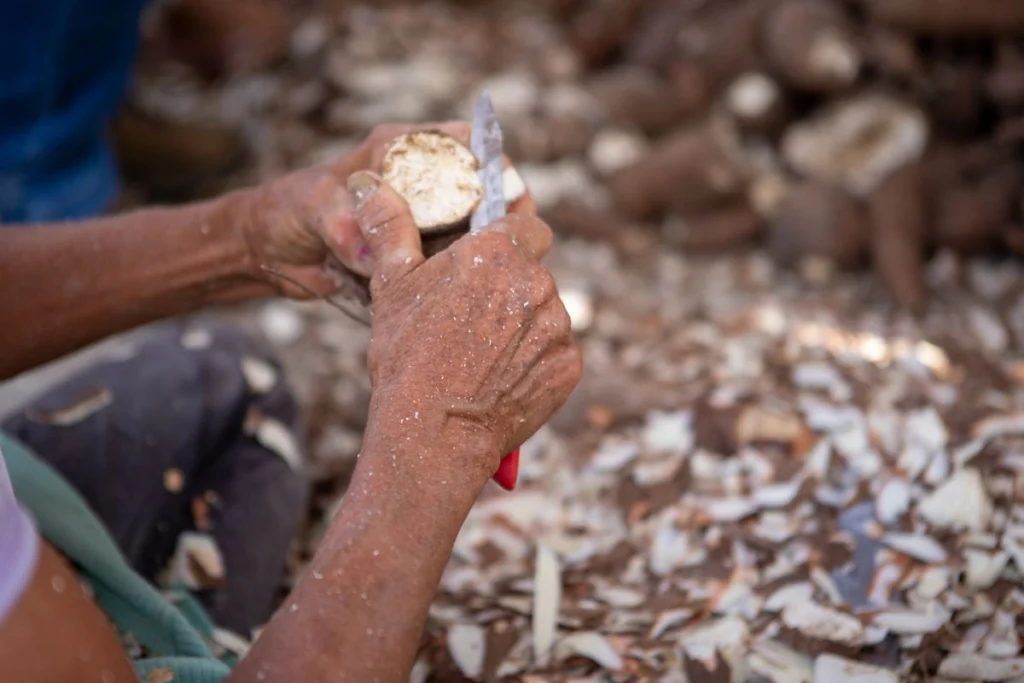
6. Post-harvest: grinder, press, grater, the processing unit
This is where the value of cassava is created. A raw root sold at the farm gate is worth 60 to 100 FCFA/kg; processed into gari, flour, attiéké or starch, it is worth 3 to 6 times more. According to value chain stakeholders, up to 40% of African production is lost for lack of immediate processing infrastructure.
6.1 The gari processing line
The standard process, validated by IITA, runs as follows: manual or mechanical peeling, washing in clean water, grating with a motorised grater (artisanal capacity about 130 kg/h; industrial capacity several tonnes/h) in which a toothed drum reduces the root to a fine mash, controlled fermentation for 24 to 72 hours, pressing with a screw press (manual or hydraulic) to remove 20 to 30% of the water (a historical contribution of Beninese artisans that greatly reduces roasting time), then sieving and roasting on an improved double hearth, drying and packaging.
6.2 The attiéké processing line (Côte d’Ivoire)
The Ivorian variant: after grating and pressing, the fermented mash is steam cooked in baskets and then granulated to the characteristic size of attiéké. Dedicated machines (steam cookers, granulators, sieves) are available from Asian manufacturers and local artisans in Abidjan.
6.3 Grinder or grater? Choosing your equipment
- Toothed drum grater: the benchmark for gari and attiéké. Higher yield of finished product.
- Hammer mill: more versatile (cassava + cereals + sweet potato) but uses more energy.
- Screw press, manual or hydraulic: essential after grating, whatever the value chain.
The market in Abidjan, Yaoundé, Douala and Lagos shows annual growth of 8 to 10% in demand for semi-industrial equipment. Suppliers: local artisan foundries, Asian importers and a few European manufacturers. Two criteria: verified supplier status and an on-time delivery rate ≥ 90%.
Our turnkey agricultural projects include the complete sizing of a processing unit matched to your production volume, from machine selection and site design to ventilation, hygiene and operator training.
Sources and references
- IITA / IAEA. Cassava Production Guidelines for Food Security and Adaptation to Climate Change in Sub-Saharan Africa.
- IITA. Production du gari à partir du manioc : guide illustré à l’intention des transformateurs à petite échelle.
- IFDC. Fiche technique, Itinéraire technique du manioc.
- Ngo-Samnick, E. L. ISF Cameroun. Production et transformation du manioc.
- Nassy, M. L. M. et al. (2020). Int. J. Biol. Chem. Sci. 14(4):1432-1447.
- IFDC / IITA. Improved Cassava Varieties; Healthy Stems for Better Yields.
- CGIAR-RTB. Au Cameroun, une filière manioc dynamique mais à valoriser.
Article written by the JOGOO Agriculture agronomy team. Recommendations should be adapted to your soil and climate conditions and to locally registered products.
Frequently asked questions
How long does cassava take to grow?
Cassava takes 10 to 15 months to grow depending on the variety. Short-cycle improved IITA varieties (TME 419, TMS 98/0505) can be harvested from 10 to 12 months, while traditional varieties are harvested at 12 to 15 months. On some suitable varieties, harvesting can be staggered up to 18 months after planting.
How many cassava cuttings are needed for 1 hectare?
One hectare of cassava at commercial density (1 m × 1 m) requires about 10,000 cuttings. At intensive density of 1 m × 0.80 m, 12,500 cuttings are planted per hectare. Each cutting should be 20 to 25 cm long, 2 to 4 cm in diameter and carry at least 5 to 7 nodes.
Which fertiliser should be used for cassava?
Cassava is fertilised in two applications: NPK 14-23-14 or 15-15-15 at 200 to 300 kg/ha at the first weeding (4 to 6 weeks after planting), then at 3 to 4 months urea 46% at 100 kg/ha and KCl 60% at 100 kg/ha for root bulking. A basal organic dressing of 2 to 5 t/ha of compost is recommended.
What is the yield of cassava per hectare?
Cassava yield depends on crop management. Under traditional cultivation: 8 to 12 tonnes/ha of fresh roots. With improved management (IITA variety, NPK + urea fertilisation, two weedings): 25 to 40 tonnes/ha. Optimised intensive trials: more than 50 t/ha.
Which machine is used to process cassava?
Three main pieces of equipment: a motorised toothed drum grater (capacity from 130 kg/h to several tonnes/h) that reduces the root to a fine mash, a manual or hydraulic screw press to dewater the fermented mash, then a sieve and a roasting pan to finish the gari.
Further reading
- Sweet potato farming: complete guide: the other major root food crop, with comparable potassium requirements and a much shorter cycle.
- The stages of maize cultivation: the crop management sequence for the cereal most often rotated with cassava.
Related articles
Get the full guide offline. Enter your details below.