You need 10,000 cassava cuttings per hectare on poor soil, at a spacing of 1 m by 1 m. On soil of average fertility, this rises to 12,500 cuttings per hectare (1 m between rows and 0.80 m within the row), and on genuinely fertile soil to 15,625 cuttings per hectare (0.80 m by 0.80 m). These three densities are the ones recommended by CNRA for Côte d’Ivoire. The IITA multiplication manual uses similar spacings, with 10,000 plants per hectare at 1 m by 1 m, 13,333 at 1 m by 0.75 m and 20,000 at 1 m by 0.50 m for dense plantings. The rest of this guide explains how to choose the density, what makes a correct cutting, and why the health status of the planting material weighs more heavily on yield than density itself.
1. How many cuttings per hectare for your soil
Density is not a single figure: it is adjusted to the fertility of the plot. A poor soil cannot support a high density, and crowding the plants there reduces root size without increasing tonnage.
| Spacing | Cuttings per hectare | Recommended situation | Source |
|---|---|---|---|
| 1 m x 1 m | 10,000 | Depleted or unfertilised soil | CNRA, IITA |
| 1 m x 0.80 m | 12,500 | Soil of average fertility | CNRA |
| 1 m x 0.75 m | 13,333 | Soil of average fertility | IITA |
| 0.80 m x 0.80 m | 15,625 | Fertile soil, organic manure applied | CNRA |
| 1 m x 0.50 m | 20,000 | Dense planting, particularly multiplication plots | IITA |
Remember the logic: the richer the soil, the higher the density can go. A wider spacing also makes weeding, earthing up and intercropping easier, which matters on family farms where manual weeding is the heaviest labour task.
2. Calculating your real cutting requirement
The basic calculation is simple: chosen density multiplied by area. For 3 hectares planted at 12,500 cuttings per hectare, you need 37,500 cuttings. Three adjustments then apply in the field:
- A gap-filling margin. Not every cutting sprouts. Keeping a reserve lets you replace missing plants within two to three weeks of planting, before the established plants get too far ahead.
- Sorting in the field. Part of the stems collected will be discarded during preparation because they are too woody, too soft or show symptoms.
- Transport distance. The further the material travels, the more it dries out, and the greater the losses at establishment.
3. What makes a correct cutting
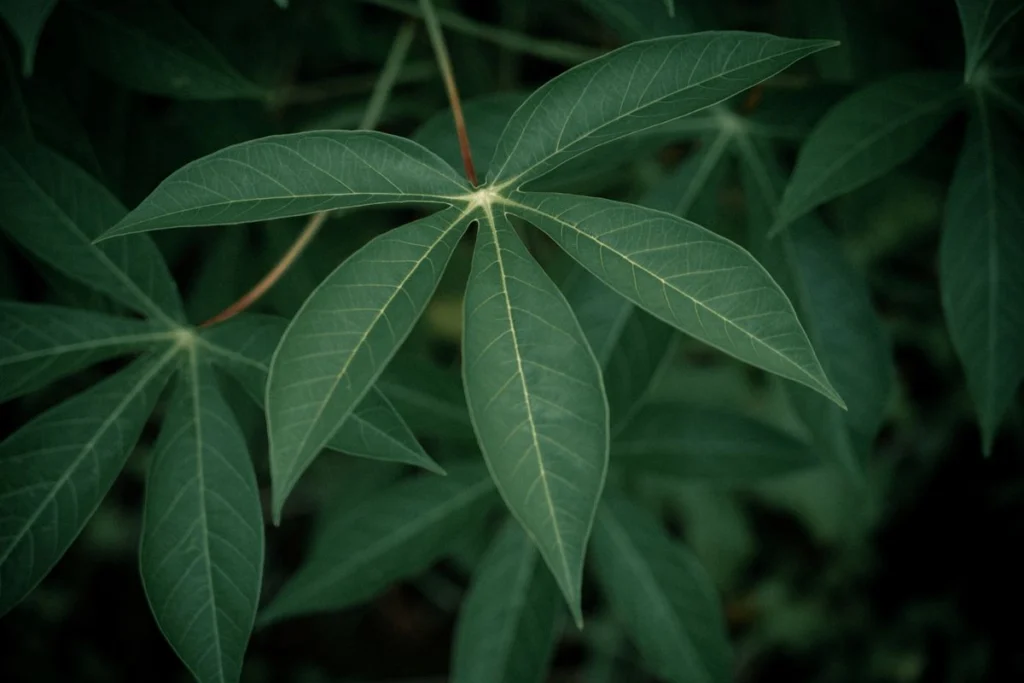
A cassava cutting is not just any piece of stem. Both reference sources agree on the dimensions:
- Length: 20 to 30 cm, with 4 to 6 nodes according to CNRA; the IITA manual specifies 20 to 25 cm for about 5 to 8 nodes. In both cases, it is the nodes that count, since each one carries a bud capable of producing a stem.
- Age of the mother plant: at least six months. CNRA recommends cutting stems from plants at least six months old before planting. This answers a question many growers ask: a six-month-old cassava stem can be used, a younger stem cannot.
- Part of the stem: neither too woody nor too soft. CNRA explicitly rules out heavily lignified sections and soft sections. The middle portion of the stem is the right one.
- Clean cut, made with a clean tool, to limit crushing of the tissue and entry points for rot.
4. Clean planting material, the first yield factor
This is the point most guides cover in a single line, even though it outweighs density. Because cassava is propagated vegetatively, any disease present in the mother stem is passed on in full to the next plot.
Cassava mosaic disease shows the scale of the problem. Storage root losses across sub-Saharan Africa are estimated at 15 to 24% per year, equivalent to 12 to 23 million tonnes, or an annual loss of 1.2 to 2.3 billion US dollars (Alabi, Kumar and Naidu, 2011). The disease is spread by infected cuttings and by the whitefly Bemisia tabaci, which is responsible for secondary spread. The same authors conclude that planting virus-free cuttings is the most effective way to limit the spread of the disease in Africa.
In practice, the IITA manual calls for taking material only from plants showing no leaf chlorosis, tip necrosis, cankers, mycelium or streaks on the stem. This check is done on standing plants in the plot, before cutting, plant by plant. Once a stem has been cut and sorted in a heap at the edge of the field, it is no longer possible to link a leaf symptom to the stem.
The most costly habit remains taking cuttings from your own plot every year without ever renewing the stock: the viral load builds up season after season, and yields fall for no apparent reason. Periodically renewing material from a controlled source, such as a research centre or licensed multiplier, is an investment, not an expense.
5. Producing your own cuttings: the multiplication plot
A grower who wants to expand should dedicate a plot to producing planting material rather than taking stems at random from production fields. There are two routes.
Multiplication by mini-cuttings. The IITA manual states that one cassava plant can produce about 60 to 100 mini-cuttings. These fragments have 1 to 2 nodes for woody sections, 4 to 6 nodes for semi-woody sections and more than 6 nodes for tip sections. The technique significantly speeds up the multiplication rate between two vegetative generations compared with conventional practice.
In vitro culture. Reserved for laboratories and variety dissemination programmes, it increases the multiplication rate by a factor of 100 to 1,000 according to IITA. Most improved varieties pass through this route before release.
For a multiplication plot, the tight density of 20,000 plants per hectare at 1 m by 0.50 m makes sense: the aim is no longer root tonnage but the length of stem produced.
6. Planting position and depth
CNRA accepts three planting positions: horizontal, less than 10 cm deep, slanted, or vertical. The choice depends mainly on rainfall and soil type:
- Horizontal planting encourages rooting along the whole length of the cutting and suits light soils and areas with well-distributed rainfall.
- Slanted planting is the most common compromise in the forest zone.
- Vertical planting, with two thirds of the cutting buried, reduces the risk of rot in heavy soil or in a very wet season, and makes harvesting easier.
In all cases, the cutting is planted the right way up, with buds pointing upwards, and on ridges or raised beds whenever drainage is uncertain.
7. Density, fertility and expected yield
Density alone produces nothing. In Cameroon, the average smallholder yield was about 16 t/ha in 2020, for national production of 5,492,522 tonnes, with a government target of 10 million tonnes per year by 2030 (MINADER). In Côte d’Ivoire, the improved varieties monitored by CNRA, such as Bocou 1, Bocou 2, Bocou 3 or TMS 4(2)1425, have cycles of 11 to 18 months and on-farm yields of around 25 t/ha, compared with the traditional varieties Yacé and Bonoua.
The gap between 16 and 25 t/ha does not come from density but from the trio of improved variety, clean planting material and fertilisation. On the last point, the MINADER advisory sheet recommends 10 to 20 tonnes per hectare of well-rotted manure on poor soil, equivalent to 250 to 500 bags of 40 kg. Complementary mineral applications and their rates by crop are detailed in our guide to NPK, foliar and organic fertilisers.
For the complete crop management sequence, from land preparation to processing into attiéké, gari or flour, see our reference guide to cassava farming in Africa. The weight of the value chain in Cameroon’s agricultural economy is put in context in our overview of agriculture in Cameroon. And if you plan in rotations, sweet potato farming is also propagated vegetatively and follows a very similar clean-material logic.
8. Storing and transporting cuttings
Between cutting and planting, the stem loses water, and that loss is paid for at establishment. A few practical rules:
- Cut the stems as close as possible to the planting date.
- Keep stems whole, not sectioned: cut them into cuttings just before planting, because each section is an open wound.
- Store them upright, in bundles, in the shade, sheltered from the wind, on slightly moist ground.
- Never pile stems in the sun on a tarpaulin, a common practice along rural roads that is very costly in terms of establishment rate.
- Treat cuttings before planting only with a registered product, at the recommended rate.
9. Securing your supply
Planting material is the only cassava input that growers produce themselves, and it is also the one they control least. For a project of several hectares, the sequence that works is: identify a controlled source of cuttings, plant a dedicated multiplication plot in year 1, then supply extensions from that plot while renewing the stock every three to four cycles. Our farm supplies and inputs teams support input sourcing, and our agricultural consulting and engineering unit sizes the multiplication plan and planting calendar to the scale of your farm.
Sources and references
- CNRA. Bien cultiver le manioc en Côte d’Ivoire. Centre National de Recherche Agronomique, technical sheet.
- IITA. Multiplication de matériel de plantation de manioc et gestion des maladies et ravageurs. Training manual for field staff, International Institute of Tropical Agriculture.
- Alabi O. J., Kumar P. L., Naidu R. A. (2011). Cassava Mosaic Disease: A Curse to Food Security in Sub-Saharan Africa. American Phytopathological Society, APSnet Features.
- MINADER. Fiche de conseil en transition agro écologique pour la culture du manioc au Cameroun. Ministry of Agriculture and Rural Development, Cameroon.
Article written by the JOGOO Agriculture agronomy team. The densities and yields given should be adjusted to your soil and climate conditions, your variety and your level of fertilisation.
Frequently asked questions
How many cassava cuttings are needed per hectare?
You need 10,000 cuttings per hectare at a spacing of 1 m by 1 m on depleted soil, 12,500 at 1 m by 0.80 m on soil of average fertility and 15,625 at 0.80 m by 0.80 m on fertile soil, according to CNRA. The IITA manual also gives 13,333 cuttings per hectare at 1 m by 0.75 m and 20,000 at 1 m by 0.50 m for dense plantings.
How long should a cassava cutting be?
A cutting is 20 to 30 cm long with 4 to 6 nodes according to CNRA, or 20 to 25 cm with about 5 to 8 nodes according to IITA. It is the nodes that count, since each node carries a bud capable of producing a stem.
Can a six-month-old cassava stem be used as a cutting?
Yes. CNRA recommends taking stems from plants at least six months old. However, heavily lignified sections and sections that are still soft should be discarded, keeping only the middle portion of the stem.
How can you recognise a healthy cutting?
The check is done on the standing plant, before cutting. IITA calls for discarding any plant showing leaf chlorosis, tip necrosis, cankers, mycelium or streaks on the stem. Cassava mosaic disease is spread by infected cuttings as much as by whitefly.
How much does cassava mosaic disease cost Africa?
Storage root losses are estimated at 15 to 24% per year across sub-Saharan Africa, or 12 to 23 million tonnes, equivalent to 1.2 to 2.3 billion US dollars per year. Planting virus-free cuttings remains the most effective way to limit its spread.
How many mini-cuttings can be obtained from one plant?
One cassava plant can produce about 60 to 100 mini-cuttings according to the IITA multiplication manual. In vitro culture, reserved for laboratories, increases the multiplication rate by a factor of 100 to 1,000.