
Maize is grown in seven stages: soil preparation, sowing, basal fertiliser, weeding, nitrogen top-dressing, crop protection and harvest. The cycle lasts 90 to 120 days depending on the variety. The yield gap between traditional management, at 1 to 2 tonnes per hectare, and improved management, at 5 to 8 tonnes, comes almost entirely down to keeping to the timing of these stages.
Stage 1. Soil preparation
Maize does best on deep, loose, well-drained soil with a pH of 5.5 to 7. Plough to 20 to 25 cm, then harrow to obtain a fine seedbed. Poorly prepared soil gives uneven emergence, and uneven emergence can never be recovered: late plants stay suppressed until harvest.
On soils that tend to be acidic, a lime amendment gives a lasting improvement in phosphorus availability. This correction should be based on a soil test.
Stage 2. Sowing
Sow as soon as the rains are established, on sufficiently moist soil. Sow 2 seeds per hole, 3 to 5 cm deep, with 0.8 m between rows and 0.4 m within the row. This layout gives about 62,500 plants per hectare after thinning.
Use certified seed of a variety suited to the zone. Replanting grain from the previous harvest, especially from hybrids, causes yields to drop from the very first generation. It is the most expensive saving in the whole calendar.
Stage 3. Basal fertiliser
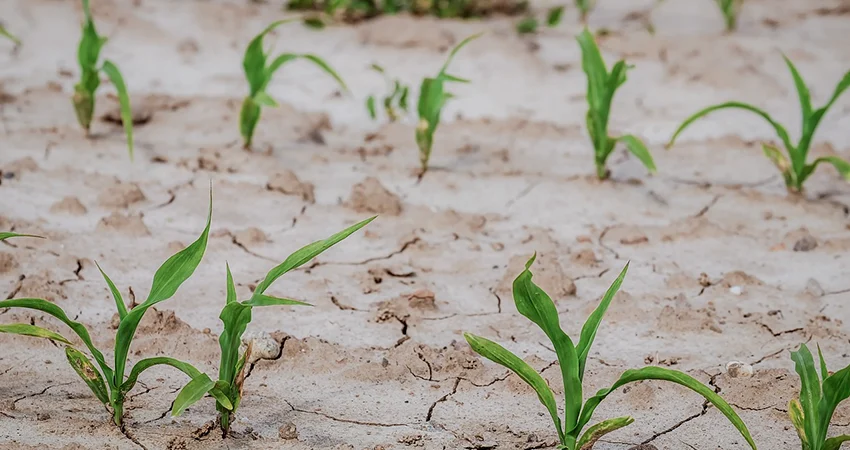
A compound fertiliser is applied at sowing or just after emergence, close to the planting hole but not in direct contact with the seed. This basal dressing covers phosphorus needs, which are decisive for root establishment, and potassium needs.
Rates depend on the field’s potential and the soil analysis, as detailed in our guide to NPK fertilisers. Our teams help with this calculation as part of our fertilisation and plant nutrition services, and our farm supplies and inputs cover the common formulas.
Stage 4. Weeding and thinning
The first weeding takes place 15 to 20 days after emergence, the second at around 40 days. The critical period of weed competition falls within the first 6 weeks: late weeding costs more yield than any other lapse in crop management.
Thinning is done at the first weeding, keeping one vigorous plant per hole if the target is a stand of 62,500 plants per hectare.
Stage 5. Nitrogen top-dressing
Nitrogen top-dressing, usually as urea, is applied around 40 to 45 days after sowing, when the maize enters rapid growth just before stem elongation. This application is the main yield lever in the entire crop programme.
Place the fertiliser in a band 10 to 15 cm from the plant, on moist soil, then work it in lightly. A foliar supplement can be considered, see our foliar fertiliser protocol for maize. Surface application on dry soil leads to heavy losses through volatilisation. Combining this operation with earthing up improves plant anchorage and limits lodging.
Stage 6. Crop protection
The fall armyworm is now the major maize pest in sub-Saharan Africa. It attacks the leaf whorl from the earliest stages and can destroy a young field in a few days.
Monitoring should be weekly from emergence, with inspection of the whorl. Early intervention targeted at infestation hotspots is far more effective and less costly than late blanket spraying. Striga, a parasitic weed, and leaf diseases complete the risks depending on the zone. See our crop protection solutions.
Stage 7. Harvest
Physiological maturity is reached when the husks turn yellow and dry and a black layer appears at the base of the kernel. The grain then still contains 25 to 30% moisture.
Leave to dry in the field or in a dryer down to 12 to 14% moisture before shelling and storage. Storing above 14% exposes the grain to moulds and mycotoxin development, a real health risk and a frequent cause of rejection at delivery on organised markets.
Summary calendar
| Stage | Timing |
|---|---|
| Soil preparation | Before the rains |
| Sowing | Onset of the rains |
| Basal fertiliser | At sowing or emergence |
| 1st weeding and thinning | 15 to 20 days |
| Nitrogen top-dressing and earthing up | 40 to 45 days |
| 2nd weeding | 40 days |
| Crop protection monitoring | Weekly from emergence |
| Harvest | 90 to 120 days |
Frequently asked questions
What are the stages of maize farming?
Soil preparation, sowing, basal fertiliser, weeding and thinning, nitrogen top-dressing, crop protection, then harvest and drying.
How long does it take to grow maize?
90 to 120 days from sowing to harvest, depending on how early the variety matures and on climatic conditions.
What is the maize yield per hectare?
1 to 2 tonnes per hectare under traditional management, and 5 to 8 tonnes with certified seed, sound fertilisation and protection against fall armyworm.
When should urea be applied to maize?
Around 40 to 45 days after sowing, on moist soil, in a band 10 to 15 cm from the plant and lightly worked in to limit volatilisation losses.
Running maize production on a commercial scale? We support variety selection, fertilisation and mechanisation. Discover our agricultural consulting.