
Download the technical sheet (PDF)
Tomato farming (Solanum lycopersicum) follows a cycle of 90 to 120 days, with a 25 to 30 day nursery stage, a density of 20,000 to 30,000 plants per hectare and yields ranging from 15 tonnes per hectare under traditional management to more than 60 tonnes in a well-run protected structure. It is the most widely grown vegetable crop in West and Central Africa, and also one of the most demanding in terms of crop health management. For the sowing and transplanting calendar, see our guide to planting tomatoes.
Soil and climate
Tomatoes prefer deep, well-drained sandy loam soils with a pH of 5.8 to 6.8. They produce best between 20 and 27 °C. Above 32 °C for prolonged periods, pollen becomes sterile and flowers drop without setting fruit, which explains most production failures in the hot season.
Soilless production partly addresses this constraint. It is also why production in an agricultural greenhouse or under shade netting is expanding in the tropics: it moderates extremes and allows off-season production, when prices are at their highest.
Nursery
Sow in a protected nursery, on a clean substrate, in rows 10 cm apart. Seedlings emerge in 5 to 8 days. Plants are ready for transplanting at 25 to 30 days, at the 4 to 5 true leaf stage and 12 to 15 cm tall.
Harden off seedlings by reducing watering and shade during the last 5 to 7 days. A leggy seedling, too tall and too soft because it was kept in the shade and overwatered, will never catch up in the field.
Transplanting and density
Transplant in the late afternoon, at 0.8 to 1 m between rows and 0.4 to 0.5 m within the row, giving 20,000 to 30,000 plants per hectare. Bury the base of the stem slightly: tomatoes form adventitious roots on the buried part, which improves anchorage and nutrient uptake.
Water immediately after transplanting. That first watering determines establishment more than any later operation.
Staking and pruning
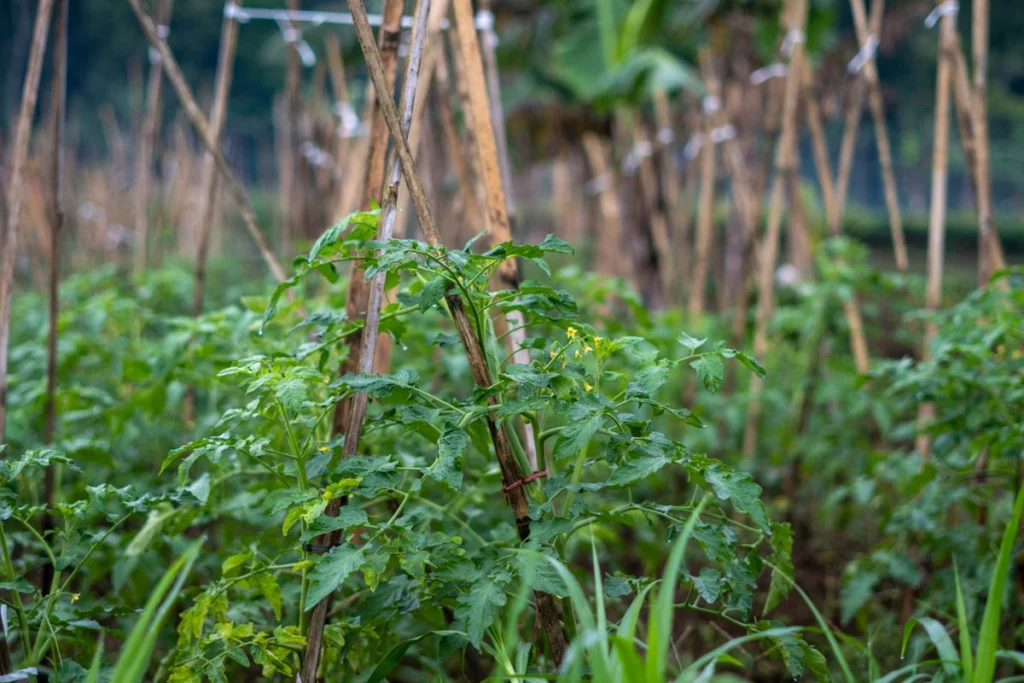
Staking is essential for indeterminate varieties. It keeps foliage and fruit off the ground, improves airflow through the canopy and sharply reduces contact rots and splash-borne infections.
Pruning means removing the suckers that develop in the leaf axils. On indeterminate varieties trained to one or two stems, this concentrates production on larger, better-graded fruit. Determinate, bushy varieties are not pruned.
Gradually remove the lower leaves once the first truss has set. This limits disease hotspots and improves air circulation.
Irrigation
Tomatoes need a steady water supply. Irregular watering causes fruit cracking and blossom end rot, the dry blackening at the tip of the fruit that reflects poor calcium transport rather than a simple soil deficiency.
Drip irrigation is the reference technique: it keeps soil moisture stable, keeps foliage dry (which is decisive against late blight) and allows fertigation. See our irrigation and pumping solutions.

Fertilisation
Tomatoes remove a lot of nutrients, especially potassium. The standard programme combines a well-decomposed organic basal dressing with split mineral applications, nitrogen-oriented during vegetative growth and then strongly potassium-oriented from the formation of the first trusses.
Calcium and magnesium must be monitored. A pH that is too low blocks their uptake whatever the dose applied, which is why a soil test beforehand pays off. See our fertilisation and plant nutrition services.
Diseases and pests
Late blight is the main threat in the wet season: oily brown spots on leaves and fruit, with very rapid spread. Prevention relies on canopy airflow, dry foliage and close monitoring.
Early blight (alternaria), bacterial wilt and nematodes complete the disease picture. Among pests, whiteflies transmit damaging viruses, and the tomato leafminer causes severe damage to leaves and fruit.
A rotation of at least 3 years without solanaceous crops remains the most effective and least costly preventive measure. See our crop protection solutions.
Harvest
Harvest starts 60 to 80 days after transplanting and lasts 1 to 3 months depending on the variety type. For a distant market, harvest at the breaker stage, when colour starts to show. For immediate local sale, harvest fully ripe, as the gain in eating quality is real.
Harvest early in the morning, handle without piling, and avoid leaving crates in the sun at the field edge, a common practice that greatly shortens shelf life.
Expected yields
| Management | Yield |
|---|---|
| Open field, traditional | 15 to 25 t/ha |
| Open field, staked and drip irrigated | 30 to 45 t/ha |
| Protected cultivation, adapted varieties | 50 to 80 t/ha |
Frequently asked questions
How long does a tomato crop take?
From 90 to 120 days from sowing to the end of harvest, including 25 to 30 days in the nursery and a harvest period of 1 to 3 months.
How many tomato plants per hectare?
From 20,000 to 30,000 plants, with 0.8 to 1 metre between rows and 0.4 to 0.5 metre within the row.
Why are my tomato flowers falling off?
The most common cause in the tropics is heat: above 32 °C for prolonged periods, pollen becomes sterile and the flower drops without setting fruit. Water stress or excess nitrogen have the same effect.
Should tomato plants be pruned?
Yes for indeterminate varieties trained to one or two stems. No for determinate, bushy varieties, where pruning would reduce yield.
Are you developing open-field or protected tomato production? We size the irrigation, the greenhouse and the crop management plan. Let’s talk about your project.
Related articles

Get the full guide offline. Enter your details below.