Soilless farming, or hydroponics, is no longer a laboratory curiosity. In Africa’s major cities (Abidjan, Dakar, Douala, Lagos, Kinshasa), it is now one of the fastest-growing routes into professional vegetable production, driven by three converging forces: urbanisation, which is eating up peri-urban farmland, pressure on water, and demand from supermarkets, hotels and restaurants for produce of consistent quality all year round.
This guide reviews the available systems, their costs and their profitability, with a particular focus on soilless tomato production, the flagship example and the best documented worldwide.
1. What is soilless farming?
Soilless farming covers every production technique in which the plant does not grow in natural soil. There are two main families:
1.1 Pure hydroponics
The roots sit in a nutrient solution (water plus dissolved fertiliser), with no solid substrate at all, or with only a minimal inert support.
1.2 Substrate culture
The roots grow in an inert substrate (coir, rockwool, perlite, expanded clay pebbles) irrigated with a nutrient solution by drip. Technically this is also a form of soilless farming, often classed as “substrate hydroponics”.
In both cases the grower has full control over water, nutrient and oxygen supply, which explains the yield gains observed.
2. Why soilless farming appeals in Africa
The structural advantages of soilless farming are especially relevant in the African context:
- Major water savings: up to 80% less than conventional soil-based growing, thanks to closed-loop systems.
- Yields 2 to 3 times higher per square metre, over shorter cycles.
- Freedom from poor, saline or contaminated soils, which are common in peri-urban areas.
- Control of soil-borne diseases (nematodes, root rots, soil Fusarium), which are almost eliminated.
- Continuous year-round production under cover, regardless of the season. For choosing and sizing the structure, see our guide to agricultural greenhouses in tropical Africa.
- Minimal use of herbicides and pesticides because the crop is isolated from the soil.
Feedback from several entrepreneurs based in Abidjan and Dakar confirms the orders of magnitude cited by Agence Ecofin: a farm becomes profitable from a volume of about 2,600 plants per cycle, for an indicative net profit of around USD 1,100/month on fast crops (salad greens, culinary herbs). On demanding crops such as tomato, cycles are longer but margins per unit produced are higher.
3. The main hydroponic systems
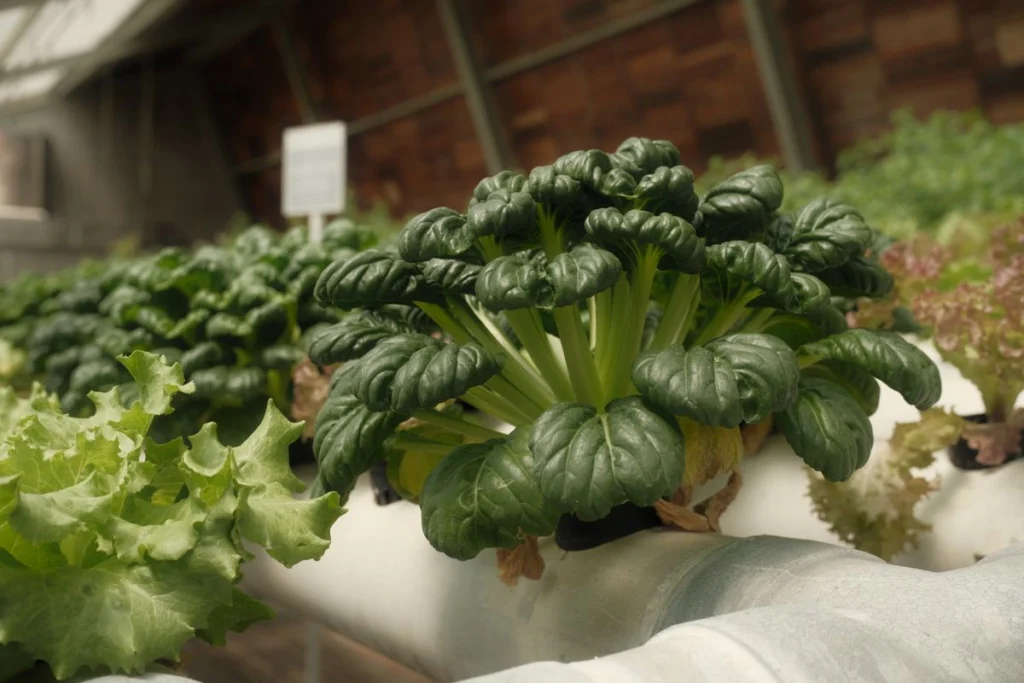
3.1 NFT (Nutrient Film Technique)
A thin film of nutrient solution flows continuously through sloping gutters in which the plant roots sit. The roots receive water, nutrients and oxygen at all times.
Ideal for: lettuce, culinary herbs (basil, parsley, mint), strawberries. Commercial lettuce production at scale.
Tomatoes: small-fruited hybrids (cherry, cocktail) work well in NFT; large processing tomatoes need sturdier systems.
3.2 DWC (Deep Water Culture)
The roots are suspended in highly oxygenated water. This is the simplest system to set up at small scale, and particularly suited to heavy-feeding plants (tomatoes, sweet peppers, aubergines).
3.3 Substrate culture with drip irrigation
Plants are grown in coir bags, rockwool cubes or expanded clay pebbles. The nutrient solution is delivered several times a day by a drip micro-irrigation system.
This is the dominant system for commercial soilless tomato production worldwide, used in the large greenhouses of Morocco, Spain and the Netherlands, and increasingly in West Africa as well.
3.4 Aeroponics
The roots are suspended in the air and regularly misted by nozzles. It is the most efficient system for growth and water saving, but also the most expensive and the most vulnerable to breakdowns.
3.5 Hybrid and low-cost systems
Local craftsmen in Abidjan, Yaoundé, Dakar and Cotonou have developed affordable hybrid systems using PVC pipes, reused buckets and local substrates (coir, carbonised rice husks). These adaptations make hydroponics accessible to project developers on tight budgets.
4. Focus: soilless tomato production
Soilless tomato production is the most studied and most profitable application of hydroponics in the world. It is now the benchmark for any project developer planning to set up under greenhouse cover.
4.1 Choosing the system and variety
- Recommended systems: substrate with drip irrigation (the commercial benchmark) or DWC (small scale).
- Suitable varieties: indeterminate hybrids with continuous growth, bred for protected cropping. Local determinate varieties are poorly suited.
- Density: 2.5 to 3 plants/m² under cover.
4.2 Crop management
- Pruning to a single stem, with progressive deleafing.
- Vertical trellising up to 3 metres.
- Pollination by hand (vibrator) or by introduced bumblebees.
- Cycle: 8 to 10 months under cover, with continuous harvesting from the 3rd month.
4.3 Nutrient solution
- EC (electrical conductivity): 2.0 to 2.8 mS/cm depending on the stage.
- pH: 5.5 to 6.5.
- Two- or three-part formulation containing macro- and micronutrients (N, P, K, Ca, Mg, S + Fe, Mn, Zn, B, Cu, Mo).
- Weekly adjustment based on analysis of the recirculated solution.
Our fertilisation and plant nutrition team formulates custom nutrient solutions matched to crop stages and local conditions.
4.4 Expected yield
The most reliable benchmarks for a tropical context come from the soilless tomato guide published by CIRAD in Réunion, which compares the two systems on the same island:
- Open-field soil cultivation: 40 to 70 t/ha.
- Soilless cultivation under greenhouse: 200 to 350 t/ha.
The real gap is therefore a factor of 4 to 6, not a factor of 10 as is often claimed. Above all, it only materialises if fertigation and drainage are managed to the values below.
4.5 Soilless greenhouse growing: measured management benchmarks
The same CIRAD guide quantifies substrate growing under cover item by item. These are the only benchmarks to rely on before committing to an investment:
- Substrate and plants per bag: blond peat in 15-litre bags for 3 plants, or 30-litre bags for 6 plants. Coir residues are used in 30-litre bags for 6 plants. Coal slag, a local industrial by-product, is a third option that can be sourced locally.
- Volume per irrigation: 225 to 350 ml, or 7 to 11 minutes with 2 l/h drippers.
- Frequency: 3 to 7 irrigations per day depending on the crop stage and climatic demand.
- Drainage: the drained volume should be 30% of the volume of solution applied.
- Target to maintain in the bag: conductivity of 2.0 mS/cm and pH of 5.8.
The 30% drainage rule is the one most often sacrificed in West Africa, where every cubic metre counts. Going well below it raises the conductivity in the substrate within a few days and blocks uptake, causing symptoms that are wrongly attributed to a deficiency and then treated with extra feed, which makes the problem worse.
4.6 Ventilation or cooling: a ratio of 1 to 7
According to the same guide, the cost difference between the two ways of controlling temperature under cover is decisive: dynamic ventilation costs 2.68 euros excluding tax per m², against 20 euros excluding tax per m² for a cooling system. In a humid tropical climate, properly sized ventilation is therefore the first item to fund, well before any air conditioning.
5. The tropical greenhouse: constraints and adaptations
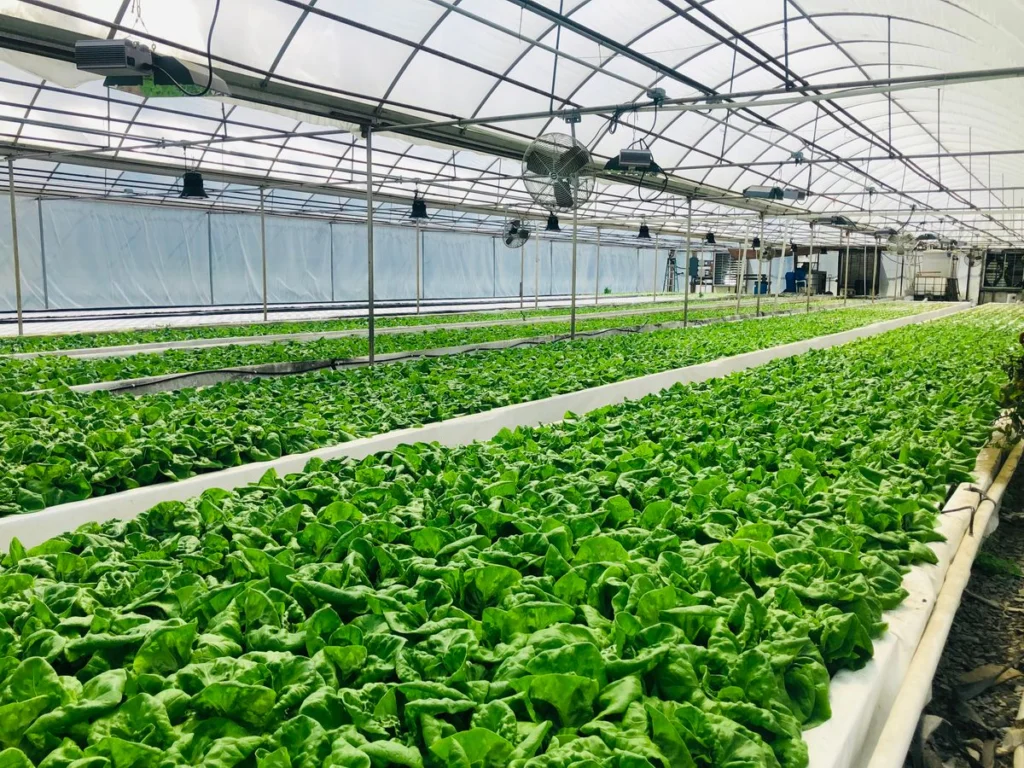
In a tropical climate, a greenhouse is not just a transparent envelope. It must:
- Protect against heavy rain and virus-carrying insects (whitefly, thrips).
- Ventilate intensively: ridge and side openings should account for at least 20 to 30% of the floor area.
- Use an insect-proof net of suitable mesh (typically 50 mesh) around the perimeter.
- Provide thermal insulation to prevent daytime overheating (temporary shade cloth) and night-time condensation (which favours downy mildew).
Our agricultural greenhouses division handles complete sizing: structure, covering, ventilation, netting and irrigation system, on areas from 500 m² to several hectares.
6. Investment and profitability
Here are indicative ranges, to be adjusted according to size, level of automation and supplier:
| System | Investment/m² (indicative) | Suited to |
|---|---|---|
| Low-cost hydroponic kit (PVC + drip) | 3,000 to 8,000 FCFA | Beginner, trial |
| Complete imported home system | 25,000 to 60,000 FCFA | Small scale |
| Greenhouse + substrate + semi-professional drip | 30,000 to 80,000 FCFA | Cooperative, SME |
| Professional greenhouse with partial climate control | 100,000 to 250,000 FCFA | Commercial farm |
Typical payback period on fast crops (salad greens, herbs): 12 to 24 months. On soilless tomato in a professional greenhouse: 24 to 48 months depending on the market outlet and selling price.
7. Common mistakes to avoid
- Undersizing ventilation: in Abidjan, Douala or Cotonou, a poorly ventilated greenhouse exceeds 40 °C within a few hours and scorches the crop.
- Using untested water: saline or heavily chlorinated water means certain failure. A water analysis is essential before any system sizing.
- Neglecting pH and EC: a pH meter and an EC meter are essential investments, not accessories.
- Underinvesting in irrigation: the irrigation and pumping system is the beating heart of a soilless farm. A breakdown means total loss within 24 hours.
- Improvising the nutrient solution: “home-made” formulas based on dissolved manure do not work in pure hydroponics. Invest in horticultural-grade nutrient salts.
8. Where to start?
Three profiles, three entry points:
- Curious beginner / entrepreneur still learning: start with a 10 to 20 m² DWC or NFT kit growing lettuce or basil. Fast ROI, learning without financial risk.
- Cooperative / SME: set up a 500 to 1,500 m² greenhouse with drip irrigation on substrate, growing cucumber, sweet pepper or cocktail tomato. Peri-urban markets, restaurants, supermarkets.
- Investor / commercial project: a professional greenhouse of 5,000 m² or more, growing licensed tomato or cucumber varieties, for urban distribution and regional export. A full feasibility study is recommended.
Our turnkey agricultural projects and agricultural consulting and engineering teams support each of these profiles, from system sizing to operator training.
Sources and references
- Simon, S. and Minatchy, J. CIRAD. Guide de la tomate hors sol à La Réunion. agritrop.cirad.fr
- Agence Ecofin. Se lancer dans l’agriculture hors-sol.
- SERRE IVOIRE. Culture hors sol : l’avenir de l’agriculture en Afrique de l’Ouest.
- Novagric. Systèmes NFT pour serres tropicales et projets africains.
- Culture-Hydroponie. Guide complet des systèmes hydroponiques (NFT, DWC, aéroponie).
- MDPI (2026). Climate-Driven Pest and Disease Dynamics in Greenhouse Vegetables: A Review. Horticulturae 12(4):415.
Article written by the JOGOO Agriculture agronomy team. Economic data are indicative at the time of writing and should be refined through a feasibility study tailored to your project.
Frequently asked questions
What is soilless farming?
Soilless farming covers every production technique in which the plant does not grow in natural soil. There are two main families: pure hydroponics (roots in a nutrient solution with no substrate) and culture on an inert substrate (coir, rockwool, clay pebbles) irrigated by drip.
How much does a hydroponic set-up cost in Africa?
Indicative 2026 ranges for West Africa run from 3,000 to 8,000 FCFA/m² for a home-built low-cost kit, 25,000 to 60,000 FCFA/m² for an imported home system, 30,000 to 80,000 FCFA/m² for a semi-professional greenhouse on substrate, and 100,000 to 250,000 FCFA/m² for a professional climate-controlled greenhouse.
Which hydroponic system is best for growing tomatoes?
For soilless tomato production, the commercial benchmark is substrate culture (coir or rockwool) irrigated by drip, suited to indeterminate hybrids grown on a single stem up to 3 metres. At small scale, DWC works well for heavy-feeding plants.
Is soilless farming profitable in West Africa?
Yes, soilless farming is structurally profitable in West Africa, with yields 2 to 3 times higher than conventional soil-based growing and water savings of up to 80%. The indicative break-even point is around 2,600 plants per cycle, for an average net profit of around USD 1,100 per month.
How much water does hydroponics save?
Hydroponics saves up to 80% of water compared with conventional soil-based growing, thanks to closed-loop systems that recirculate the nutrient solution.
What yield can you expect from soilless greenhouse growing?
The soilless tomato guide published by CIRAD in Réunion puts soilless greenhouse production at 200 to 350 t/ha, against 40 to 70 t/ha in open fields on the same island, a ratio of 4 to 6. This level assumes drainage kept at 30% of the volume of solution applied, a conductivity of 2.0 mS/cm and a pH of 5.8 in the substrate bag.
Further reading
- Tomato growing: crop management guide: the crop most often grown soilless under cover, and the temperature thresholds that justify this choice.
- Melon growing technical sheet: a high-value crop that rewards the same control of fertigation.
- Managing soilless tomatoes: substrate, nutrient solution conductivity, pH and drainage rates to respect.