“How much water does a ginger plot need, and how often?” The question comes up at every installation. There is a figure-based answer: the ICAR-Indian Institute of Spices Research recommends 1,300 to 1,500 mm of water over the whole cycle, and the sustainable production guide published by COLEAD in 2025 puts the optimum rainfall at around 1,500 mm per year, within an acceptable range of 1,270 to 1,900 mm per cycle. Because the rhizome develops in the top 30 centimetres of soil, this water must arrive in small, frequent doses rather than large, widely spaced irrigations. That is exactly what drip irrigation does.
What ginger needs, in figures
Before laying a single pipe, you need to know the plant’s requirements. The COLEAD guide gives benchmarks that can be used directly on a plot in Côte d’Ivoire:
- Optimum temperature: 19 to 28 °C, no tolerance below 10 °C.
- Relative humidity: 70 to 90 %.
- Soil pH: 5.7 to 6.5 optimum, 5.5 to 8.5 acceptable.
- Soil electrical conductivity: keep below 2 deciSiemens per metre.
- Rhizome planting depth: 3 to 5 cm, with roots reaching down to 30 cm.
- Density: 30,000 to 40,000 rhizomes per hectare, or 800 to 900 kg of planting material at 25 to 30 g per seed piece.
- Spacing: 20 to 25 cm within the row, beds 1 m wide and 15 cm high, at least 50 cm apart.
- Cycle: 8 to 10 months from planting to harvest.
Two figures govern the rest of the irrigation plan: 30 cm root depth and 2 dS/m maximum salinity. The first rules out large doses, which drain below the root zone. The second means you must know your water quality before choosing equipment.
Why drip irrigation pays on this crop
A multi-year trial published in the journal Water SA in 2022 compared four water regimes on ginger. Under strictly rainfed conditions, with seasonal evapotranspiration of 250 mm, yield was 7.10 tonnes per hectare. Raising water use to 404 mm lifted yield to 10.85 t/ha, and to 454 mm, 10.92 t/ha. The measured yield response factor was 0.77, meaning a yield loss of 0.77 % for each percent reduction in evapotranspiration.
In other words, ginger responds to water steadily, with no sharp threshold effect, and the gain levels off between 400 and 450 mm of water used. A system that delivers little and often, without saturating the bed, is therefore the right tool. The same work shows that the highest water productivity, about 3.2 kg of rhizomes per cubic metre, is achieved under the intermediate regimes, not the wettest one. Watering more than necessary costs water without adding anything to the harvest.
Laying the system on ginger beds
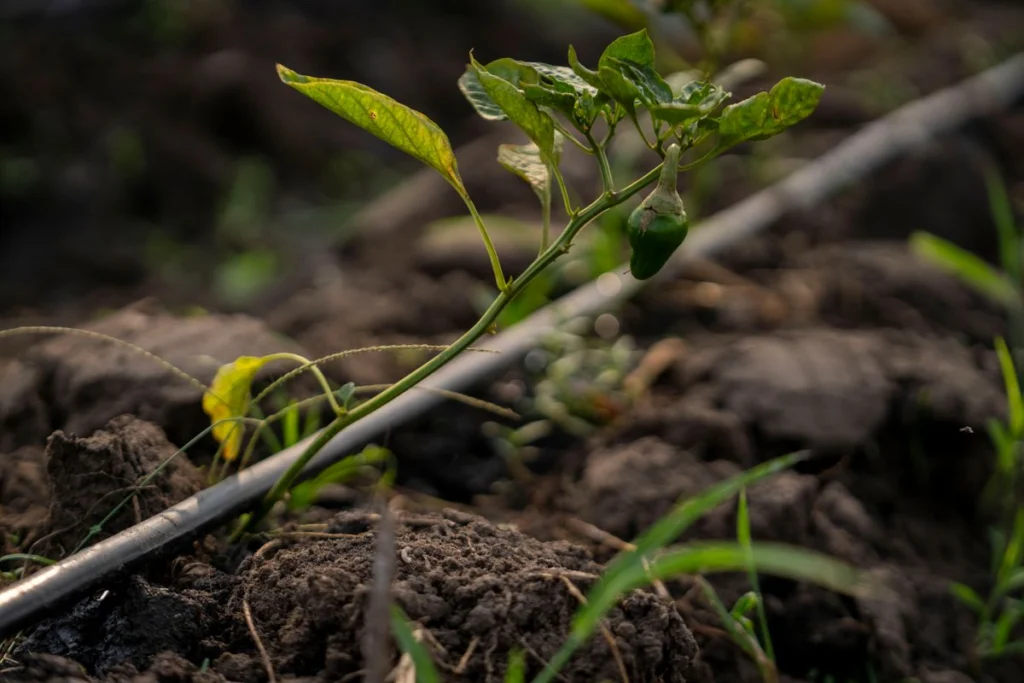
The bed geometry described by COLEAD, 1 m wide with 50 cm between beds, determines the layout of the system. Here is the order of operations.
- Mark out the beds before the pipes. Build the ridges 15 cm high and 1 m wide, aligned with the slope so that rainwater drains between the beds and not into them. Ginger does not tolerate waterlogging.
- Two laterals per bed. A 1 m bed carries two rows of plants. Lay one lateral per row, 40 to 50 cm apart, not a single central lateral: with only 30 cm of root depth, a single wetted bulb in the middle of the bed leaves both rows short of water.
- Choose an emitter spacing that matches the plant spacing. With plants 20 to 25 cm apart in the row, an emitter spacing of 20 to 30 cm gives a continuous wetted strip. A 50 cm spacing leaves gaps between the wetted bulbs on sandy soil.
- Divide the system into sections. Each section must be able to run at the emitters’ nominal pressure. Four sections that work properly are better than a single section where the last laterals receive half the flow.
- Plan flush points from the start. A flush valve at the end of each submain, accessible without dismantling anything, is what will make the difference after two seasons.
A rough guide to watering time
The calculation is easy to redo for your own plot. Taking 1,400 mm over a 225 day cycle, the average of the ICAR-IISR benchmarks, gives about 6.2 mm per day on average over the cycle. On a module 1.50 m wide (a 1 m bed plus 50 cm between beds), this represents 9.3 litres per linear metre per day, so 4.65 litres per metre of lateral with two laterals. With 2 litre per hour emitters every 25 cm, that is 8 litres per hour per metre of lateral, running time comes down to about 35 minutes per day. Note that this is a cycle average. During rhizome bulking, demand exceeds this average, and the system must have been sized with a margin.
Water quality and filtration: thresholds to check before ordering
The leading reason drip systems are abandoned is emitter clogging, and it is decided at purchase, not during maintenance. The FAO document Water quality for agriculture gives clogging risk thresholds for localised irrigation in its table 24:
- Suspended solids: no risk below 50 mg/l, moderate from 50 to 100 mg/l, severe above 100 mg/l.
- pH: none below 7.0, moderate from 7.0 to 8.0, severe above 8.0.
- Total dissolved solids: none below 500 mg/l, moderate from 500 to 2,000 mg/l, severe above 2,000 mg/l.
- Iron and manganese: none below 0.1 mg/l, moderate from 0.1 to 1.5 mg/l, severe above 1.5 mg/l.
- Hydrogen sulphide: none below 0.5 mg/l, moderate from 0.5 to 2.0 mg/l, severe above 2.0 mg/l.
- Bacterial population: none below 10,000 per ml, moderate from 10,000 to 50,000, severe above 50,000 per ml.
A water test on borehole or river water costs little and guides the whole choice of filtration unit. Virginia Cooperative Extension gives the filter sizing rule: retain all particles larger than one tenth of the diameter of the smallest emitter opening. In practice, a 200 mesh screen filter, with openings of about 0.003 inch, suits groundwater whose main problem is sand. River water loaded with organic matter needs a sand or disc filter. Backwash thresholds are also given: 3 to 5 psi pressure loss for a screen filter, about 10 psi for a sand filter.
Two preventive treatments should be part of routine management. Maintenance chlorination at 1 to 2 ppm, measured at the end of the lateral furthest from the injection point, limits biofilms. Continuous acid injection keeping pH below 7.0 prevents calcium carbonate deposits with hard water. Laterals are flushed at a velocity of at least 0.3 m/s, continuing until the water runs clear for two minutes.
Watering schedule over an 8 to 10 month cycle
ICAR-IISR identifies three stages where a water deficit is paid for immediately: germination, rhizome initiation around 90 days after planting, and rhizome bulking around 135 days. Under surface irrigation, the institute recommends an interval of 7 to 10 days. With drip irrigation, the interval shortens to one or two days, and the volume per application falls accordingly.
| Stage | Calendar benchmark | Drip management |
|---|---|---|
| Planting and emergence | 0 to 30 days | Short, frequent doses while the seed pieces get going. Mulch limits surface evaporation. |
| Vegetative growth | 30 to 90 days | Gradual increase in dose. Earthing up at 45 days: lift the laterals before the tool passes. |
| Rhizome initiation | Around 90 days | Critical stage. No break in watering. Second earthing up at 90 days, same precaution with the laterals. |
| Rhizome bulking | Around 135 days | Peak demand of the cycle. This stage sets the nominal flow rate of the system. |
| Maturity and harvest | 210 to 240 days | Reduce, then stop watering, to make lifting and drying of the rhizomes easier. |
Mulching: the essential complement
Mulching is not optional on ginger, and it belongs in the irrigation plan because it directly reduces the volume to apply. COLEAD recommends a thickness of 5 to 10 cm. ICAR-IISR quantifies the amounts: 10 to 12 tonnes of green leaves per hectare at planting, then 7.5 tonnes per hectare at 45 and 90 days, that is at the two earthing up dates. On small beds, the practical benchmark is 2 to 3 kg of dry coconut leaves or straw per bed.
Two precautions apply when mulch and laterals share the bed. Lay the laterals under the mulch, not on top: the mulch shields them from the sun, which significantly extends the life of the polyethylene. And mark the lateral lines with a stake at the end of each row, otherwise the first earthing up will cut pipes that nobody can see any more.
Fertigation: feeding through the system
A drip system in place is also a nutrition tool. The COLEAD guide recommends a basal application of 10 to 20 tonnes of well-rotted manure per hectare, incorporated a month before planting, and an NPK fertiliser such as 10-10-10 or 14-14-14 close to the seed. The value of fertigation is to replace one or two heavy applications with a series of small doses timed to the growth stages, which limits leaching losses on sandy soil. Our crop-by-crop dosage benchmarks are set out in our article on NPK 15 15 15 fertiliser, and the AgriBiosol foliar range is presented in our AgriBiosol guide.
One rule of practice: inject fertiliser in the middle of the watering time, never at the end of the irrigation run. A system shut down with nutrient solution left in the laterals is a system that clogs.
Common faults and what causes them
| What you see | Most common cause | What to do |
|---|---|---|
| Dry emitters at the end of the lateral, fine at the head | Section too long for the available pressure, or a dirty filter | Check pressure loss across the filter, backwash, then shorten the section |
| Flow dropping everywhere at once | Chemical clogging, carbonate or iron deposits | Water test, then acid treatment or chlorination depending on the type of deposit |
| Laterals cut after earthing up | Lines not marked before the tool passed | Stake the rows, lift the laterals before each earthing up at 45 and 90 days |
| Yellowing foliage and rotting rhizomes | Excess water and poor drainage between beds, conditions favouring soft rot | Restore drainage between beds, shorten watering time, treat seed rhizomes before planting |
| White crust on the surface around emitters | Salt build-up, water too saline for a soil that must stay below 2 dS/m | Lengthen watering to leach salts, check water salinity |
For soft rot and bacterial wilt, ICAR-IISR describes treating seed rhizomes before planting, followed by soil drenches at 30 and 60 days after planting. The drip system makes these targeted interventions easier. For product choice and use, see our Crop Protection page.
The Ivorian context
The room for improvement is documented. According to FIRCA, the average annual ginger yield in Côte d’Ivoire was 9.8 tonnes per hectare from 1961 to 2013, with marked regional differences: about 10 t/ha in Nawa and Agneby-Tiassa, against 4 t/ha in Moronou. The production areas cited are Bongouanou, Divo, Gagnoa, Soubré, Tiassalé and Koun-Fao. Most plots are between 0.5 and 1.5 hectares, and 79 % of growers report difficulty accessing fertiliser, against 6 % for seed.
An irrigation system does not remove the fertiliser constraint, but it makes fertiliser pay: it allows applications to be split instead of lost. For full crop management, see our guide to growing ginger in Côte d’Ivoire. For components, installation costs and suitable crops, our guide to the drip irrigation system covers the equipment. An overview of the national farm sector is in our article on agriculture in Côte d’Ivoire.
Get your system sized
JOGOO Agriculture designs and installs drip irrigation systems, supplies filters, laterals and emitters, and supports irrigation scheduling. For a ginger plot, sizing starts from three inputs: the area, the water source and its analysis, and the geometry of your beds. See our Irrigation & Pumping page, and write to us from the Contact page to receive a quote tailored to your plot.
Sources
- COLEAD, Guide de la production durable de gingembre (Zingiber officinale), 2025
- ICAR-Indian Institute of Spices Research, Ginger: cultivation practices, Kozhikode
- Water SA, vol. 48 no. 4, 2022, Improving the growth, yield and quality of ginger through irrigation and nutrient management
- FAO, Water quality for agriculture, table 24, clogging risk in localised irrigation
- Virginia Cooperative Extension, Filtration, Treatment and Maintenance Considerations for Micro-Irrigation Systems, publication 442-757
- FIRCA, Le FIRCA et la filière gingembre, Côte d’Ivoire
Frequently asked questions
How much water does a hectare of ginger need?
The ICAR-Indian Institute of Spices Research recommends 1,300 to 1,500 mm over the whole cycle. COLEAD puts the optimum rainfall at about 1,500 mm per year, within a range of 1,270 to 1,900 mm per cycle. Irrigation tops up the rain available on your plot; it is not added on top of it.
Should you use one or two drip laterals per ginger bed?
Two laterals, one per row of plants. The beds described by COLEAD are 1 m wide and carry two rows. With roots limited to 30 cm depth, a single central lateral leaves both rows short of water at the edges of the bed.
What emitter spacing should you choose for ginger?
A spacing of 20 to 30 cm, matched to the plant spacing within the row, which is 20 to 25 cm according to COLEAD. On sandy soil, stay at the low end of this range to get a continuous wetted strip rather than a series of separate bulbs.
What filtration is needed ahead of the laterals?
The Virginia Cooperative Extension rule is to retain any particle larger than one tenth of the smallest emitter opening. A 200 mesh screen filter suits borehole water carrying sand. Surface water rich in organic matter needs a sand or disc filter, with backwashing from 3 to 5 psi of pressure loss on a screen, about 10 psi on a sand filter.
Does mulching replace part of the irrigation for ginger?
It reduces surface evaporation and therefore the volume to apply, without eliminating it. COLEAD recommends a thickness of 5 to 10 cm, and ICAR-IISR specifies 10 to 12 tonnes of green leaves per hectare at planting, then 7.5 tonnes per hectare at 45 and 90 days.
When should you stop irrigating before the ginger harvest?
Maturity comes 210 to 240 days after planting according to ICAR-IISR. Watering is reduced and then stopped as this date approaches, to make lifting and drying of the rhizomes easier.