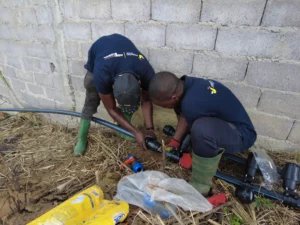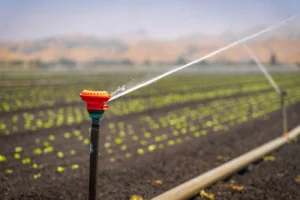
A drip irrigation system delivers water and fertiliser straight to plant roots, drop by drop, through a network of pipes and emitters. For African farmers dealing with erratic rainfall and long dry seasons, it makes year-round production possible instead of farming only in the rainy season. This guide explains how a drip system works, where it fits in the wider picture of irrigation in Africa, which crops suit it best, and how to install one. The observations below draw on the field experience of JOGOO Agriculture, gained on plots ranging from a quarter acre to full commercial blocks.
Need a system sized for your farm? Request a free quote from the JOGOO Agriculture team.

What is a drip irrigation system?
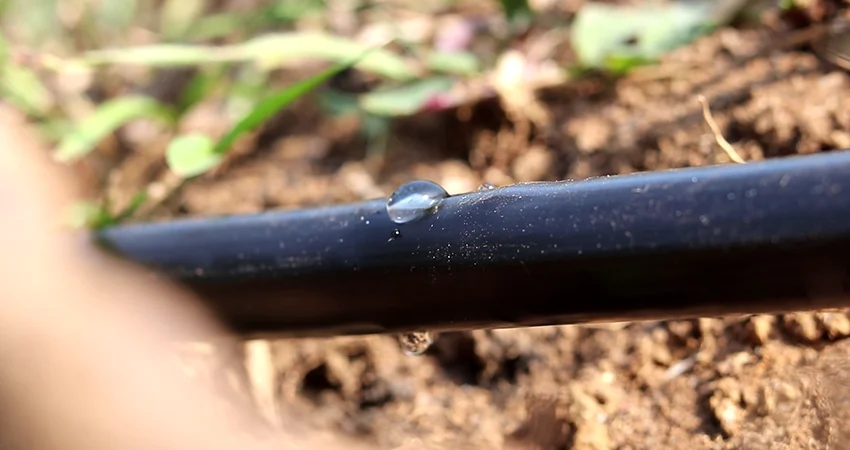
A drip irrigation system works on the wetted bulb principle: it moistens only a small, controlled zone of soil around each plant’s roots instead of soaking the whole field. Water and dissolved nutrients seep slowly out of an emitter, forming a “bulb” of moist soil beneath and around it. Because the rest of the field stays dry, weeds get far less water, evaporation losses fall sharply, and the plant receives a steady supply rather than a cycle of flooding followed by drying out.
That precision makes drip the most water-efficient irrigation method available. Field studies summarised by the Food and Agriculture Organization of the United Nations put the efficiency of drip systems at 80 to 90%, compared with roughly 40 to 60% for surface (flood) irrigation and 70 to 85% for sprinklers (FAO, 2014; Brower et al., 1989). A drip system can use up to 80% less water than flood irrigation for the same crop, and studies in arid regions report water savings of 30 to 60% when farms switch from furrow irrigation to drip (FAO, 2002). That difference matters when boreholes drop in the dry season and reservoirs start shrinking as early as October, as they do in northern Cameroon.
How a drip irrigation system works (step by step)
Following a single drop of water from the source to the root shows how the parts fit together:
-
- Water source. Water is drawn from a borehole, river, dam, reservoir or storage tank.
- Pump, solar pump or gravity head. Water is either pumped (electric, diesel or solar) or simply fed downhill from a raised tank.
- Filter. Water passes through a filter (screen, disc or media) that removes sand, silt and organic matter before they can block the system.
- Main line. Filtered water flows through the main line (usually PVC or HDPE) to the field.
- Sub-main line. The main line branches into sub-mains that run along the edges of the crop blocks.
- Drip line or drip tape. From the sub-mains, drip line or drip tape runs down each crop row.
- Emitter. Emitters, built into or fitted along the drip line, release water at a slow, controlled rate.
- Root zone. Water soaks into the soil and spreads sideways and downwards into the root zone, where the crop takes it up.
Drip vs sprinkler vs flood irrigation
| Criterion | Drip | Sprinkler | Flood |
|---|---|---|---|
| Water efficiency | Highest (80 to 90%) | Medium (70 to 85%) | Lowest (40 to 60%) |
| Upfront cost | Higher | Medium | Low |
| Suitable crops | Vegetables, fruit, row crops | Cereals, pasture | Rice, staple crops on flat land |
| Labour | Low once installed | Medium | High |
| Suitability for dry areas | Excellent | Fair | Poor |
Sources: FAO (2014); Brower et al. (1989); Agriculture Institute (2026).
Where does irrigation stand in Africa? A quick overview.
Before getting into the mechanics of a drip irrigation system, it helps to place irrigation within African agriculture today. It is far less developed than most farmers assume, which is exactly why the room for growth is so large.
Worldwide, about 20% of cropland is irrigated, and it produces close to 40% of the global food supply (FAO, 2015). Sub-Saharan Africa sits at the bottom of the global ranking: only about 4% of cropland receives supplementary water, and some thirty countries, most of them south of the Sahara, have less than 1% of their cropland equipped for irrigation (FAO AQUASTAT, 2025). The World Bank estimates that rain-fed farming still accounts for about 96% of cropland in sub-Saharan Africa (Our World in Data, based on World Bank data).
Table 1: share of cropland under irrigation, by region
| Region | Irrigated share of cropland | Source |
|---|---|---|
| South Asia | ~41% | FAO / NEPAD |
| East and Southeast Asia | ~29% | FAO / NEPAD |
| North Africa | ~28% | IFPRI (2024) |
| Latin America | ~15% | Kandiah (1997) |
| Africa (continental average) | ~7% | FAO / NEPAD |
| Sub-Saharan Africa | ~3.7 to 4% | IFPRI (2024) |
The concentration is striking: about two thirds of the continent’s roughly 13.4 million hectares of irrigation-equipped land lie in just five countries, namely Egypt, Morocco, Sudan, Madagascar and South Africa (IFPRI, 2024). For the rest of the continent, from Cameroon to Ghana and Tanzania, the picture is one of huge untapped potential rather than fields already crowded with drip lines.
The growth of drip irrigation in Africa
Within this under-equipped landscape, drip is the fastest-growing irrigation category. Market analysts value the Middle East and Africa drip irrigation market at about USD 420.8 million in 2024, with a projection of USD 847.3 million by 2030, a compound annual growth rate (CAGR) of 12.6% (Grand View Research, 2025). Mordor Intelligence puts the Africa-specific CAGR at 11.0% through 2031 and describes the continent as the fastest-growing regional drip market in the world (Mordor Intelligence, 2026).
Conditions on the ground back up these market forecasts. Sub-Saharan Africa reportedly added about 58,000 new hectares of drip in 2024 alone, and system components are becoming more affordable as Chinese and Indian manufacturers scale up, with component prices falling by about 12% recently (Market Reports World, 2026; Mordor Intelligence, 2026).
Table 2: snapshot of the Middle East and Africa drip irrigation market
| Indicator | Figure | Source |
|---|---|---|
| MEA drip market size (2024) | USD 420.8 million | Grand View Research (2025) |
| Projected MEA market size (2030) | USD 847.3 million | Grand View Research (2025) |
| Africa market CAGR (2025 to 2031) | 11.0% | Mordor Intelligence (2026) |
| South African drip market (2024) | USD 78.5 million | Grand View Research (2025) |
| New hectares installed in SSA (2024) | ~58,000 ha | Market Reports World (2026) |
| African hectares under drip (recent) | ~310,000 ha | Mordor Intelligence (2026) |
These figures are still modest next to Asia. India alone has more than 4.5 million hectares under drip (Market Reports World, 2026), largely thanks to subsidies covering up to 55% of system cost through the Pradhan Mantri Krishi Sinchayee Yojana programme (Mordor Intelligence, 2026). Adoption in Africa is about closing exactly that gap.
Components of a drip irrigation system
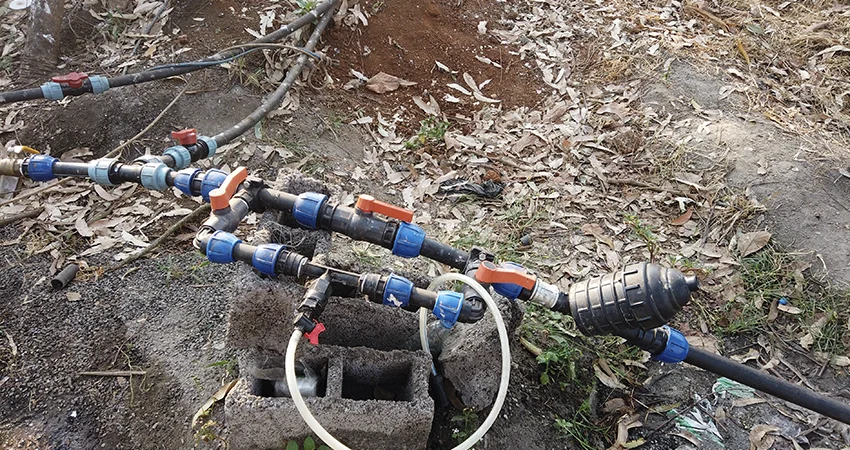
Every drip kit is built from the same basic parts. Here is what each one does and how to choose it for African field conditions:
- Water source. Boreholes, rivers, dams, reservoirs and tanks all work, but muddy surface water needs heavier pre-filtration. Sediment build-up is the leading cause of early system failure.
- Power (solar, gravity or pump). A solar pump feeding a raised tank is usually the cheapest long-term option for off-grid farms. Gravity systems work up to about 25 metres of head; motorised pumps up to about 40 metres.
- Filter. The single most important component for preventing clogging. Never run a system on river, dam or reservoir water without a filter.
- Pressure regulator. Keeps pressure even so that every emitter delivers a similar flow, ideally with less than 10% variation between the first and last emitter.
- Main and sub-main lines. PVC or HDPE pipes that carry water to the field and distribute it to each crop block.
- Drip lines and drip tape. Thin tape (about 0.3 mm) suits short-season, low-budget vegetable crops; thicker drip line (0.4 to 0.8 mm) is the better choice for commercial or multi-year use.
- Emitters. Match the flow rate to the soil type: low flow for clay (which holds water and spreads it sideways), high flow for sandy soil (fast-draining, needing larger doses). Spacing is usually 15, 20 or 30 cm depending on the crop.
- Fittings, valves and end caps. Join pipe sections, let you isolate blocks for maintenance, and allow the system to be flushed periodically.
For drip tape, fittings or spare parts suited to your region, browse the JOGOO Agriculture farm supplies and inputs catalogue.
Solar-powered drip irrigation systems
Most African farms are off the electricity grid, and solar-powered drip irrigation has become the default choice rather than a luxury. Solar panels power a pump that fills a raised tank during the day, then gravity carries the water through the filter and drip lines into the evening.
Compared with a diesel pump, a solar system has no recurring fuel cost, works in remote areas with no access to fuel, and costs far less to run. Nairobi-based SunCulture says it serves more than 60,000 customers and holds over 70% of the sub-Saharan solar irrigation market, and monitoring data from a Kenyan project covering 10,815 installed systems show that 87% of farmers reported higher savings and 90% reported higher output after switching to solar (Shell Foundation, 2026; Climate Impact Partners, n.d.).
The main cost is upfront: panels, pump and tank. Two set-ups dominate. Direct-pumping systems only run while the sun is shining, so tank capacity limits how much water is stored. Battery systems store electricity so the pump can run on demand, at night or in cloudy weather, at a higher upfront cost.
Is solar drip irrigation worth the investment in Africa?
Yes, for most off-grid farms. A solar drip system removes the recurring cost of diesel, runs reliably where there is no grid power, and pairs naturally with a raised tank for gravity-fed watering. The higher upfront cost is usually recovered within two to four years through fuel savings, extra growing seasons and better yields.
JOGOO Agriculture designs and installs solar, gravity-fed or motorised irrigation and pumping solutions matched to your water source and your plot.
Benefits for African farms
- Up to 80% less water used compared with flood irrigation (Climate Impact Partners, n.d.; FAO, 2014). A decisive advantage when a borehole or reservoir is the only source available in the dry season.
- Substantial gains in yield and income. SunCulture in Kenya has documented income increases of more than 400% among smallholders moving from rain-fed farming or hand watering to solar drip (Nordic Development Fund, 2021).
- Year-round cropping. Two to three planting cycles a year instead of a single rainy season, which smooths out income.
- Fertigation. Liquid fertiliser delivered straight to the root zone through the drip lines cuts waste and labour, and can reduce fertiliser use by about 40% without hurting yields (Agriculture Institute, 2026). Explore JOGOO’s fertilisation and plant nutrition solutions to go further.
- Fewer weeds and diseases. Dry strips between rows starve weed seeds of water and reduce the humidity that favours fungal diseases.
- Less labour. No more daily hand watering or moving hoses once the system is in place.
- Works with lower-quality water. With proper filtration, drip can use sources that would block sprinkler nozzles.
Drawbacks and common problems (with solutions)
Drip irrigation is not perfect, and an honest look at its limits helps farmers prepare for them:
- Clogged emitters. Cause: sediment, algae or mineral deposits in the water. Solution: fit a suitable filter at the head of the system and flush the lines on a regular schedule (see Maintenance below).
- High upfront cost. Cause: pipes, drip tape, filters and, where needed, solar equipment are a bigger investment than a simple garden hose. Solution: the cost is usually recovered within 2 to 4 years through savings on water and labour and higher yields. Studies suggest that about 23% of installed systems underperform or are abandoned within the first three years, often for lack of technical support, which is why maintenance should be budgeted from the start (Market Reports World, 2026). Support from agricultural consulting and engineering helps avoid that risk at the design stage.
- Damage from rodents and field work. Cause: rats chew through drip tape, and tractor or hoe work can cut the lines. Solution: keep lines away from field margins where rodents nest, and train workers to spot buried or surface lines during weeding and tillage.
- Plastic waste from drip tape. Cause: thin tape is often single-use and ends up discarded. Solution: choose thicker drip line that can be reused over several seasons when the budget allows, and collect used tape for recycling where collection schemes exist.
- Poor design leading to uneven watering. Cause: undersized main and sub-main lines, or lines laid across the slope rather than along the contours. Solution: design the layout (and pipe diameters) around the specific slope and length of the field, and use pressure regulators to even out flow on long runs.
Cost considerations for a drip irrigation system in Africa
The upfront cost of a drip irrigation system depends on four main variables: field size, the number of drip lines per bed (higher for closely spaced crops), the water source and pumping method (gravity, diesel or solar), and whether the system is a ready-made kit or assembled from separate components. Market studies put the global average cost per hectare at USD 1,200 to 2,800 in recent years, although the figure varies widely with terrain and system complexity (Market Reports World, 2026).
For African smallholders, that figure can look daunting. For many households it equals more than 15 months of net income, which explains why 68% of Latin American farmers surveyed cite high upfront cost as the main barrier to adopting drip (Market Reports World, 2026). Development finance has stepped in to close the gap: the Green Climate Fund has backed solar drip installations across the Sahel, the Adaptation Fund co-finances precision irrigation in southern Africa, and “pay-as-you-grow” credit models have put these systems within reach of households with no starting capital (Mordor Intelligence, 2026; Nordic Development Fund, 2021).
For an accurate quote in your local currency (KES, NGN, TZS, UGX, GHS, XAF, ZMW), contact JOGOO Agriculture: the team will size a system for your acreage, crop rotation and water source rather than relying on generic regional averages.
DIY kits and prices for small plots
For farmers starting on a smaller scale, quarter-acre drip kits are widely available as complete packs (drip tape, fittings, a basic filter and connectors) and cost a fraction of a full one-acre installation. Basic DIY kits, where the farmer sources the components separately, can work out cheaper than a ready-made kit but take more know-how to assemble correctly. You will find the full range on the JOGOO Agriculture farm supplies and inputs page.
Return on investment and payback
For a typical vegetable bed fitted with a two-line system, three factors determine the payback period:
- Water and fuel savings. Switching from furrow irrigation to drip typically cuts water use by 50 to 80%, which translates directly into fewer pumping hours and lower fuel or electricity costs across both seasons of the year (FAO, 2014).
- Yield gains. Vegetable yields under drip with fertigation are generally well above those from rain-fed or furrow-irrigated production. Kenyan monitoring data show that 90% of solar drip adopters report higher output (Climate Impact Partners, n.d.).
- An extra season. Because the system does not depend on the rainfall calendar, a second planting becomes possible within the year on land that previously gave only one rain-fed harvest.
Overall, a correctly sized drip system on a family farm plot typically pays for itself in 2 to 4 years, before even counting the cumulative effect of higher yields in each following season.
How to install a drip irrigation system
- Assess your water source and its quality. Check the flow rate and test the water for sediment. Surface water from rivers, dams or reservoirs will need more thorough filtration than borehole water.
- Test your soil with a simple jar test. Fill a clear jar with soil and water, shake it and let it settle. The layers that form will give you a rough sand/silt/clay ratio, which determines your choice of emitters and how often to water.
- Divide your field into blocks. Split the plot into manageable crop blocks based on crop type, slope and the reach of your main line.
- Lay the main line, sub-mains and laterals along the contours. Running pipes along the slope (not across it) keeps pressure even and prevents water from pooling.
- Install the filter, pressure regulator and valves at the head of the system, before water enters the main line.
- Place emitters at the spacing that suits your crop (see the crop-by-crop guidance in the next section).
- Flush the system and test the pressure before planting. Run water through every line to clear debris and check that pressure and flow are even from the first emitter to the last.
Tools and materials checklist:
- PVC or HDPE pipe (main and sub-main lines)
- Drip tape or drip line with suitable emitter spacing
- Filter (screen or disc)
- Pressure regulator
- Connectors, tees, elbows, end caps and valves
- Pipe cutter and glue or solvent (for PVC joints)
- Tape measure and stakes for marking out blocks and rows
- Jar (for the soil settling test)
Would you rather leave the sizing to experts? JOGOO’s agricultural consulting and engineering team carries out the full study, from equipment selection to the installation plan.
Drip irrigation by crop
Each crop calls for a different emitter spacing and number of drip lines per bed. As a rule of thumb from field practice, closely planted leafy crops such as kale (sukuma wiki) and onion do well with three or four drip lines per bed and tighter emitter spacing (about 15 cm), so the whole bed sits within a shared wetted bulb. Tomato, sweet pepper and green beans usually work with two drip lines per bed at 20 to 30 cm spacing, matching the spread of a mature root system. Widely spaced crops such as watermelon and butternut squash generally need only one drip line per bed at 30 cm spacing.
Sample irrigation schedule (JOGOO field experience). As a starting point, irrigate each block for 20 to 30 minutes for leafy crops such as kale and onion, and 30 to 40 minutes for fruiting crops such as tomato and watermelon, adjusting upwards during hot, dry weeks and downwards during light rain. Always check soil moisture at root level rather than relying on the clock alone. This schedule is a starting point, not a fixed rule.
Maintenance and troubleshooting
- Every week. Flush the main and sub-main lines by briefly opening the end caps, and clean or backwash the filter. Walk the lines and check for clogged emitters. A dry patch under an emitter that should be wet is usually the first warning sign.
- As needed. Repair leaks at joints and punctures promptly. A small leak near the head of the system can starve emitters further down the line.
- End of season or off-season. Drain, clean and store drip tape out of direct sunlight to extend its life until the next planting.
FAQ
How does a drip irrigation system work?
A drip irrigation system pumps or gravity-feeds water through a filter into main and sub-main lines, then into drip lines laid along the crop rows. Emitters spaced along the drip line release water slowly and directly at each plant’s root zone, keeping the soil moist around the roots while the rest of the field stays dry, which saves water and reduces weed growth.
How popular is drip irrigation in Africa?
Drip is the fastest-growing irrigation category on the continent, with projected expansion of 11 to 12.6% a year through 2030 to 2031 for the Middle East and Africa region (Grand View Research, 2025; Mordor Intelligence, 2026). Sub-Saharan Africa added about 58,000 new hectares of drip in 2024 alone, although total coverage still lags far behind Asia (Market Reports World, 2026).
Is drip irrigation better than sprinkler irrigation?
For most African smallholder crops (vegetables, fruit and row crops), drip irrigation is more water-efficient than sprinklers, typically reaching 80 to 90% efficiency against 70 to 85% for sprinklers (FAO, 2014). Sprinklers remain a sensible choice for cereals or pasture grown over large areas, where row-by-row drip installation is less practical.
Can a drip system run on solar power or by gravity without a pump?
Yes. A gravity drip system works without any pump if the water source or storage tank sits high enough above the field, typically up to about 25 metres of elevation. Solar systems use a solar pump to lift water into a raised tank during the day, which then feeds the drip lines by gravity, making both options workable for off-grid farms.
How long does drip tape last?
Thin drip tape (about 0.3 mm) is generally treated as a single-use product and may need replacing every year, especially where rodents or field work damage it. Thicker drip line (0.4 to 0.8 mm), used for commercial and long-term installations, can last several seasons with proper end-of-season storage and care.
What are the best crops for drip irrigation?
High-value vegetables and fruit respond best to drip irrigation, including tomato, onion, sweet pepper, kale (sukuma wiki), watermelon and green beans. Drip is also used effectively on maize, particularly where water is limited, although cereals grown at scale are sometimes irrigated by sprinkler because of their lower value per row.
How do I prevent emitters from clogging?
Fit a suitable filter at the head of the system. This is the single most effective step, especially when water comes from sediment-laden rivers, dams or reservoirs. Flush the main line, sub-mains and drip lines on a weekly schedule by opening the end caps, and clean or backwash the filter regularly to stop build-up before it reaches the emitters.
Take the next step
Ready to size a drip irrigation system for your farm? Request free system sizing and a quote from JOGOO Agriculture. Our field team will recommend the right layout, the number of drip lines per bed and the power option (solar, gravity or pump) for your crop, water source and acreage. You can also explore our turnkey farm projects and real-world examples in our projects section, or browse all our solutions.
References
- Agriculture Institute (2026). Comparing Different Irrigation Methods for Optimal Water Use.
- Brower, C., Prins, K., and Heibloem, M. (1989). Irrigation Water Management: Irrigation Scheduling. FAO Training Manual 4. Rome: Food and Agriculture Organization of the United Nations.
- Climate Impact Partners (n.d.). Solar Irrigation for Smallholder Farmers, Kenya.
- FAO (2002). Improving Irrigated Production Using Water-Saving Technologies. Rome: Food and Agriculture Organization of the United Nations.
- FAO (2014). AQUASTAT Global Irrigation Efficiency Estimates. Rome: Food and Agriculture Organization of the United Nations.
- FAO / NEPAD (2015). Comprehensive Africa Agriculture Development Programme: Regional Irrigation Coverage Statistics. Rome: Food and Agriculture Organization of the United Nations.
- FAO AQUASTAT (2025). Water Data Snapshot. Reported by UN News, December 2025.
- Grand View Research (2025). Middle East & Africa Drip Irrigation Market Size and Outlook, 2024-2030.
- IFPRI (2024). Irrigating Africa. Washington, DC: International Food Policy Research Institute.
- Kandiah, A. (1997). Summary of Findings of Missions in Selected Countries in East and Southern Africa. Rome: FAO.
- Market Reports World (2026). Drip Irrigation Market Size and Insights Report.
- Mordor Intelligence (2026). Africa Agricultural Irrigation Machinery Market.
- Mordor Intelligence (2026). Drip Irrigation Market Report.
- Nordic Development Fund (2021). Solar Irrigation for Smallholder Farmers Scaled Up with Debt Financing.
- Our World in Data (n.d.). Share of Agricultural Land Which Is Irrigated. Based on World Bank data.
- Shell Foundation (2026). Solar Irrigation in Kenya: Transforming Smallholder Farming.
- UN News (2025). UN Sounds Alarm Over Rising Demands on Water Resources as Scarcity Increases.
Further reading
- Melon growing technical guide: a crop where water management late in the cycle directly decides sugar content.
- Tomato growing: crop management guide: why keeping foliage dry changes late blight pressure, and how to plan fertigation around it.