
Download the technical sheet (PDF)
This technical guide sets out the complete crop management for chilli pepper (Capsicum spp.) in tropical Africa: a nursery of 25 to 35 days, a density of 20,000 to 25,000 plants per hectare, first harvest 70 to 90 days after transplanting and production spread over 4 to 6 months, for a yield of 8 to 20 tonnes of fresh peppers per hectare.
Technical guide at a glance
| Parameter | Reference value |
|---|---|
| Nursery duration | 25 to 35 days |
| Transplanting stage | 4 to 6 true leaves, 12 to 15 cm |
| Spacing | 0.8 m between rows, 0.5 m within the row |
| Density | 20,000 to 25,000 plants/ha |
| First harvest | 70 to 90 days after transplanting |
| Harvest period | 4 to 6 months |
| Soil pH | 5.5 to 6.8 |
| Yield | 8 to 20 t/ha fresh |
Choosing the plot
Chilli pepper needs loose, deep soil that is rich in organic matter and well drained. Waterlogging, even briefly, causes root rots that doom the plot. On flat land in high-rainfall areas, growing on raised beds of 20 to 30 cm is strongly recommended.
Keep a rotation of at least 3 years without any solanaceous crop: no tomato, eggplant, potato or pepper. These crops share the same soil-borne pests and diseases, particularly bacterial wilts and nematodes, which build up quickly.
Nursery
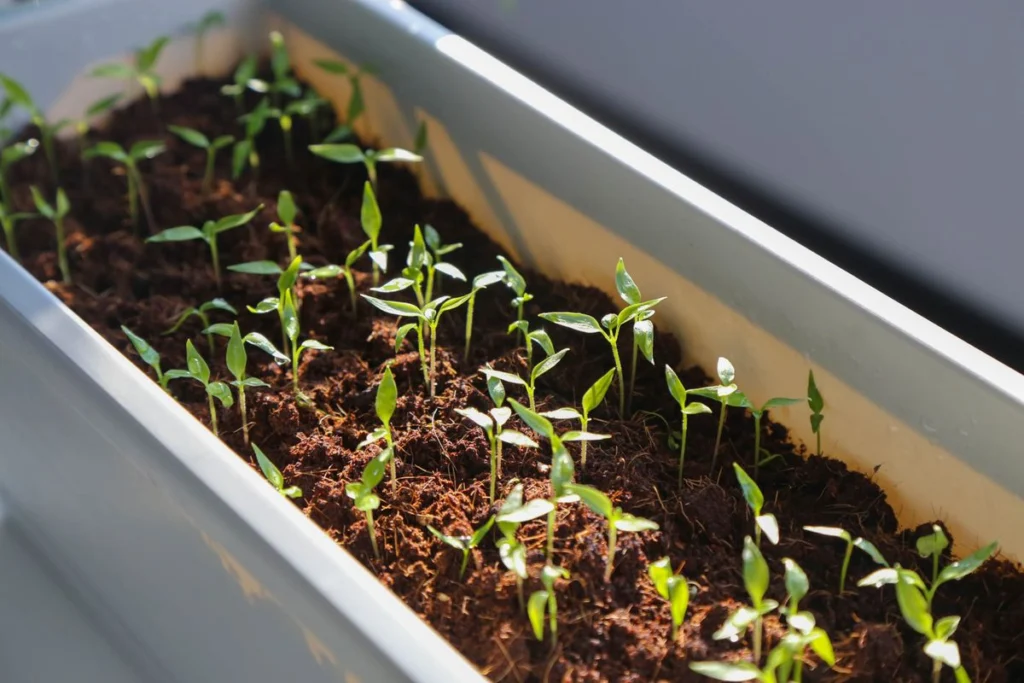
Set up the nursery on a raised bed, protected from direct sun by light shade netting, or in seedling trays for better disease control. Sow in rows 10 cm apart, at shallow depth, then cover lightly.
Emergence takes 7 to 12 days. Gradually reduce shade and watering during the last week to harden off the seedlings before transplanting. A hardened seedling establishes much better and withstands transplant shock.
Damping-off is the main risk at this stage. It is prevented with a clean substrate, a reasonable sowing density and measured watering, never by curative treatment after the fact.
Transplanting
Transplant at 4 to 6 true leaves, that is 25 to 35 days after sowing. Work late in the day, water the nursery thoroughly an hour before lifting to protect the roots, then set the plants at 0.8 m between rows and 0.5 m within the row.
This density of 20,000 to 25,000 plants per hectare balances production with canopy ventilation. A denser stand automatically increases fungal pressure and complicates harvesting, which is manual and repeated.
Fertilisation
Chilli pepper is a long-duration crop that removes a lot of nutrients. An organic basal dressing of 15 to 25 tonnes of well-rotted manure per hectare forms the foundation. Mineral fertiliser is split: a balanced basal dressing at planting, then top-dressings at establishment, at flowering and during the harvest period.
Potassium and calcium deserve particular attention. Calcium deficiency, often made worse by irregular irrigation, causes blossom end rot, the black drying at the tip of the fruit that downgrades the harvest. See our fertilisation and plant nutrition services.
Irrigation and maintenance
Regularity matters more than volume. Alternating drought and excess water causes flower drop and blossom end rot. Drip irrigation combined with mulching gives the best results and keeps the foliage dry.
Plan two to three weedings before the canopy closes, along with light earthing up to improve anchorage of fruit-laden plants. On tall-growing varieties, simple staking prevents lodging at the end of the cycle.
Pests and diseases
Thrips and mites cause leaf distortion and transmit viruses. Aphids and whiteflies are also vectors. Anthracnose, managed on the same principles as tomato late blight, marks the fruit with sunken circular lesions, especially in the wet season and on ripe fruit left too long on the plant.
Weekly scouting, regular harvesting of ripe fruit, removal of affected fruit from the plot and strict rotation form the backbone of control. See our crop protection solutions.
Harvest
The first harvest comes 70 to 90 days after transplanting. Peppers are then picked every 5 to 7 days for 4 to 6 months. This regularity is not a matter of convenience: leaving fruit to ripen on the plant slows the formation of new flowers and lowers cumulative yield.
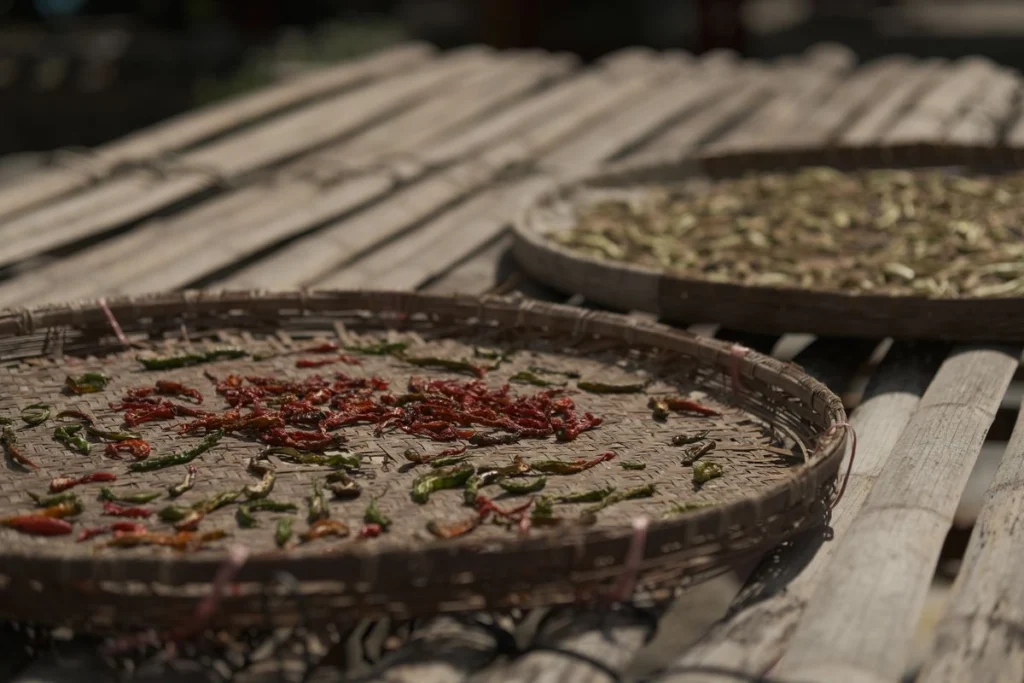
Cut the stalk with secateurs rather than pulling the fruit, which injures the plant. For drying, spread the peppers in a thin layer on ventilated racks, off the ground and sheltered from rain.
Frequently asked questions
How long does a chilli pepper crop take?
About one month in the nursery, then 70 to 90 days to first harvest, and a production period of 4 to 6 months. The full cycle therefore runs 7 to 9 months.
How many chilli pepper plants per hectare?
20,000 to 25,000 plants, that is 0.8 metre between rows and 0.5 metre within the row.
What yield can you expect from a hectare of chilli pepper?
8 to 20 tonnes of fresh peppers per hectare depending on variety, fertilisation and harvest regularity. A source-by-source breakdown, with costs and gross margin, is in our analysis of chilli pepper yield per hectare.
Why are my peppers turning black at the tip?
This is blossom end rot, linked to a shortage of available calcium and almost always made worse by irregular irrigation. The first step to correct it is regular watering.
Growing chilli pepper for an organised market? We support variety choice, irrigation and disease management. Discover our agricultural consulting.
Related articles

Get the full guide offline. Enter your details below.