
Download the technical sheet (PDF)
This technical sheet sets out the complete crop management sequence for melon (Cucumis melo) under tropical conditions: a cycle of 75 to 110 days, a density of 8,000 to 12,000 plants per hectare and a yield of 15 to 30 tonnes per hectare. Melon is a short-cycle, high-value crop, but it needs plenty of water and is susceptible to fungal diseases, which makes it a crop for skilled growers rather than beginners.
Technical sheet at a glance
| Parameter | Reference value |
|---|---|
| Total cycle | 75 to 110 days |
| Optimum temperature | 25 to 30 °C |
| Soil pH | 6.0 to 6.8 |
| Nursery period | 15 to 20 days |
| Spacing | 2 m between rows, 0.5 to 0.8 m within the row |
| Density | 8,000 to 12,000 plants/ha |
| Water requirement | 400 to 600 mm over the cycle |
| Yield | 15 to 30 t/ha |
Soil and land preparation
Melon needs a light, deep soil that is rich in organic matter and, above all, perfectly drained. It tolerates neither waterlogging nor acid soils. On heavy soils, growing on ridges or raised beds is essential.
Plough to 30 cm, work in 20 to 30 tonnes of well-rotted manure per hectare, then refine the tilth. Melon should return to the same plot no more often than every 3 to 4 years, and never after another cucurbit, because of the soil-borne diseases they share.
Sowing and nursery
There are two options. Direct sowing, at 2 to 3 seeds per planting hole followed by thinning, suits large areas. Transplanting from a nursery in pots gives a more even stand, saves seed and shortens the time the crop occupies the field.
In the nursery, seedlings are ready to transplant at 15 to 20 days, at the 2 to 3 true leaf stage. Beyond that, establishment is poor because melon does not tolerate root disturbance well. Transplant late in the day and water immediately.
Irrigation
Drip irrigation is the reference solution. It keeps moisture constant in the root zone, avoids wetting the foliage (which greatly limits fungal diseases) and makes fertigation possible.
Water demand peaks during flowering and fruit enlargement. However, irrigation must be cut back sharply 7 to 10 days before harvest: excess water at the end of the cycle dilutes the sugars and gives bland melons that cannot be sold into quality markets. Our irrigation and pumping solutions cover the design of these systems.
Fertilization
Melon responds well to a basal organic dressing supplemented by split applications. The standard approach favours nitrogen during vegetative growth, then switches to potassium from fruit set, since potassium governs fruit size and above all sugar content.
Applications should be based on a soil analysis, using our NPK fertilizer guide. See our fertilization and plant nutrition services.

Crop management
Mulching, with plastic or plant material, brings a clear gain on this crop: it limits evaporation, controls weeds and above all keeps the fruit off damp soil, preventing contact rots. On melon, it is one of the most profitable operations.
Pruning, used in intensive production, consists of pinching the main stem to encourage the secondary branches that carry the female flowers. Thinning to 4 to 6 fruits per plant improves fruit size and the uniformity of the batch.
Pollination is carried out by insects. Any insecticide application during flowering should be avoided or moved to late in the day, otherwise fruit set will suffer.
Diseases and pests
Powdery mildew, a white felt on the leaves, is the most persistent disease in the hot dry season. Downy mildew and fusarium wilt spread in humid conditions, following the same pattern as late blight of tomato in tropical climates. Fruit flies, aphids and whiteflies, the last of these being virus vectors, complete the picture.
Prevention comes before cure: long rotation, tolerant varieties, sensible density to keep the canopy open, drip irrigation and weekly scouting. See our crop protection solutions.
Harvest
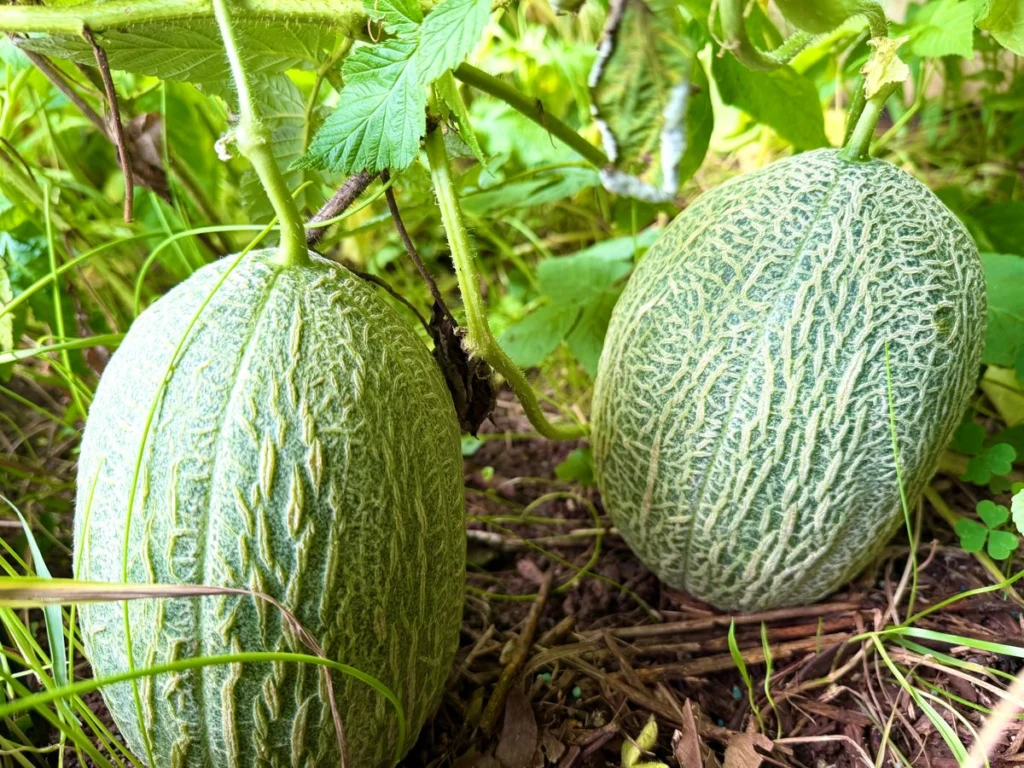
Harvest begins 75 to 110 days after sowing depending on the variety. The signs of ripeness are a change in background colour, a circular crack appearing where the stalk joins the fruit, and the characteristic aroma.
Melon does not gain sugar after it is cut. Harvesting too early permanently ruins the eating quality of the batch. Pick every 2 days at peak season and harvest in the cool of early morning.
Frequently asked questions
How long is the melon growing cycle?
From 75 to 110 days between sowing and the last harvest, depending on the variety and temperature.
What planting density should be used for melon?
From 8,000 to 12,000 plants per hectare, that is 2 metres between rows and 0.5 to 0.8 metre within the row.
What yield can be expected from one hectare of melon?
From 15 to 30 tonnes per hectare depending on the variety, irrigation management and disease control.
Why are my melons not sweet enough?
The two most common causes are over-irrigation in the ten days before harvest and harvesting too early. Melon stops accumulating sugar once it is detached from the plant.
Setting up a commercial vegetable project? Our engineers design the irrigation, fertilization and cropping calendar. Contact our teams.
Further reading
- Watermelon farming: sowing, irrigation and yield per hectare: melon’s close cucurbit relative, with its FAO water requirements and gross margin per hectare.
Related articles

Get the full guide offline. Enter your details below.