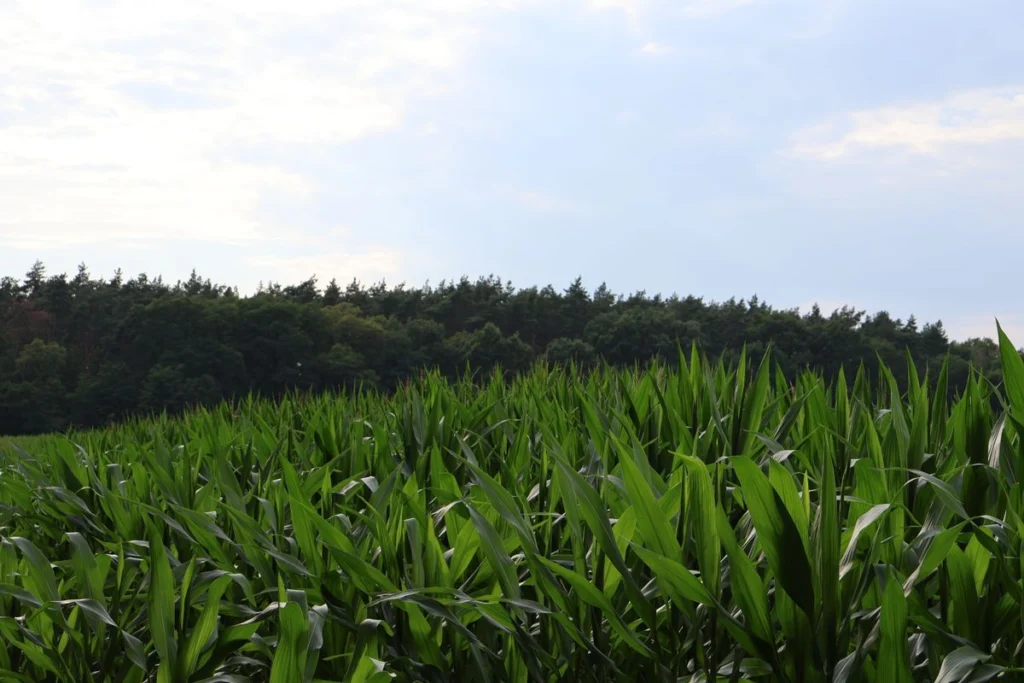
Since it was first detected in West Africa in 2016, the fall armyworm, Spodoptera frugiperda (FAW), has spread to more than 80 countries across Africa, Asia and Oceania. In Africa it attacks mainly maize, but its recorded host range exceeds 350 plant species. It is now the leading biotic threat to African maize, ahead of the long-established stem borers.
The mass response that followed its arrival, repeated spraying of broad-spectrum insecticides, had two serious side effects: rapid development of resistance in the pest, and the loss of natural enemies that kept other pest populations in check. This guide sets out an integrated pest management (IPM) plan endorsed by FAO, IITA and West African research stations, adapted to production systems in Cameroon, Senegal and Côte d’Ivoire.
Biology: what matters for effective control
Understanding the pest’s life cycle lets you act at the right moment with the right tool, and avoid costly, ineffective treatments.
Development cycle in a tropical climate:
- Egg: laid in masses of 100 to 200 on the underside of young leaves, often deep in the whorl. Hatching takes 2 to 3 days.
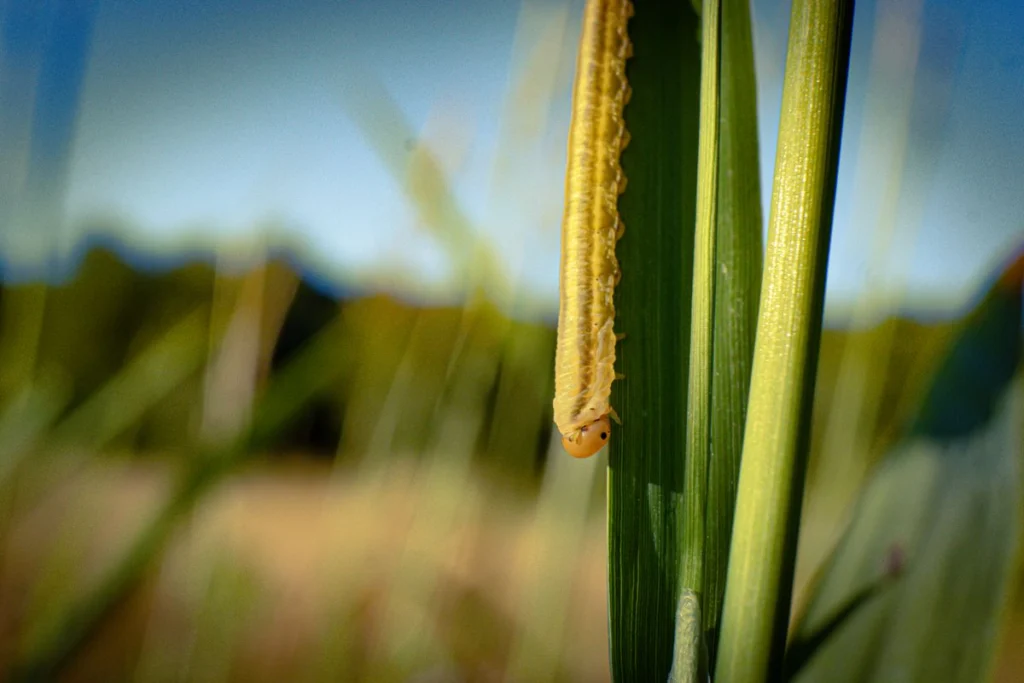
- Larva (caterpillar): 6 instars over about 14 to 22 days. This is the stage that causes the damage. Young larvae (L1 to L3) are vulnerable to treatment; older larvae (L4 to L6) retreat deep into the whorl and become hard to reach.
- Pupa: in the soil, 2 to 8 cm deep, for 7 to 13 days.
- Adult (moth): lives 10 to 14 days. Only the male can be caught in pheromone traps. A female lays 1,500 to 2,000 eggs over several batches.
Total cycle: 30 to 40 days in the humid tropics. That allows 3 to 6 generations per maize crop cycle, which is why the “one spray per season” approach has to go.
Two strains coexist: the “corn” strain (C-strain), which prefers maize, sorghum and cotton, and the more versatile “rice” strain (R-strain). This explains why the same field can be reinfested from different sources.
Flight: moths can travel 100 km in a night on the wind. Control by individual farmers alone is bound to fail without an area-wide strategy.
Symptoms and diagnosis: identify before you treat
On young maize (V3 to V8):
- Small round or elongated holes in regular rows on newly unrolled leaves (“windowpane” pattern).
- Granular droppings (frass) piled up in the whorl, a very distinctive sign.
- Ragged whorl, with central leaves holed and shrivelled.
On maize at whorl stage (V8 to VT):
- Large, irregular holes in the leaves, with damage concentrated in the centre.
- Larva visible when the whorl is opened: brownish-green body with three white longitudinal lines along the back and a white inverted Y on the front of the head (diagnostic).
On cobs (R1 to R3):
- Caterpillar entering the developing cob through the silk or the tip. Missing kernels or kernels fouled with frass. Direct loss of marketable yield.
Do not confuse with:
- Stem borers (Sesamia calamistis, Busseola fusca): tunnels in the stem, not in the whorl.
- African armyworm (Spodoptera exempta): massive gatherings in bands, usually more sporadic.
- Grasshoppers: damage along the leaf edge, no frass in the centre.
Integrated pest management plan: four pillars, in this order
The IPM (Integrated Pest Management) approach recommended by FAO and IITA rests on one cardinal principle: chemical control is never the first reflex, but the last resort. Here is the working hierarchy.
Pillar 1, Agronomic prevention
- Choose a tolerant or resistant cultivar. Since 2019, CIMMYT and IITA have been releasing maize hybrids with native tolerance to S. frugiperda, developed from resistant germplasm from the Mexican programme.
- Plant early, with the first effective rains. Late planting coincides with peak pest populations.
- Plant together (a whole village in the same window). Staggered planting keeps food continuously available to the pest.
- Rotate with legumes (groundnut, cowpea, soybean) or non-host root and tuber crops. Avoid continuous maize and sorghum monocropping.
- Intercrop with repellent crops. Trials in East Africa of the push-pull system (maize intercropped with Desmodium as a trap crop between rows, with Brachiaria on the borders to attract females) show notable reductions in infestation. It can be adapted to sub-humid zones.
- Residue management: plough in deeply or burn the previous season’s residues to destroy overwintering pupae.
Pillar 2, Monitoring and decision thresholds
Pheromone trapping: the standard tool for early detection of adult flights.
- Density: 1 trap per 0.5 to 2 hectares. Place one trap in the centre of the field and a second on the edge.
- Height: 1.5 metres above the ground, raised above the canopy as the season progresses.
- Lure (reference blend, Russell IPM): Z9-14Ac (81.7%), Z11-16Ac (17.5%), Z7-12Ac (0.5%), Z9-12Ac (0.25%). Replace every 3 to 6 weeks.
- Checking frequency: weekly.
Field scouting: at least two visits a week from planting to VT (before tasselling).
- Inspect 20 plants in each of 5 zones (100 plants in total), walking a W pattern.
- Count plants with fresh whorl damage, frass, or visible larvae.
Indicative action threshold (FAO / CGIAR):
- V3 to V6 (young plant): 20% of plants with fresh whorl damage → act.
- V7 to V8 (whorl): 20 to 40% depending on context.
- R1 to R3 (cob formation): lower threshold, because the loss is directly measurable.
Pillar 3, Biocontrol
Once the threshold is crossed, favour biological options before synthetic insecticides. Two options are available in Africa:
- Bacillus thuringiensis (Bt) var. kurstaki: an entomopathogenic bacterium applied as a spray. Toxic only to lepidopteran larvae. Target instars L1 to L3; it does not work on older larvae. Apply in the evening (UV breaks it down). Repeat every 5 to 7 days under heavy pressure. Approved for organic farming.
- Azadirachtin (neem oil): an extract of Azadirachta indica. Antifeedant, growth regulator and partial ovicide. Typical concentration 1,500 to 3,000 ppm. Apply preventively as soon as the first egg masses appear.
- Entomopathogenic fungi (Metarhizium anisopliae, Beauveria bassiana): useful in intensive production systems, but less available through mainstream African retail channels.
Pillar 4, Judicious chemical control
When biocontrol is not enough and the threshold is crossed, insecticide treatment remains an option, provided products are registered, active ingredients are rotated and label instructions are strictly followed.
Active ingredients most widely used in Africa against S. frugiperda:
- Emamectin benzoate (spinosyns): very effective on larvae, rate 10 to 15 g a.i./ha, pre-harvest interval generally 7 to 14 days.
- Chlorantraniliprole (diamides): a different mode of action, very useful for rotation.
- Spinetoram / Spinosad: fermentation-derived biocides with low impact on beneficial insects.
Anti-resistance rotation rules:
- Never apply the same chemical family twice in a row.
- Do not exceed 2 to 3 applications of the same active ingredient per season.
- Always alternate a systemic active ingredient with a contact one.
- Target early larval instars (L1 to L3); beyond that, efficacy drops and costs soar.
Safety: full personal protective equipment (coveralls, gloves, mask, goggles), spray in the evening, and no treatment at full tasselling (to protect pollinators around the field).
For a crop protection plan tailored to your crop and built on locally registered products, our crop protection team and our agricultural consulting and engineering unit offer diagnostics and customised programmes.
FAO’s community-based FAMEWS system
Finally, note the FAMEWS app (Fall Armyworm Monitoring and Early Warning System), developed by FAO and already deployed in East Africa through the CBFAMFEW programme. Community Focal Persons collect field data (trapped adults, damage, practices). The system provides early warnings and near real-time mapping of populations. It is gradually being extended to Central and West Africa.
Integrating this kind of system across a production basin is a major competitive advantage for large farms and well-organised cooperatives, and it is part of our turnkey agricultural projects offer.
Operational summary
A grower who puts the following package in place keeps losses below 15% even in a high-pressure year:
- Tolerant hybrid seed, planted early and in sync with neighbours.
- Rotation with a legume from one cycle to the next.
- Pheromone trapping from emergence, scouting twice a week.
- Threshold-based decisions; first response = Bt + neem.
- Synthetic insecticide as a last resort, rotating families and respecting rates and pre-harvest intervals.
- Ploughing in residues after harvest.
By contrast, a farm that sprays on a fixed calendar without monitoring will see its crop protection costs soar and its FAW populations become resistant within 3 to 4 seasons.
Sources and references
- FAO. Integrated management of the Fall Armyworm on maize.
- Kansiime, M. K. et al. (2021). Bioecology of fall armyworm Spodoptera frugiperda in Africa. PLOS One.
- Prasanna, B. M. et al. (2022). Host plant resistance for fall armyworm management in maize. CIMMYT / IITA.
- Ouedraogo, N. et al. (2025). Development of viable IPM strategies to control fall armyworm on maize. Crop Protection.
- Kumar, R. M. et al. (2024). Evaluation of farmers friendly IPM modules for management of fall armyworm. Heliyon.
Article written by the JOGOO Agriculture agronomy team. Crop protection recommendations must be adapted to the products registered in your country.
Frequently asked questions
What is the fall armyworm?
The fall armyworm (Spodoptera frugiperda) is a lepidopteran pest native to the Americas, first detected in West Africa in 2016. It is now present in more than 80 countries and is the leading biotic threat to African maize. A female lays 1,500 to 2,000 eggs and the full cycle takes 30 to 40 days in a tropical climate.
How do I recognise Spodoptera frugiperda damage on maize?
Typical fall armyworm damage on young maize is small round or elongated holes in regular rows on newly unrolled leaves (windowpane damage), granular droppings piled up in the whorl and a ragged whorl. Deep in the whorl you will find the larva: a brownish-green body with three white longitudinal lines along the back and a white inverted Y on the front of the head.
How do I control fall armyworm in maize?
Fall armyworm control relies on a four-pillar IPM strategy applied in this order: agronomic prevention, monitoring with pheromone traps and scouting, biocontrol (Bacillus thuringiensis, azadirachtin, entomopathogenic fungi), and chemical control as a last resort (emamectin benzoate, chlorantraniliprole) with rotation of active ingredients.
Is Bacillus thuringiensis effective against fall armyworm?
Yes, Bacillus thuringiensis var. kurstaki is effective against fall armyworm, but only on early larval instars L1 to L3. It does not work on older L4 to L6 larvae, which retreat deep into the whorl. Bt is applied in the evening (UV breaks it down) and repeated every 5 to 7 days under heavy pressure. It is approved for organic farming.
Further reading
- The stages of maize cultivation: where whorl monitoring fits into the full crop programme, from planting to harvest.