The integrated management guide published by FAO in 2018 states a sentence that most failed sprays ignore: the insecticide has to reach the larva inside the whorl, and spraying with a backpack sprayer without delivering the mix into the whorl is often ineffective. That is where this article starts. Controlling the fall armyworm, Spodoptera frugiperda, is not a matter of picking a product. It is a matter of scouting at the right rhythm, deciding on a measured threshold, then placing the spray in the right place, at the right crop stage, with a sprayer set up for the job. Below you will find the pest cycle, the scouting method, the thresholds by maize growth stage, and how to run the spray.
The pest cycle sets the intervention calendar
The durations below are those of the FAO 2018 guide on integrated management of fall armyworm on maize for Farmer Field Schools in Africa.
- Egg: hatching in 2 to 3 days.
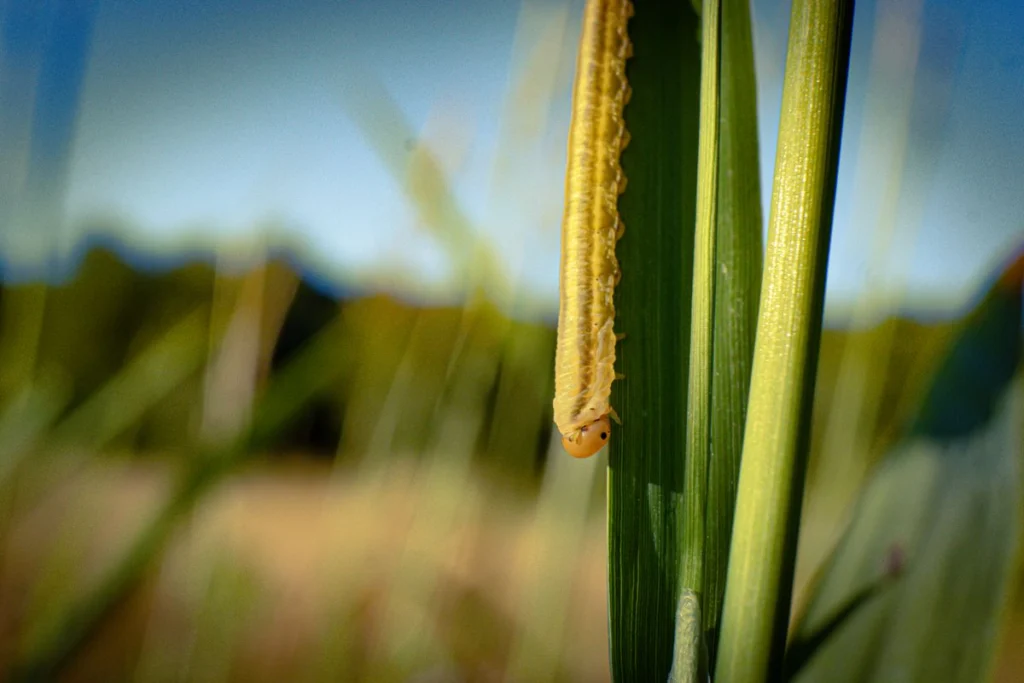
- Larva: 6 larval stages, spread over 12 to 20 days depending on temperature and conditions. This is the stage that causes the damage, and the only one a spray can reach.
- Pupa: 12 to 14 days before the adult emerges.
- Adult: the moth lives 2 to 3 weeks.
Still according to FAO, under warm conditions a female lays 6 to 10 egg masses of 100 to 300 eggs each, for a maximum of 1 500 to 2 000 eggs in her lifetime. The integrated management guide published by CIMMYT in 2018 adds two points that explain reinfestation: the pest’s recorded host range counts over 80 plants, with a clear preference for grasses, and migrating moths can travel over 500 km before laying. A protected plot in the middle of an unmonitored production basin therefore stays exposed.
The practical consequence is simple: less than three weeks pass between an egg mass and a larva out of reach deep in the whorl. How often you walk the field decides everything else.
Recognise the damage before deciding
On young maize and at whorl stage, three signs read together:
- Holes in a regular series on young, freshly unrolled leaves, the damage known as windowing.
- Granular frass piled in the heart of the whorl, the most reliable sign from a distance.
- A ragged whorl, with central leaves holed and shrivelled.
Unroll the whorl and the larva is identified by its three white longitudinal lines along the back and the white inverted Y on the front of the head capsule. On a forming ear, the caterpillar enters through the silk or the tip and fouls the grain.
What not to confuse it with: tunnels in the stem point to a stem borer, Sesamia calamistis or Busseola fusca, not the fall armyworm; massed marching bands suggest the African armyworm, Spodoptera exempta; leaf-margin damage with no frass in the centre comes from a grasshopper. Reading symptoms works the same way on any crop, and we set it out on another example in Okra pests: from scouting to treatment.
Scouting: where to look, how many plants, how often
The CIMMYT guide describes the sampling method in operational terms: walk about 5 metres into the field, avoiding border rows, stop at 5 locations, and examine 10 to 20 plants at each stop. The W pattern works well up to tasselling. Beyond that, in a dense canopy, the guide recommends the ladder pattern.
The frequency comes from the FAO guide: two visits a week throughout the vegetative phase, then one visit a week or every 15 days at later stages. At each pass, count the plants carrying fresh damage in the whorl, not the accumulated old damage, which inflates the figure.
Pheromone trapping complements scouting by flagging adult flights before damage shows. It indicates an arrival, not a damage level: the decision to spray is taken on the field count, never on the trap alone.
Action thresholds by maize growth stage
The CIMMYT guide publishes thresholds expressed as a percentage of plants carrying typical damage. These are what turn a count into a decision.
| Maize stage | Threshold used | Range |
|---|---|---|
| Early whorl, emergence to V6 | 20 % of plants | 10 to 30 % |
| Late whorl, V7 to tasselling | 40 % of plants | 30 to 50 % |
| Tassel and silk, R1 to R3 | 20 % of plants, progressive farms | 10 to 30 % |
For the R1 to R3 stage the guide recommends no spray on smallholdings, unless the product is low in toxicity and compatible with conserving natural enemies. The logic is the same as for fertilisation: measure before you spend. We developed that reasoning on the other major maize input in Is a soil test needed before fertilising a maize plot?.
Placing the spray inside the whorl: the part that gets missed
This is where most failures happen. The older larva shelters deep in the whorl, protected by the rolled leaves. The FAO guide is explicit: the insecticide has to reach it there, and a backpack spray that does not deliver the mix into the whorl is often ineffective. The CIMMYT guide adds that placement into the whorl is easier at the earlier vegetative stages, when the applicator is not spraying overhead.
What that means in the field:
- Spray early in the crop cycle. A plant at V4 has an open, accessible whorl from above. At late whorl stage the same operation needs more volume and more care for a smaller result.
- Point the lance downwards, directly over the whorl. A pass from the side wets the foliage and leaves the larva dry. Walk the row with the nozzle above the plant.
- Choose a solid-cone or hollow-cone nozzle rather than a wide flat fan. The aim is to carry the mix down a funnel a few centimetres across, not to cover a surface.
- Calibrate the sprayer before the first pass. Measure the output of one nozzle over one minute, measure your walking speed over 25 metres, and work out the resulting volume per hectare. A worn nozzle delivers more than its rated output and distorts the applied dose.
- Check the volume deposited in the whorl. On a few check plants, unroll the whorl after the pass: it should be wet at the bottom. If it is not, raise the volume per plant before raising the product dose.
On time of day, the CIMMYT guide recommends applying late in the day, just before dusk, once honey bees and other pollinators have returned to their hives. Full protective equipment remains the rule: coverall, gloves, mask and goggles, with products stored under lock, out of reach of children and away from food.
Agronomic prevention: what lowers the pressure before any spray
- Sow early and as a group. Staggered sowing across a whole village keeps food continuously available and feeds successive generations.
- Choose a tolerant cultivar where the local seed sector offers one, and avoid continuous maize on maize.
- Rotate with a legume, groundnut, cowpea or soybean, or with a non-host root crop.
- Manage residues after harvest, burying them deeply to destroy pupae present in the soil.
- Look after natural enemies. Repeated broad-spectrum sprays remove the parasitoids and predators that regulate the first egg masses, and pressure rises season after season.
The full calendar these decisions sit in is set out in The stages of maize cultivation.
Biocontrol and resistance management
The FAO guide lists neem among the usable botanicals, and notes that Bacillus thuringiensis sprays remain of limited availability in Africa. Where these options are accessible they target young larvae, so they belong early, as soon as the first egg masses are picked up in scouting.
For synthetic active ingredients the CIMMYT guide gives two resistance management instructions, to be applied without exception: rotate the active ingredient with products that have a different mode of action every 30 days, and avoid treating successive generations of the pest with the same active ingredient. Products are chosen from those registered in your country, and that list changes: have it checked before the season.
Operational summary
- Early, grouped sowing, rotation with a legume, residues buried after harvest.
- Scouting twice a week in the vegetative phase, 5 stops of 10 to 20 plants, W pattern.
- Decision on threshold: 20 % of plants from emergence to V6, 40 % from V7 to tasselling.
- Spray directed into the whorl, calibrated sprayer, applied late in the day.
- Modes of action rotated every 30 days, never two successive generations with the same active ingredient.
- Result checked by unrolling a few whorls after the pass.
JOGOO supplies sprayers, nozzles and protective equipment, and draws up crop protection plans using locally registered products. See the Crop Protection page, the Agricultural Consulting and Engineering page for a field diagnosis, or the Contact page for a quote. Across a whole production basin, collective monitoring is organised within our turnkey agricultural projects.
Sources
- FAO, Integrated management of the Fall Armyworm on maize: a guide for Farmer Field Schools in Africa, Rome, 2018, drafted by Anne-Sophie Poisot, Allan Hruska, Marjon Fredrix and Koko Nzeza
- Prasanna, B. M., Huesing, J. E., Eddy, R. and Peschke, V. M. (editors), Fall Armyworm in Africa: A Guide for Integrated Pest Management, CIMMYT, 2018
- AGRIS bibliographic record for the FAO guide
Frequently asked questions
What is the fall armyworm?
The fall armyworm, Spodoptera frugiperda, is a lepidopteran pest whose recorded host range counts over 80 plants, with a clear preference for grasses, according to the integrated pest management guide published by CIMMYT in 2018. According to the FAO 2018 guide, eggs hatch in 2 to 3 days, the larva passes through 6 stages in 12 to 20 days, the pupa lives 12 to 14 days and the moth 2 to 3 weeks. A female lays 6 to 10 egg masses of 100 to 300 eggs, for a maximum of 1 500 to 2 000 eggs.
How do you recognise Spodoptera frugiperda damage on maize?
On young maize the characteristic damage is holes in a regular series on freshly unrolled leaves, granular frass piled in the whorl and a ragged whorl. Unroll the whorl and you find the larva, with three white longitudinal lines along the back and a white inverted Y on the front of the head capsule. Tunnels in the stem, by contrast, point to a stem borer and not to the fall armyworm.
At what damage level should a maize plot be sprayed?
The CIMMYT guide uses 20 % of plants carrying typical damage at early whorl stage, from emergence to V6, with a range of 10 to 30 %, and 40 % at late whorl stage, from V7 to tasselling, with a range of 30 to 50 %. At tassel and silk, R1 to R3, the threshold comes back down to 20 % for progressive farms, and the guide recommends no spray on smallholdings unless the product is low in toxicity.
Why does a backpack spray sometimes have no effect?
Because the product does not reach the larva. The FAO 2018 guide states that the insecticide must reach the larva inside the whorl and that spraying with backpack sprayers without delivering the material into the whorl is often ineffective. The CIMMYT guide adds that placement into the whorl is easier at the earlier vegetative stages, when the applicator is not spraying overhead.
What time of day should the spray go on?
The CIMMYT guide recommends applying insecticides late in the day, just before dusk, once honey bees and other pollinators have returned to their hives.
How many times can the same active ingredient be used in a season?
The CIMMYT guide gives two resistance management instructions: rotate the active ingredient with products that have a different mode of action every 30 days, and avoid treating successive generations of the pest with the same active ingredient. Products must be chosen from those registered in your country.
Further reading
- The stages of maize cultivation: where whorl monitoring fits into the full crop management sequence, from sowing to harvest.
- Okra pests: from scouting to treatment: the same method applied to a market garden crop.