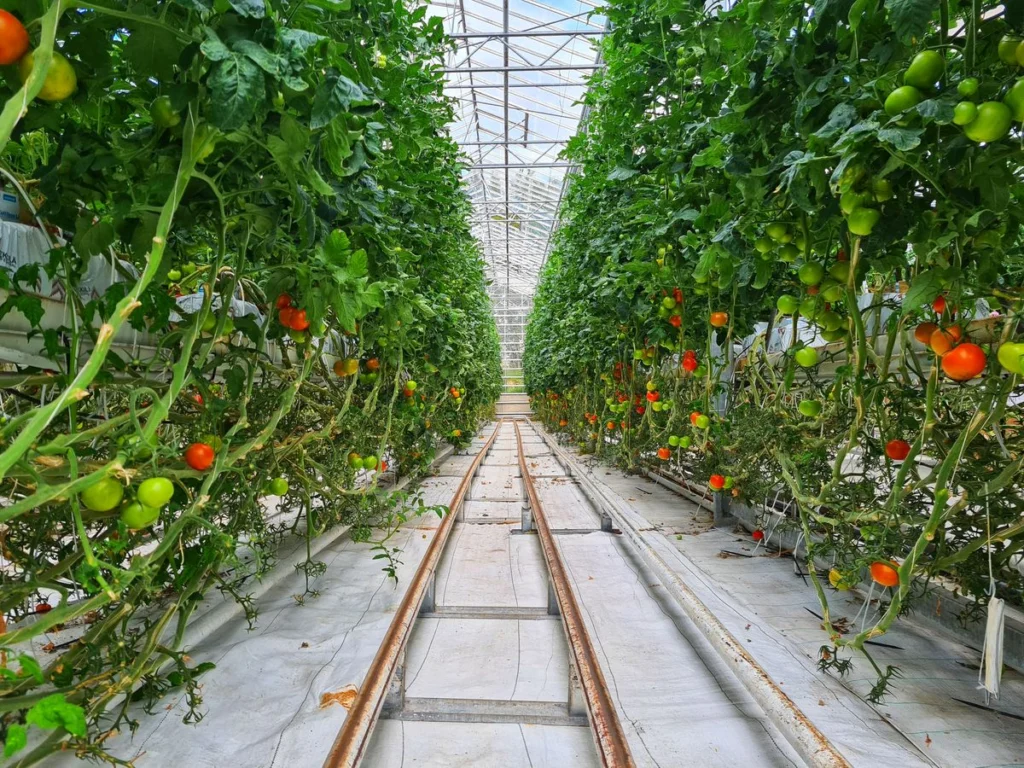
Soilless (hydroponic) tomato growing means raising the crop in an inert substrate (coconut coir, peat or cinder) fed by drip with a nutrient solution whose electrical conductivity and pH are closely controlled. The management benchmarks are well established: about 5 litres of substrate per plant, a conductivity of 2.0 mS/cm in the substrate, a pH close to 5.8, drainage kept at 30% of the volume applied and 3 to 7 irrigations a day. In return for this precision, the reference guide published by CIRAD in La Réunion reports yields of 200 to 350 tonnes per hectare over a 6 to 9 month cycle.
What soilless growing really changes for tomatoes
Taking tomatoes out of the soil does not make agronomy disappear; it moves the control point. In open ground, the soil acts as a buffer: it stores water, holds nutrients and corrects excesses. In a 30 litre coir bag shared by six plants, that buffer no longer exists. Every nutrient solution mistake shows up within 48 hours.
Even so, three reasons are pushing growers in West and Central Africa towards this technique. The first is plant health: getting out of the soil eliminates the nematodes and soil-borne wilts that make it hard to replant tomatoes on the same plot. The second is water, because controlled fertigation measures what goes in and what drains out. The third is yield per square metre, which justifies investing in a protective structure. The overall framework for the technique is set out in our feature on soilless growing and hydroponics in Africa.
Choosing the substrate
The guide to soilless tomatoes in La Réunion, written by Serge Simon and Janice Minatchy for CIRAD and FDGDON, compares the growing media used in tropical climates.
- Coconut coir. Supplied in 30 litre bags holding 6 plants. It is the most accessible medium in the humid tropics, since the raw material is local. It holds water well while keeping air in the root zone, provided it is properly rinsed before planting.
- Light (blond) peat. Used at 5 litres per plant, in modules of 3 to 6 plants per bag, with a target pH of 5.8. A consistent medium, but imported and therefore expensive.
- Coal cinder. A mineral substrate, cited as a local alternative. Very free-draining, it requires more frequent irrigation and closer monitoring of the solution.
Volume matters as much as the type of medium. Five litres per plant is the threshold below which the slightest interruption in irrigation causes visible stress, leading to blossom end rot on the first trusses.
The nutrient solution: conductivity, pH and growth stages
Two references usefully overlap. The CIRAD guide uses a conductivity of 2.0 mS/cm in the substrate solution and a pH of 5.8 on light peat. Ohio State University fact sheet HYG 1437, by Mark Kroggel and Chieri Kubota, recommends a pH between 5.5 and 6.5 and raises conductivity from 2.0 dS/m at the start to 2.4 dS/m in full production.
The same fact sheet breaks the solution down into three stages, the point most often overlooked in the field.
| Nutrient (ppm) | Stage 1, young plant | Stage 2, fruit set | Stage 3, full harvest |
|---|---|---|---|
| Nitrate nitrogen | 90 | 120 | 190 |
| Phosphorus | 47 | 47 | 47 |
| Potassium | 144 | 350 | 350 |
| Calcium | 144 | 160 | 200 |
| Magnesium | 60 | 60 | 60 |
The logic is spelled out in the fact sheet: keep nitrogen low at stage 1 to avoid an overly vegetative plant, then raise nitrogen, potassium and calcium as the fruit load increases. A grower who keeps the same solution from sowing to harvest gets a vigorous but unproductive plant, then fruit prone to blossom end rot.
Managing irrigation
The CIRAD guide provides a framework that can be applied directly. On peat, it uses 3 to 7 irrigations a day, each lasting 7 to 11 minutes, with 2 litre per hour drippers, and a target drainage of 30% of the volume of solution applied.
This 30% drainage rate is not waste; it is the control tool. The drainage water is measured: its volume shows whether the application is right, and its conductivity shows whether the plant is taking up more water than salts, which is normal in the hot season. Rising drainage conductivity signals under-application. Almost no drainage signals a risk of salt build-up in the bag.
Water quality determines everything else. Water with a high mineral load starts the solution at an already high conductivity and leaves little margin. Sizing the head unit, filtration and steady pressure are the same skills described in our article on the drip irrigation system, and they are at the heart of our Irrigation and pumping service.
Water use and yield benchmarks
For a field tomato grown for 90 to 120 days after transplanting, FAO gives a total requirement of 400 to 600 mm, with crop coefficients of 0.4 to 0.5 at the initial stage, 0.7 to 0.8 during development, 1.05 to 1.25 at mid-season and 0.8 to 0.9 at the end of the cycle. It puts a good irrigated commercial yield at 45 to 65 tonnes per hectare, with a water use efficiency of 10 to 12 kg per cubic metre, and notes that water supply is affected as soon as more than 40% of the available soil water is depleted.
The comparison with the 200 to 350 tonnes per hectare of soilless production under cover in La Réunion must be read with care: the cycle there lasts 6 to 9 months against 3 to 4 months in the field, the structure protects against erosion and wind, and density is higher. The gap nonetheless remains the economic justification for the technique. CTIFL work published in Infos CTIFL number 345, based on density trials carried out in 2017 and 2018, points the same way: yield can be increased by raising density, provided the leaf area index (the leaf surface that feeds the fruit) is maintained.
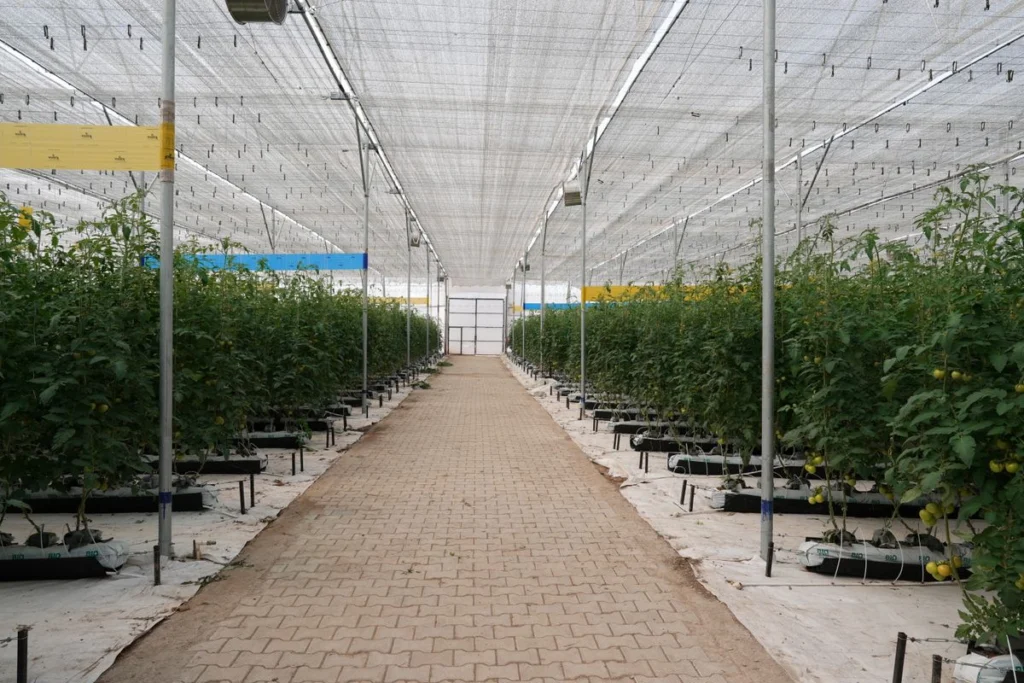
The structure and crop protection
Soilless growing without a cover makes little sense in our climates: rain upsets the water balance of the bags and leaches the solution. The choice of structure, especially its ventilation and insect-proof netting, must be settled first, and we cover it in detail in our guide to agricultural greenhouses in tropical Africa. It is the focus of our Agricultural greenhouses service.
Getting out of the soil solves soil-borne problems, not airborne diseases. Late blight remains the main threat whenever humidity stagnates under the cover, and the disease management described in our article on tomato late blight in tropical climates applies in full. The basics of variety choice and plant management remain those of the tomato crop management guide.
Where to start in practice
A first 500 m² module is enough to learn the trade without putting the farm at risk. Three conditions must be met before planting: tested water, an EC and pH meter kit used every day, and a drainage logbook. Until these three points are in place, increasing the area only increases losses.
Frequently asked questions
Which substrate should be used for hydroponic tomatoes in Africa?
Coconut coir is the most accessible medium in the tropics, supplied in 30 litre bags for 6 plants according to the CIRAD guide. Light peat, at 5 litres per plant, behaves more consistently but is imported.
What conductivity and pH should be targeted?
A conductivity of about 2.0 mS/cm in the substrate and a pH close to 5.8 according to the CIRAD guide. The Ohio State University fact sheet uses a pH of 5.5 to 6.5 and a conductivity that rises from 2.0 to 2.4 dS/m between the young plant and full harvest.
How many irrigations a day for hydroponic tomatoes?
From 3 to 7 daily applications of 7 to 11 minutes with 2 litre per hour drippers, aiming for 30% drainage, according to the guide to soilless tomatoes in La Réunion.
What yield can be expected from hydroponic tomatoes?
The CIRAD guide reports 200 to 350 tonnes per hectare over a 6 to 9 month cycle under cover, compared with the 45 to 65 tonnes per hectare FAO gives for an irrigated field tomato over 90 to 120 days.
Is a greenhouse essential?
Yes, in practice. Under tropical rain, water entering the bags makes it impossible to manage the nutrient solution and leaches the nutrients.
Does soilless growing eliminate diseases?
It eliminates soil-related problems such as nematodes and soil-borne wilts. Airborne diseases, led by late blight, remain fully present and are managed through ventilation and preventive hygiene.
Sources
- Serge Simon and Janice Minatchy, Guide de la tomate hors sol à La Réunion, CIRAD and FDGDON Réunion, 2008
- Mark Kroggel and Chieri Kubota, Hydroponic Nutrient Solution for Optimized Greenhouse Tomato Production, fact sheet HYG 1437, The Ohio State University
- FAO, Crop Information: Tomato, water requirements, crop coefficients and yields
- CTIFL, Culture de tomate hors sol sous serre, densité évolutive et architecture de plante, Infos CTIFL number 345, 2018