The mistake that forces a cashew plantation costing to be redone fits in one line: asking for a quote before the plot has been measured and the soil has been looked at. Without a net area, without a rainfall pattern and without a soil profile, a costing can only cover theoretical quantities, and it gets reworked at the first field visit. The file is assembled during the dry season, before planting: boundaries and area, soil depth and drainage, rainfall in the zone, planting layout, origin of the grafted plants, and water access for the nursery and the young trees.
First check that the plot will carry a cashew tree
The Agroforestree Database of the World Agroforestry Centre places cashew between 0 and 1 000 m of altitude, under a mean annual rainfall of 500 to 3 500 mm and mean annual temperatures of 17 to 38 degrees Celsius. The tree accepts most soils, except pure clays, impermeable soils, poorly drained soils and those subject to periodic flooding. It prefers deep, fertile, sandy soils. In drier zones, between 800 and 1 000 mm of annual rainfall, the same source insists on a deep, well drained soil with no impervious layer in the profile.
Rainfall distribution matters more than the total. Cashew fruits well when flowering is not soaked by heavy rain and the nuts mature in a dry period. Two plots receiving the same annual total therefore behave differently if one of them takes its rain during flowering. That is the first piece of information to attach to the file: the local rainfall calendar, month by month, and the usual flowering date in your area.
The size of the trees already growing nearby is a useful field indicator. According to the same database, cashew reaches about 12 m, but it rarely exceeds 6 m on lateritic, gravelly or coastal sandy sites, and it climbs to 15 m inland on loams. A neighbouring orchard stuck at head height on a gravelly soil says something about the potential of your plot, before any analysis.
A single observation pit 80 cm to 1 m deep is enough to see what matters: usable depth, texture, the presence of a hardpan or compacted horizon, and how water disappears after watering. Dig three pits spread across the plot rather than one at the edge of the track.
Measure the area and settle the planting layout
Everything else in the costing follows from the net area and the density. In Côte d’Ivoire, CNRA uses a density of 100 plants per hectare, at a spacing of 10 m between rows and 10 m within the row. The Chambre Nationale d’Agriculture de Côte d’Ivoire repeats the same density of 100 trees per hectare in its presentation of the sector, drawing on the work carried out by CNRA at the Lataha station.
At that density, the number of stakes, holes, plants and working days follows directly: a plot of 4 net hectares calls for 400 holes and 400 plants, plus a replacement margin. An area quoted from memory is a frequent source of error, because it usually includes tracks, lowland patches and retained trees. Have the real boundaries surveyed, then deduct the areas that cannot be planted.
The scale of orchards in the zone helps to calibrate the project. The same sector presentation reports family orchards averaging 0.5 to 3 hectares according to a RONGEAD-INADES survey from 2010, and areas of 13 to 23 hectares at Korhogo and Dianra according to an AFD survey from the same year. A 20 hectare project is not run like a 2 hectare project, neither for the nursery nor for the organisation of the hole digging work.
Planting material: grafted plants, and on which date
CNRA is explicit on this point: use grafted plants from the planting material released by research, vigorous, disease free, and at least 30 days past grafting when they go into the ground. The Chambre Nationale d’Agriculture de Côte d’Ivoire lists the absence of selected planting material among the weaknesses of the sector, alongside the fact that technical itineraries are not followed.
The calendar constraint comes from the seed. The Agroforestree Database of the World Agroforestry Centre reports 100 percent germination after 4 months of open storage at room temperature, viability down to 50 percent after 10 months, and none after 13 to 14 months. In hermetic storage at ambient temperature with seed moisture of 11 to 15 percent, viability exceeds 3 years. In other words, a nursery cannot be improvised with nuts kept two seasons in a bag: the seed order and the sowing date are decided at the same time as the planting date.
The same source flags damping off caused by Phytophthora palmivora as a common nursery disease. The file must therefore state where the nursery will sit, on which substrate and with what drainage, and not only how many plants are expected.
Water for the nursery and the first two dry seasons
A mature cashew orchard is grown rainfed. Water needs concern the nursery and the young trees. CNRA puts planting in the middle of the rainy season, which leaves the plantation several weeks to settle before the dry season. The World Agroforestry Centre notes for its part that weeding is needed to conserve soil moisture around young plants during the dry months.
Two items therefore belong in the file: the distance between the nursery and a usable water point, and the flow available at that water point in the driest month. The survey method is the same as for a conventional irrigated plot, and it is set out in our article on the field records to take before equipping a plot with irrigation. Without those two figures, the pumping and nursery watering item cannot be costed.
Prepare the soil and dig the holes before the plants arrive
CNRA recommends ploughing where the dry season is long and the soil is poor in organic matter. For the holes, the sheet gives 50 cm in diameter and 50 cm deep, with the soil separated: the first 25 cm on one side, the bottom 25 cm on the other.
The amendment is specified too: 20 kg of well decomposed, dry cattle manure, or 1 kg of poultry manure, split into three parts. One part at the bottom of the hole, one part mixed with the first 25 cm of soil, one part mixed with the bottom 25 cm. At 100 holes per hectare, that comes to 2 tonnes of well decomposed manure per hectare to source and to carry, an item that projects regularly forget to budget in working time.
The work is therefore planned in this order: survey and staking, ploughing where needed, hole digging, amendment of the holes, then planting in the middle of the rains. The plants arrive last, not first.
Intercrops in the first years
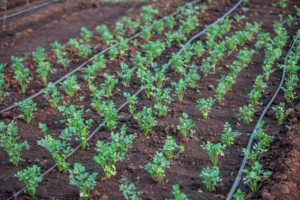
Between rows 10 m apart, the space available in the early years is considerable. CNRA describes an association with groundnut, sown between the rows and in the inter rows until the empty spaces are entirely covered by the canopy of the trees. The figures given are precise: 50 kg of shelled seed per hectare, groundnut lines 0.50 m apart, holes every 0.20 m along the line, two seeds per hole.
Upkeep follows the same logic: two manual weedings, one at the vegetative growth stage and one at flowering, and no weeding after pod formation. This association changes the work plan for the plot, and therefore the costing: it adds seed and weedings, but it occupies ground that would otherwise be maintained for nothing. It must appear in the file if you plan to use it.
The file to send in order to get an accurate costing
- Net plantable area, after deducting tracks, lowland patches and retained trees.
- Observations from three soil pits: usable depth, texture, compacted horizon or hardpan, drainage.
- Rainfall calendar for the zone and the usual flowering period.
- Dominant slope and plot access for a truck.
- Nearest water point, distance to the nursery and flow in the driest month.
- Number of grafted plants needed, area multiplied by 100, plus the replacement margin.
- Target planting date, in the middle of the rainy season.
- Planned intercrop and the area concerned.
- Labour available locally for hole digging and weeding.
This file fits on two pages. It allows the plants, the hole digging, the amendment, the nursery and the water item to be costed without back and forth, and it stays useful afterwards for following the work.
The mistakes that force a quote to be redone
- Ordering plants before the holes are open, then leaving them waiting in the nursery.
- Planting at the end of the rainy season, which exposes young plants to the dry season before they have rooted.
- Buying ungrafted seedlings, cheaper to buy and with no guarantee on how the orchard will behave.
- Declaring an area from memory, then discovering that 20 percent of the ground cannot be planted.
- Forgetting the nursery water point, and carrying water by hand for three months.
- Weeding the associated groundnut after pod formation.
For the agronomic context of the orchard itself, density, upkeep and management, see our article on cashew farming in Côte d’Ivoire, and for the place of the sector in the country’s farm economy, our overview of agriculture in Côte d’Ivoire.
Frequently asked questions
Does the soil need analysing before asking for a cashew plantation quote?
A field observation is enough for the initial costing. You need to know the usable depth, the texture, whether there is an impermeable layer, and the drainage. The World Agroforestry Centre states that cashew accepts most soils except pure clays, impermeable soils, poorly drained soils and those subject to periodic flooding, and that in zones with 800 to 1 000 mm of rain it calls for a deep, well drained soil.
How many cashew plants should be budgeted per hectare?
CNRA uses 100 plants per hectare, at a spacing of 10 m between rows and 10 m within the row. The Chambre Nationale d’Agriculture de Côte d’Ivoire repeats this density of 100 trees per hectare, drawing on CNRA work at Lataha.
When should young cashew trees be planted?
In the middle of the rainy season, according to CNRA, with vigorous, disease free grafted plants that are at least 30 days past grafting.
Can anything be grown between the rows in the first years?
Yes. CNRA describes an association with groundnut sown between the rows until the canopy closes, at 50 kg of shelled seed per hectare, in lines 0.50 m apart with holes every 0.20 m, two seeds per hole, with two manual weedings and no weeding after pod formation.
How long before the first flowering?
The World Agroforestry Centre states that cashew normally comes into flowering after 3 to 5 years.
Can a project be costed without a field visit?
An indicative costing is possible from the file described above. The visit remains necessary before ordering, to confirm the plantable area, the drainage and the access.
Moving to the next step
JOGOO supports orchard projects from the study through to production: surveys, planting layout, nursery, hole digging and the water item. See the Turnkey Agricultural Projects page for a project run end to end, or the Agricultural Advisory & Engineering page for support limited to the planting layout. Send your field records through the Contact page to receive a costing matched to your plot.
Sources
- CNRA, Comment conduire une parcelle d’association culturale entre arachide et jeunes plants d’anacardier, 2025
- World Agroforestry Centre, Agroforestree Database, Anacardium occidentale sheet (Orwa et al., 2009)
- Chambre Nationale d’Agriculture de Côte d’Ivoire, presentation of the cashew sector