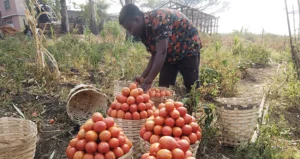
Market gardening is the intensive production of vegetables for sale, on short cycles of 60 to 150 days, with controlled irrigation and staggered harvests. It is the farming segment that generates the highest revenue per hectare in sub-Saharan Africa, because it allows three to four cycles a year where cassava or cocoa give only one. It is also the most demanding: without reliable irrigation and crop protection, a vegetable plot loses its margin in a single season.
Market gardening: definition and scope
Market gardening is the commercial growing of vegetables for sale, as opposed to a household garden grown for home consumption. Three features set it apart from other crop production.
Cycles are short. Tomato completes its cycle in 90 to 120 days, okra in 60 to 90 days. Capital turns over quickly, which completely changes a farm’s cash flow compared with a perennial crop such as cocoa, which needs three to four years before the first significant harvest.
Planting density is high. Where maize is planted at 50,000 plants per hectare, onion rises to 400,000 bulbs and more. Every plant counts, and uneven emergence is paid for directly in tonnage.
Water is non-negotiable. According to FAO references, a field tomato crop grown over 90 to 120 days needs 400 to 600 mm after transplanting, or 4,000 to 6,000 m³ per hectare. Onion needs between 350 and 550 mm. In the dry season, without a properly sized irrigation system, the question is not yield but whether the plot survives at all.
Why market gardening changes the economics of a farm
A well-managed hectare of vegetables produces several times the value of a hectare of extensive food crops, for a structural reason: rotation. Three cycles of 100 days a year on the same plot, with selling prices that climb in the off-season when local supply collapses.
It is precisely this off-season window that creates the margin. Fresh vegetable prices in the urban markets of Central and West Africa vary sharply with the season, and the grower who can deliver when others have nothing left sells at a completely different level. That means producing when it does not rain, which means irrigating, which means investing.
The reverse is just as true, and this is where many projects fail. A grower who only produces in the rainy season reaches the market at the same time as everyone else, when prices are at their lowest. He has carried the costs of an intensive crop only to sell at the price of an extensive one.
Which vegetable crops to choose
The choice rests on three criteria: cycle length, tolerance to heat and humidity, and above all the capacity of the local market to absorb the crop. A crop that is profitable on paper but has no buyer within 200 kilometres is not a profitable crop.
| Crop | Indicative cycle | Indicative density (plants/ha) | Key points |
|---|---|---|---|
| Tomato | 90 to 120 days | 20,000 to 40,000 | Highly susceptible to late blight in humid climates |
| Onion | 100 to 150 days | 200,000 to 600,000 | Requires careful curing and storage |
| Chilli pepper | 120 to 150 days | 20,000 to 30,000 | Long cycle but harvests spread over several months |
| Okra | 60 to 90 days | 40,000 to 60,000 | Harvest every 2 to 3 days, high labour demand |
| Cabbage | 75 to 100 days | 25,000 to 40,000 | Susceptible to caterpillars, needs close monitoring |
| Watermelon | 75 to 90 days | 3,000 to 5,000 | Heavy yield, transport logistics to plan |
These ranges vary with variety, agro-ecological zone and management. They are for sizing a project, not a substitute for agronomic advice on the plot.
Tomato remains the most common entry point, and it is also the riskiest for a beginner. We cover its full crop management in our tomato planting guide, and the control of its main threat in tropical climates in our late blight guide. Potato is an interesting alternative in highland areas.
Crop management, step by step
1. The nursery
The nursery decides the cycle before it even begins. A weak seedling at transplanting never catches up, whatever fertiliser is applied afterwards. Sow on a clean substrate, under shade netting, and transplant at the 4 to 5 true leaf stage. For tomato, FAO places transplanting 25 to 35 days after sowing, with emergence within 10 days.
The most costly mistake at this stage is direct sowing in the open field to save time. The gain is two weeks; the loss is uneven emergence across the whole plot.
2. Soil preparation

Ploughing, harrowing to a fine tilth, then raised beds of 15 to 25 centimetres. In a tropical climate, the raised bed is not an aesthetic refinement; it is insurance against root asphyxiation during heavy rain. Waterlogged soil kills more vegetable plants than drought.
A soil test before planting guides the basal fertiliser and avoids blindly applying nutrients that are already present. It is one of the items where an apparent saving costs the most.
3. Transplanting
Transplant late in the day or in overcast weather, water immediately, and plan to replace missing plants within 7 to 10 days. A survival rate below 90 % should trigger a diagnosis, not just replacement.
4. Irrigation
Drip irrigation has become the standard in commercial market gardening because it delivers water to the root, keeps foliage drier and therefore reduces fungal pressure, and allows fertigation. On high-density crops such as onion or tomato, the yield gap compared with hand watering is considerable.
Sizing depends on the area, the available water source and the crop. We cover installation costs and the best-suited crops in our drip irrigation guide.
5. Fertilisation
Vegetable crops remove large amounts of nutrients in a short time. An organic basal application, supplemented by split applications during the cycle, gives far better results than a single heavy application, much of which is leached away.
The orders of magnitude published by FAO provide a useful benchmark for sizing fertiliser rates. For high-yielding tomato varieties, requirements are 100 to 150 kg/ha of nitrogen, 65 to 110 kg/ha of phosphorus and 160 to 240 kg/ha of potassium. For onion, they fall to 60 to 100 kg/ha of nitrogen, 25 to 45 kg/ha of phosphorus and 45 to 80 kg/ha of potassium. These values are then adjusted from the soil test, never the other way round.
Choice of formulations and rates is covered in our NPK fertiliser guide. Foliar feeds, as a complement to and not a replacement for basal fertiliser, make it possible to correct a visible deficiency quickly during the cycle.
6. Crop protection
In hot, humid climates, pest and disease pressure is constant. The approach that works is close monitoring rather than calendar spraying: walk the plot every two days, turn the leaves over, and act on the first outbreaks. Late blight detected on day 2 can be controlled. By day 10, the plot is lost.
Insect nets, mulching and crop rotation structurally reduce the need for treatments. They cost money to install and pay for themselves over several cycles.
Open field, vegetable greenhouse or soilless growing
The choice of production system is a trade-off between capital tied up and control over the growing environment.
Open field production remains the most accessible and suits hardy crops and large areas. It is fully exposed to the climate and to pest pressure.
A vegetable greenhouse changes the picture for high-value crops. It protects against the violent rains that cause flower drop and fruit cracking, sharply reduces insect pressure when fitted with nets, and allows off-season production, and therefore sales when prices are high. In a tropical climate, the design challenge is not heating but ventilation: a poorly ventilated greenhouse becomes an oven and causes tomato flowers to abort. Our agricultural greenhouse solutions are designed for these constraints.
Soilless growing is aimed at farms dealing with degraded, contaminated or unavailable soil, and at those targeting consistent grading for a demanding market. It calls for greater technical skill and closer monitoring. We describe the systems in our guide to soilless growing and hydroponics.
What we see on the plots we support
In the trials we run with partner growers, the gap between an average vegetable plot and a well-managed one almost never comes from a single dramatic factor. It comes from the accumulation of three decisions taken early: seedling quality at transplanting, regularity of water supply, and how early crop protection steps in.
In our fertilisation protocols based on the Agribiosol biofertiliser, the most visible effects concern establishment and early vigour. On maize in Cameroon, we measured clearly superior root development and tillering compared with the control, with a yield gain at harvest. On tomato, growers report dense foliage, abundant and regular flowering, and fruit of a larger size than their usual references. The full protocol is described in our Agribiosol technical sheet, and plot-by-plot results on our projects page.
One observation comes up consistently enough to be worth mentioning: farms that invest in irrigation first, before increasing their area, reach break-even faster than those that do the opposite. Doubling the area without securing water means doubling the risk.
How much does a hectare of market gardening cost
The set-up budget breaks down into six items. The amounts depend too heavily on the country, the water source and the level of equipment for a single range to make sense, but the structure itself is stable.
| Item | Type | Covers |
|---|---|---|
| Land preparation | Initial investment | Ploughing, beds, drainage |
| Water source | Initial investment | Borehole or intake, pumping, storage |
| Irrigation system | Depreciable investment | Network, filtration, drippers |
| Shelter or greenhouse | Depreciable investment | Structure, cover, nets |
| Inputs per cycle | Recurring cost | Seed, fertilisation, protection |
| Labour | Recurring cost | Transplanting, maintenance, harvest |
The first two items are the ones project promoters most consistently underestimate. Access to water often accounts for a decisive share of the set-up budget, and it is also the item that determines all the others: an irrigation network without enough flow upstream is useless.
For costing tailored to your plot, your water source and your target crop, our team carries out a sizing study as part of our agricultural consulting and engineering services. The corresponding inputs and equipment are available in our range of farm supplies.
Five mistakes that destroy the margin
Planting before securing water. This is the most common and most final mistake. The dry season always comes.
Choosing the crop before the buyer. Market gardening produces perishables. Without a sales channel identified before sowing, the harvest is sold off cheaply.
Spraying by the calendar rather than by observation. Expensive when nothing is happening, and too late when an outbreak starts.
Neglecting rotation. Growing tomato after tomato on the same bed concentrates soil-borne pathogens and makes yields drop from the third cycle.
Sizing by area rather than by capacity to monitor. One well-managed hectare earns more than three hectares barely looked after, especially in market gardening where the window for action is counted in days.
Market gardening by zone
Constraints change markedly from one country to another. Zones with two rainy seasons allow different calendars from those with a single season, and the structure of urban markets determines the real outlets. We cover these specifics in our overviews of agriculture in Cameroon and agriculture in Côte d’Ivoire.
Growers who diversify beyond vegetables often combine these short crops with long-cycle crops that secure annual income, such as cassava or ginger.
Frequently asked questions
What is the difference between market gardening and subsistence farming?
Market gardening produces vegetables for sale, on short cycles and with intensive management. Subsistence farming aims first at feeding the household, with limited inputs and irrigation.
How much land do you need to start?
A quarter of a hectare that is well irrigated and well monitored is a realistic starting point and lets you learn crop management without exposing significant capital. Expansion comes later, once the sales channel is established.
Is drip irrigation profitable on a small area?
Yes, as long as the crop is high-density and high-value, and especially if the goal is off-season production. It is off-season production that pays for the installation, more than the yield gain alone.
Do you need a greenhouse for market gardening in Africa?
No, many crops do very well in the open field. A greenhouse is justified for high-value crops, in zones with violent rains, and when the goal is off-season production. Ventilation is the critical design point in a tropical climate.
How many cycles can you grow per year?
Three cycles are common with reliable irrigation, four with the shortest crops such as okra. Without irrigation, you fall back to a single useful cycle, which completely changes the economics.
Sources and references
- FAO, Land & Water, crop information sheet Tomato: water requirements, planting densities, fertilisation and sensitivity to waterlogging.
- FAO, Land & Water, crop information sheet Onion: water requirements, bed spacing, fertilisation and sensitivity to salinity.
- FAO, Crop Information: database of crop water requirements and crop response to water.
- FAO, Irrigation Water Management, chapter 2: Crop Water Needs.
- FAO, Irrigation Water Management, chapter 4: Irrigation Water Needs.
- JOGOO Agriculture field observations, Agribiosol fertilisation protocols run with our partner growers. See our projects.
Further reading
On an off-season onion plot, the pumping station decides the outcome. Calculating flow rate from peak demand, total head section by section and the comparison between a solar pump and a motor pump are covered in our article on how to size a solar pump for an onion plot.