The price of NPK fertilizer cannot be summed up in a single figure. In RECA Niger’s weekly survey of April 2022, the 50 kg bag of NPK 15-15-15 sold for between 13,500 and 27,000 FCFA depending on the location, with an average of 19,400 FCFA, and NPK 20-10-10 for between 7,000 and 28,350 FCFA. In 2026 the picture has changed: world urea prices climbed to 856.9 dollars per tonne in April according to the World Bank, their highest level since April 2022. This article explains where these gaps come from and how to calculate what you are really paying.
How much does a 50 kg bag cost: the published benchmarks
Niger’s national network of chambers of agriculture (RECA) publishes price surveys by market. Its special fertilizer bulletin, dated 28 April 2022, gives the following orders of magnitude for the 50 kg bag.
| Product | Recorded average | Recorded range |
|---|---|---|
| NPK 15-15-15 | 19,400 FCFA | 13,500 to 27,000 FCFA |
| NPK 20-10-10 | 16,700 FCFA | 7,000 to 28,350 FCFA |
| Urea | 23,600 FCFA | 18,000 to 27,500 FCFA |
| NPK SB and SBZn cotton, Benin | not reported | 27,000 to 28,000 FCFA |
Two lessons stand out. First, the gap between the cheapest and the most expensive market is more than double for an identical product: for urea, RECA recorded 18,000 FCFA in Konni against 27,500 FCFA in Niamey in the same week. Second, a more expensive bag is not necessarily a bad buy, and a very cheap bag is often a warning sign about quality, a point we return to below.
For recent seasons, Burkina Faso provides an official benchmark. The Council of Ministers of 9 April 2025 set the price of the 50 kg bag of NPKSB and urea for the 2025-2026 cotton season at 17,500 FCFA on credit, a 5.4 percent reduction from the 18,500 FCFA of the previous season, thanks to a 5 billion FCFA subsidy paid to the cotton inter-professional body.
Why prices soared in 2026
Village prices follow international prices, with a delay and some cushioning. The World Bank survey, published in its Commodity Price Data series, shows the scale of the movement.
| Product, in dollars per tonne | 2024 average | 2025 average | March 2026 | April 2026 | May 2026 |
|---|---|---|---|---|---|
| Urea, Eastern Europe | 338.3 | 422.7 | 725.6 | 856.9 | 770.5 |
| DAP | 563.7 | 685.2 | 658.3 | 725.3 | 769.5 |
| TSP | 474.6 | 577.6 | 558.1 | 658.1 | 713.5 |
| Potassium chloride | 295.1 | 347.5 | 380.6 | 401.3 | 405.0 |
| Phosphate rock | 152.5 | 152.5 | 152.5 | 152.5 | 152.5 |
The World Bank attributes this movement to disruptions in the Strait of Hormuz, which tightened supply from the Middle East. Its analysis indicates that the urea price rose by 80 percent from February 2026 to reach about 850 dollars per tonne in April, and that its fertilizer price index gained more than 12 percent in the first quarter of 2026, returning to its highest level since October 2022.
The projections published by the same institution are worth building into a season plan: urea would rise by nearly 60 percent over 2026 as a whole before easing in 2027, DAP by nearly 6 percent in 2026 followed by a fall of about 10 percent in 2027, and potash by about 12 percent in 2026 before a 6 percent decline in 2027. The practical message is simple: nitrogen is the input whose cost is rising fastest, so that is where efficient use pays off most.
From world price to village bag: how the price builds up
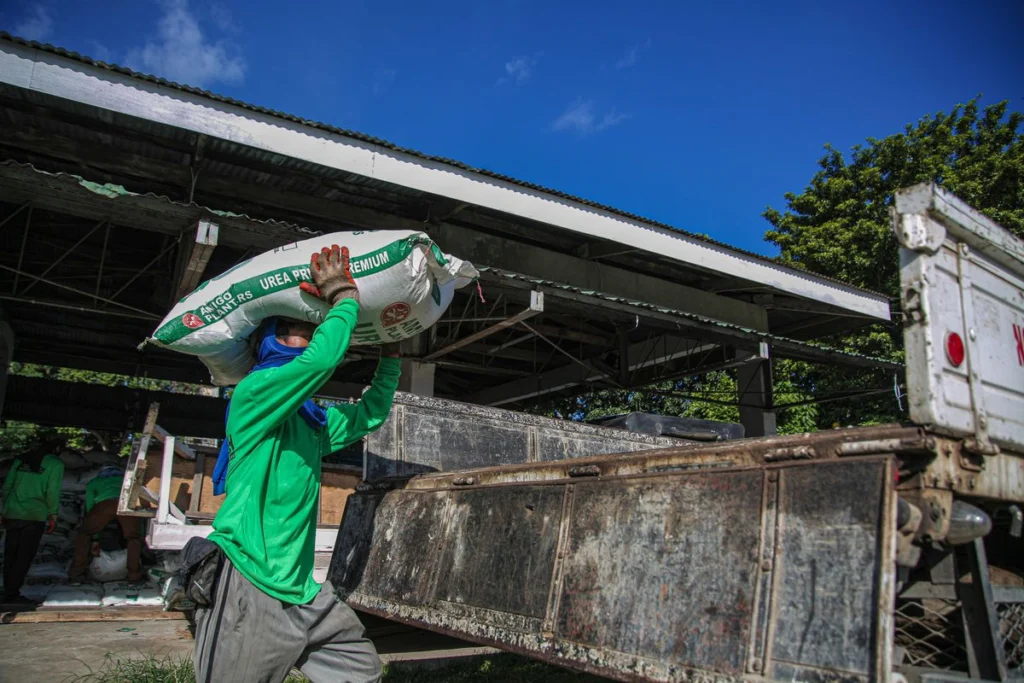
Between the quoted tonne and the bag on the distributor’s shelf in the district town, the price generally doubles. The analysis published by AfricaFertilizer, in collaboration with WAFA and IFDC, breaks down the chain.
- International FOB price: about 220 dollars per tonne for urea in May 2020, at the time of the analysis.
- Observed retail price: 400 to 550 dollars per tonne, more than double the FOB price.
- Sea freight: down to about 20 dollars per tonne, in a range of 17 to 21 dollars, against 35 to 40 dollars the previous year.
- Wholesale to retail margin: a difference of 20 to 30 percent.
The rest comes down to geography and public policy. The same analysis notes that Nigeria has the lowest costs, around 350 dollars per tonne, thanks to domestic production, that Ghana benefits from subsidies covering about 80 percent of its market, and that Mali, Senegal and Burkina Faso bear the highest costs. For a landlocked country, every hundred kilometres of inland transport ends up in the price of the bag.
This is why comparing a price displayed in Abidjan with one displayed in Ouagadougou makes little sense. The right comparison is local, in the same week, between suppliers in the same area.
Comparing two bags: the price per kilo of nutrient
The price of the bag is a poor basis for a decision. Two 50 kg bags can contain very different amounts of nutrients. The correct method takes two steps, using the formula printed on the bag.
Step one: calculate the amount of nutrients in the bag. An NPK 15-15-15 contains 15 percent of each nutrient, 45 percent in total, so 22.5 kg of nutrients in a 50 kg bag. An NPK 20-10-10 contains 40 percent in total, or 20 kg per bag.
Step two: divide the price of the bag by that amount. Using the averages recorded by RECA in April 2022, this gives about 862 FCFA per kilo of nutrient for NPK 15-15-15 at 19,400 FCFA a bag, and about 835 FCFA per kilo of nutrient for NPK 20-10-10 at 16,700 FCFA a bag. The two products, which 2,700 FCFA seemed to separate, actually cost almost the same per unit of nutrient.
The same calculation applies to urea, using the nitrogen percentage printed on the bag. It does not tell you which fertilizer to choose, which depends on the crop and the soil, but it stops you paying extra for filler. For choosing formulas and rates, see our article on NPK 15 15 15 rates by crop and our guide to NPK, foliar and organic fertilizers.
Regulated prices, subsidies and parallel channels
Some fertilizer is sold at administered prices. The Burkina Faso case mentioned above is the clearest example, with a bag of NPKSB and urea at 17,500 FCFA on credit for the 2025-2026 cotton season. As early as 2020, the AfricaFertilizer and IFDC analysis recorded a 50 kg bag in Burkina Faso at 12,000 FCFA through the subsidised channel against 15,000 to 17,500 FCFA through the commercial channel.
This has three practical consequences. First, the price you are offered depends on whether or not you belong to an organised value chain. Second, the gap between subsidised and open-market channels fuels resale, with a risk of repackaged product. Finally, a price well below the local administered price should prompt a check, not a hasty purchase.
Check quality before you pay
RECA describes a simple field test: moisten a little fertilizer and rub it between your hands. A counterfeit or adulterated product shows separation of materials and stony residues. This test does not replace a laboratory analysis, but it rules out the crudest frauds.
For formal verification, RECA indicates that INRAN’s LASEVE laboratory accepts 200 gram samples, accompanied by the product label, with a turnaround of one to three days. A buyer committing to several tonnes would do well to have a sample analysed before settling the order.
What this means for your season budget
The FARM Foundation points out that fertilizer use averages about 15 kg per hectare in West Africa, compared with an average of 120 kg per hectare in the rest of the world. At this level of use, the question is not how to cut rates further when prices rise, but how to make sure every kilo bought is actually used by the plant.
Three practical levers, in order of profitability:
- Split nitrogen applications rather than applying everything at once, since nitrogen is the input whose price is rising most according to World Bank projections.
- Place fertilizer in the right spot at the right time, which is worth more than increasing the rate.
- Keep foliar products for their real purpose, correcting trace element deficiencies, as our analysis of NPK foliar fertilizer explains. A foliar product is not a cheap alternative to basal fertilization.
The budget calculation is then straightforward: the number of bags planned per hectare multiplied by the local bag price, compared with the expected gross output of the crop. Our farm budgets for vegetable farming give orders of magnitude for the main crops.
For a secure, traceable supply, our farm supplies and inputs team supports sourcing, and our agronomists build the matching fertilization and plant nutrition plan.
Frequently asked questions
What is the price of a 50 kg bag of NPK 15-15-15?
In April 2022, RECA Niger recorded an average of 19,400 FCFA for the 50 kg bag, in a range of 13,500 to 27,000 FCFA depending on the market. The actual price depends on the country, the distance from the port, the season and whether a subsidy applies.
Why did fertilizer prices rise in 2026?
According to the World Bank, disruptions in the Strait of Hormuz tightened supply. The urea price rose by 80 percent from February 2026 to reach about 850 dollars per tonne in April, its highest level since April 2022.
How do you compare the price of two different fertilizers?
By converting the price to a price per kilo of nutrient. A 50 kg bag of NPK 15-15-15 contains 22.5 kg of nutrients, an NPK 20-10-10 contains 20 kg. Divide the bag price by that amount and compare the two results.
Why does the same fertilizer cost more in my village than in town?
Inland transport and the retail margin explain most of the gap. The AfricaFertilizer and IFDC analysis puts the difference between wholesale and retail prices at 20 to 30 percent, and notes that landlocked countries bear the highest costs.
How can you spot counterfeit fertilizer?
RECA recommends moistening a little product and rubbing it between your hands: separation of materials and stony residues indicate a counterfeit. For confirmation, a 200 gram sample analysed in a laboratory gives a result in one to three days.
Will prices fall in 2027?
World Bank projections expect prices to ease in 2027 after the 2026 rise, with a fall of about 10 percent for DAP and 6 percent for potash. These are projections, not guarantees.
Sources
- World Bank, Commodity Price Data, June 2026 edition
- World Bank, Fertilizer prices surge as Strait of Hormuz disruptions tighten supplies
- RECA Niger, Brèves numéro 4, spécial engrais, 28 April 2022
- AfricaFertilizer, WAFA and IFDC, Prix et coûts des engrais en Afrique de l’Ouest, June 2020
- SOFITEX, 2025-2026 cotton season, fertilizer prices set by the Council of Ministers
- FARM Foundation, Engrais et fertilité des sols en Afrique de l’Ouest
The prices quoted are those published by the sources listed, on the date given for each. Always check the price charged by your local distributor before setting a budget.