Watermelon farming (Citrullus lanatus) is a short, heavily irrigated vegetable crop: FAO gives a cycle of 80 to 110 days and a water requirement of 400 to 600 mm per cycle, for a marketable yield of 25 to 35 tonnes per hectare under well-managed irrigation. Under minimal irrigation, the same source considers 15 t/ha an acceptable result. Water, far more than variety, therefore decides the outcome. This guide covers soil, sowing, density, fertilisation, irrigation scheduling, pests and the farm budget, based on technical sheets published by CNRADA, RECA Niger, CIRAD and FAO.
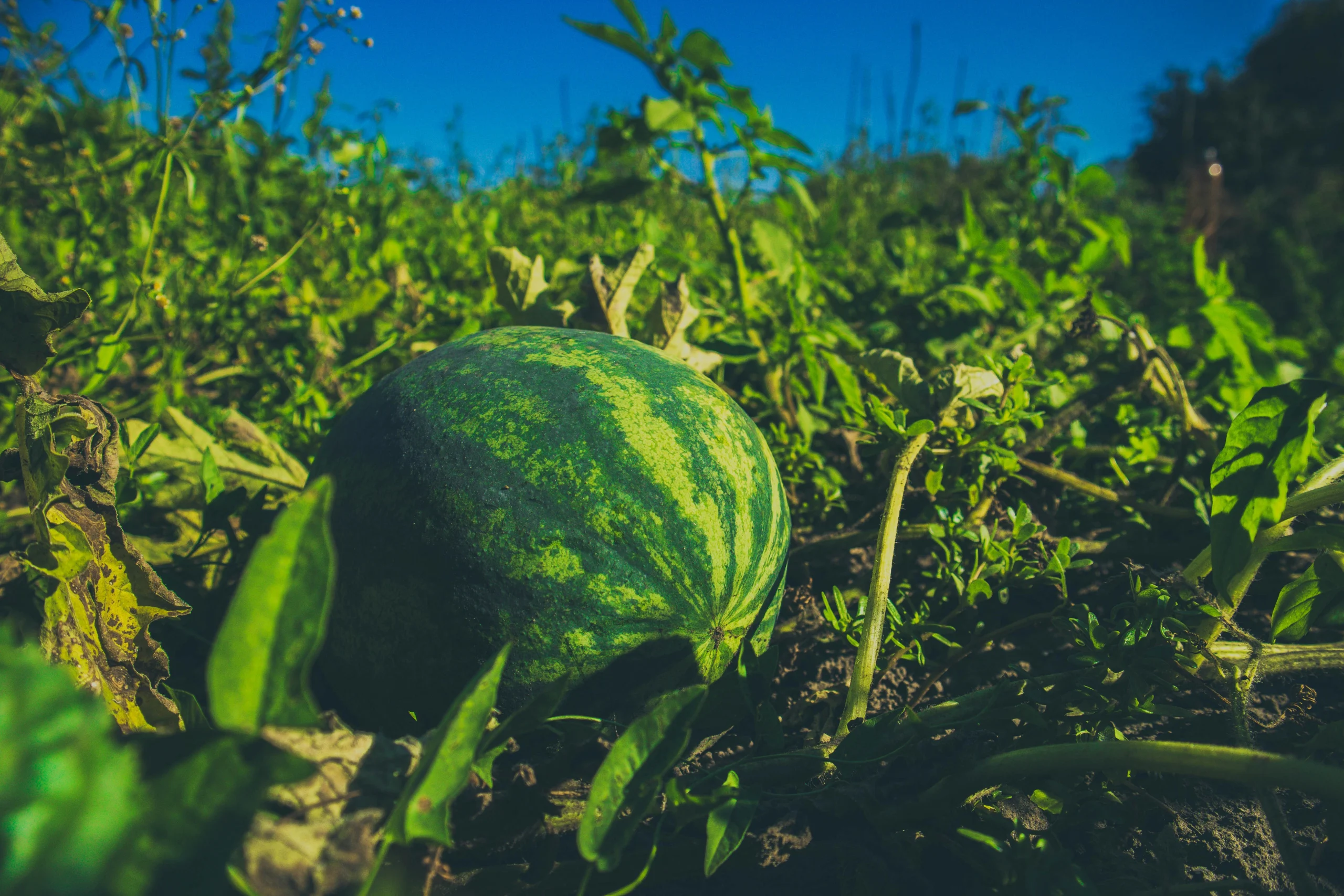
Watermelon reference figures
- Species: Citrullus lanatus, Cucurbitaceae family, like melon.
- Cycle: 80 to 110 days according to FAO, 70 to 100 days according to the CNRADA sheet, and as little as 64 days to first harvest for Sugar Baby in the CIRAD trial.
- Temperatures: daily means of 22 to 30 °C, maximum around 35 °C, minimum around 18 °C (FAO).
- Water requirement: 400 to 600 mm per cycle (FAO), or about 6,000 m³ per hectare in the CNRADA sheet.
- Density: about 10,000 plants per hectare on a 1 m by 1 m square grid (CNRADA), up to 16,000 plants per hectare in twin rows in the CIRAD trial.
- Yield: 20 to 35 t/ha under careful irrigated management, 11 t/ha as the smallholder dry-season benchmark in Niger.
Soil, climate and sowing window
Watermelon needs a loose, deep, well-drained soil rich in organic matter, neither too clayey nor too sandy according to the CNRADA sheet. Its root system goes deep: FAO reports maximum rooting depth of 1.5 to 2 m, with an active root zone of 1.0 to 1.5 m when water supply is adequate. This has two practical consequences. First, compacted soil or a plough pan caps the crop before flowering even begins. Second, on deep, well-prepared soil the plant reaches a water reserve that shallow-rooted vegetables cannot, which explains its reputation for relative hardiness.
The ideal climate is hot and dry. A pronounced rainy season is unfavourable: the trial run by CIRAD at the Dembéni station during the 2005 and 2006 rainy seasons gave only 2.0 to 5.2 t/ha depending on variety, far below usual tropical levels, with the researchers attributing this to poor plant survival and a lack of bees for pollination.
The practical conclusion for West and Central Africa: watermelon is grown as an irrigated dry-season crop, when sunlight is strong and humidity low. In Niger, the RECA technical and economic sheet describes sowing at the end of March for harvest from the end of May. The CNRADA sheet states that sowing is possible all year round as long as irrigation is secured.
Sowing, density and seed rate
Watermelon is direct-seeded in planting holes, with no nursery. The references differ on seed rate, and the gap is explained by seed type:
| Reference | Seed rate | Spacing | Density |
|---|---|---|---|
| CNRADA (improved variety) | 3 to 5 kg/ha | 100 cm by 100 cm | about 10,000 plants/ha |
| RECA Niger (local cultivar) | 1 kg/ha | holes 0.5 to 1 m apart | 3 to 4 seeds per hole |
| CIRAD trial (F1 hybrids) | not specified | 0.5 m in the row, twin rows | 16,000 plants/ha |
Sow 3 seeds per hole at a depth of 1 to 2 cm (CNRADA), then thin after emergence, keeping only the most vigorous plant. Local Nigerien cultivars are known as Fara and bakka, distinguished by flesh colour. Among distributed varieties, CNRADA cites Sugar Baby (deep red flesh, small fruit), and the CIRAD trial compared Vizir F1, Logone F1, Sugar Baby and Baby Doll F1. In that trial, Baby Doll gave the best yield and the best marketable rate, with marketable fruit rates ranging from 71 to 92% depending on variety.
Fertilisation: watermelon is a demanding crop
CNRADA’s recommendations for an irrigated crop are as follows:
- Organic manure: 30 tonnes of manure per hectare, worked in at land preparation.
- Mineral basal dressing: 300 kg/ha of 10-10-20 fertiliser.
- Top dressing: 250 kg/ha of the same 10-10-20, 40 days after sowing, when the plant enters full vine and flower production.
The formula is strongly potassium-based, and that is no accident: potassium drives fruit filling and sugar content. If you only have NPK 15 15 15, plan a potassium supplement at fruit set rather than raising the overall dose, or you will produce plenty of leaves and little sugar.
Under smallholder conditions, the RECA sheet describes a much lighter and perfectly workable programme: 20 cartloads of organic manure, about 8 tonnes per hectare, plus two pinches of NPK 15-15-15 per hole, a three-finger pinch at the 3-leaf stage then a five-finger pinch at branching. The CIRAD trial applied 5 g of 15-12-24 fertiliser per plant at 15, 30 and 60 days after planting.
All three protocols tell the same story: a generous organic base, then two to three split mineral applications timed to key growth stages. Our farm supplies and inputs team calibrates these applications based on your plot’s soil analysis.
Irrigation: the factor that decides yield
This is where most of the result is decided. FAO gives the following crop coefficients for watermelon:
| Stage | Duration | Kc |
|---|---|---|
| Initial | 10 to 20 days | 0.4 to 0.5 |
| Development | 15 to 20 days | 0.7 to 0.8 |
| Mid-season | 35 to 50 days | 0.95 to 1.05 |
| Late season | 10 to 15 days | 0.8 to 0.9 |
| At harvest | 70 to 105 day cycle | 0.65 to 0.75 |
FAO identifies three periods of maximum sensitivity to water deficit: the end of the vegetative phase, flowering and fruit formation. Stress at any of these three points translates directly into lost tonnage. That is why the RECA sheet prescribes irrigating five times a week in the dry season, and why CNRADA puts total demand at 6,000 m³ per hectare.
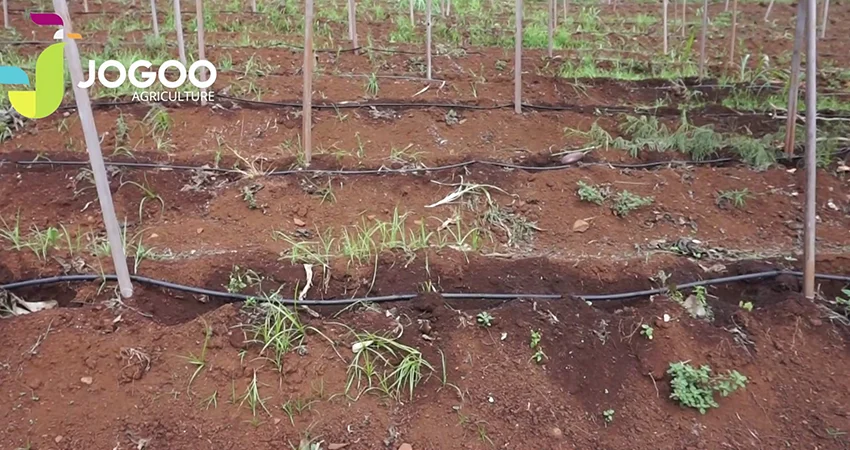
The same volume delivered by surface irrigation or by drip does not give the same result: FAO caps yield under flood irrigation at about 20 t/ha, against 25 to 35 t/ha under well-managed irrigation. A drip irrigation system offers three combined advantages here: steady supply during fruit set, dry foliage and therefore less powdery mildew, and the option of fertigation. Our irrigation and pumping service sizes the network, pump and filter based on your area and water source.
Pests, diseases and pollination
The CNRADA sheet lists two main pests and one dominant disease:
- Fruit flies (Dacus ciliatus, Atherigona spp.): they sting developing fruit, which rots on the vine. Trapping and systematic removal of stung fruit are the basis of control.
- Cucurbit ladybird (Epilachna chrysomelina): defoliation of young plants.
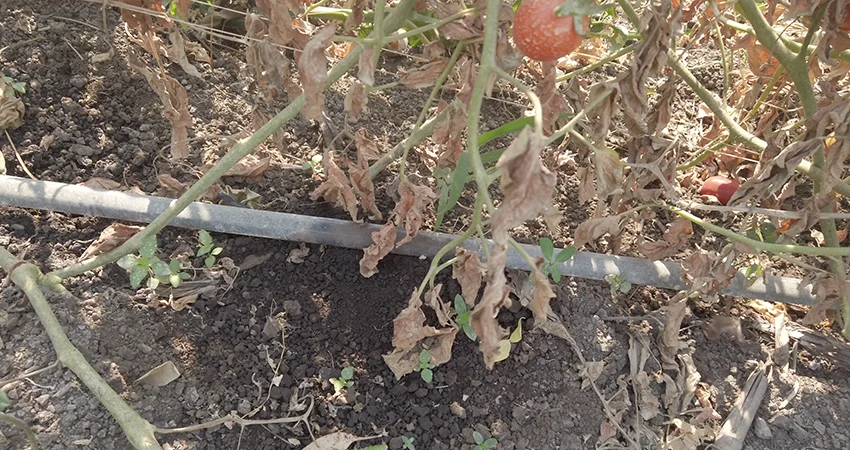
- Powdery mildew: white felt on the foliage, favoured by hot days alternating with humid nights. Localised irrigation greatly reduces the risk compared with sprinklers.
One point too often ignored: pollination. Watermelon has separate male and female flowers and depends entirely on insects. The authors of the CIRAD trial explicitly cite the lack of bees as one of the factors limiting their result. On an isolated plot, sprayed with insecticide at full bloom or grown under a closed structure, fruit set collapses even if everything else is perfect. Never spray insecticide during foraging hours, and keep a flowering field margin. Under an agricultural shelter, opening the nets during flowering or introducing pollinators becomes a technical necessity.
For diagnosis and the choice of products approved in your country, our crop protection team supports growers.
Harvest and expected yield
Harvest takes place 70 to 100 days after sowing according to CNRADA, and the CIRAD trial recorded first pickings at 64 days for Sugar Baby and Logone, against 75 days for Vizir and Baby Doll. The classic signs of ripeness are a dried tendril at the base of the fruit stalk, a ground spot turning from white to creamy yellow, and a dull sound when tapped.
Yield benchmarks to keep in mind:
- 20 to 35 t/ha under irrigation with full fertilisation (CNRADA).
- 25 to 35 t/ha under well-managed commercial irrigation, 15 t/ha under minimal irrigation and about 20 t/ha under flood irrigation (FAO).
- 11 t/ha as the smallholder benchmark in the cool dry season at Dosso, Niger (RECA).
Farm budget: the Dosso example in figures
The RECA Niger technical and economic sheet gives an actual budget, not a projection, for one hectare of watermelon in the cool dry season at Dosso:
| Item | Amount (FCFA/ha) |
|---|---|
| Total operating costs | 235,500 |
| Gross revenue | 1,785,000 |
| Gross margin | 1,549,500 |
Gross revenue is calculated on a benchmark yield of 11 t/ha, sold by the korya, a local sales unit of 100 fruits, or about 220 kg. The price per korya ranges from 25,000 to 45,000 FCFA, with the figures above based on an average price of 35,000 FCFA.
Three lessons for a project developer. First, the ratio of costs to gross revenue is exceptionally favourable for a vegetable crop, because local cultivar seed is cheap and labour dominates costs. Second, this budget does not include depreciation of an irrigation network: under mechanised management, that item must be added. Third, the price is very volatile: the same hectare is worth 1,275,000 FCFA at 25,000 FCFA per korya and 2,295,000 FCFA at 45,000 FCFA, which makes the timing of market entry the first lever of profitability, ahead of yield itself.
To compare watermelon with other crops in your area, see our feature on the most profitable vegetable crops in Africa. Our agricultural consulting and engineering teams draw up a farm budget tailored to your country and your marketing calendar.
Sources and references
- FAO, Land and Water Division. Crop Information: Watermelon. View the sheet
- CNRADA (Centre National de Recherche Agronomique et de Développement Agricole, Mauritania). Fiche technique du melon et de la pastèque. View the sheet
- RECA Niger. Fiche technico-économique pour la culture de la pastèque en saison sèche froide, Dosso, juillet 2017. View the document
- CIRAD, Agritrop. Test de culture de 4 variétés de pastèque cultivées en plein champ, station de Dembéni. View the report
Article written by the JOGOO Agriculture agronomy team. Rates and products must be adapted to your soil and climate and to the products approved in your country.
Frequently asked questions
How long does a watermelon crop take?
FAO gives a cycle of 80 to 110 days. The CNRADA sheet states 70 to 100 days to harvest, and the CIRAD variety trial recorded first pickings from 64 days for Sugar Baby and Logone, against 75 days for Vizir and Baby Doll.
What yield can you expect from one hectare of watermelon?
Under irrigation with full fertilisation, CNRADA reports 20 to 35 t/ha and FAO 25 to 35 t/ha. Under minimal irrigation, FAO considers 15 t/ha acceptable. As a smallholder dry-season benchmark at Dosso in Niger, RECA uses 11 t/ha.
How much water does watermelon use per hectare?
FAO puts the requirement at 400 to 600 mm per cycle, with a crop coefficient peaking at 0.95 to 1.05 in mid-season. The CNRADA sheet translates this into about 6,000 m³ per hectare, and RECA recommends irrigating five times a week in the dry season.
How many watermelon seeds do you need per hectare?
CNRADA gives 3 to 5 kg of seed per hectare for a density of 10,000 plants at 1 m by 1 m. With a local cultivar sown at 3 to 4 seeds per hole, the RECA Niger sheet goes down to 1 kg per hectare.
Which fertiliser should you use for watermelon?
CNRADA recommends 30 t/ha of manure, then 300 kg/ha of 10-10-20 as a basal dressing and 250 kg/ha of the same fertiliser 40 days after sowing. The formula is deliberately rich in potassium, the nutrient that drives fruit filling and sugar content.
Why are my watermelons not setting fruit?
The most common cause is poor pollination. Male and female flowers are separate and depend entirely on insects. The authors of the CIRAD trial cite the lack of bees as a limiting factor. Avoid any insecticide spraying during foraging hours and open shelters at full bloom.
Further reading
- Melon growing technical sheet: watermelon’s sister cucurbit, with the same pests and the same dependence on pollinators.
- Vegetable farming in Africa: profitable crops, techniques and costs: to see how watermelon compares with tomato, onion and chilli.
- Drip irrigation systems: costs and installation: sizing the network that delivers 6,000 m³ per hectare without waste.