
Download the technical sheet (PDF)
In Cameroon, potatoes are planted in February and March in humid regions and in April and May in Sahelian regions, on sites above 1,200 m altitude, according to the production and post-production fact sheet issued by MINADER in October 2024. The cycle runs from 100 days to three and a half months depending on the variety. This guide covers the full crop programme, from choosing seed tubers to storage, with plant densities, fertiliser rates and official economic benchmarks for Central Africa, followed by the planting calendar for temperate climates.
1. When to plant potatoes: the official calendar
The potato is not a tropical lowland crop. MINADER sets three conditions that determine the planting date far more than the calendar does.
| Requirement | Reference value (MINADER, 2024) |
|---|---|
| Minimum altitude | 1,200 m |
| Temperature | 16 to 28 °C, optimum 18 to 25 °C |
| Rainfall over the cycle | 300 to 700 mm |
Central Africa, highland zones
- Humid regions: plant in February and March.
- Sahelian regions: plant in April and May.
- Established production areas in Cameroon: Tibati, Dschang, Bangou, Bamenda, Mokolo, and the mountain sites of the South West.
Both windows follow the same logic: fit the cycle into a period when the crop receives 300 to 700 mm and night temperatures stay within the tuber-forming range. If expected rainfall is below that range, the planting date becomes an irrigation decision rather than a seasonal one. On a three-and-a-half-month crop, this is where yield is won or lost: see our irrigation and pumping solutions.
Temperate climates, for reference
In France, Belgium and Switzerland, planting runs from March, under fleece or tunnels for early varieties, to early June for late varieties. The practical benchmark is the end of frost risk, since a light frost destroys potato foliage. These benchmarks do not transfer to tropical highlands, where rainfall, not winter temperature, closes the window.
2. Choosing seed tubers and variety
Potatoes are propagated from seed tubers (“seed potatoes”), not from true seed. The choice of seed is the first yield factor, and the gap between varieties is considerable.
Reference varieties in Central Africa
| Variety | Yield | Cycle | Tolerance |
|---|---|---|---|
| UNICA | 45 t/ha | 2.5 to 3.5 months | Tolerant to late blight |
| CHULU | 40 t/ha | 2.5 to 3.5 months | Tolerant to late blight |
| CIPIRA | 20 to 35 t/ha | 100 days | Tolerant to late blight |
MINADER recommends these three varieties for Cameroonian production. The gap between CIPIRA at the low end of its range and UNICA is more than double, under the same crop management. In temperate climates, the common varieties remain Charlotte and Amandine for firm flesh, Bintje for frying, and Désirée and Cara for their hardiness.
Seed certification
Always buy certified seed potatoes from an approved supplier. Seed saved from the previous harvest accumulates viruses and loses its potential within a few generations. The reference sizes adopted by MINADER are 28 to 35 mm and 36 to 45 mm.
Availability of certified seed is the bottleneck of the value chain in the subregion. ISRA notes, for example, that potato production in Senegal is limited by the lack of quality seed and by high seed costs because seed is imported. This is an item to secure even before setting a planting date.
How much seed to plan for
- Size 28 to 35 mm: 1,200 to 1,500 kg per hectare.
- Size 36 to 45 mm: 1,500 to 2,000 kg per hectare.
Pre-sprouting
Place the seed tubers in crates in a cool, well-lit room a few weeks before planting. Pre-sprouting produces short, sturdy green sprouts, speeds up emergence and shortens the period during which the tuber is exposed to soil rots.
3. Soil preparation
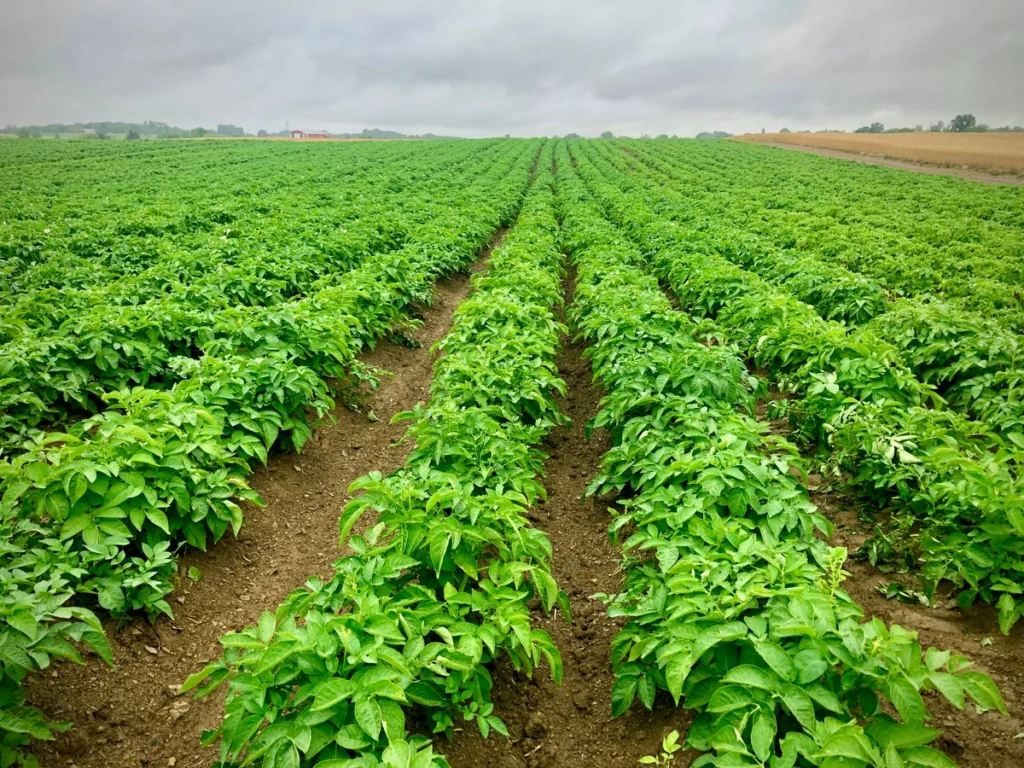
- Soil: light, loose, deep and well drained. Potatoes do not tolerate heavy, waterlogged soils.
- Soil reaction: slightly acidic. Avoid calcareous soils, which favour common scab.
- Rotation: do not replant a solanaceous crop on the same plot several years in a row. Tomato, eggplant, sweet pepper and chilli share the same soil-borne pests and diseases.
- Organic matter: 2 to 5 tonnes per hectare according to the MINADER fact sheet, incorporated before planting.
4. Planting
Density and spacing
- Between rows: 65 to 80 cm.
- Within the row: 25 to 30 cm.
- Density: 40,000 to 60,000 plants per hectare.
Depth, depending on soil condition
- Moist soils: 5 to 7 cm. Planting deeper exposes the tuber to asphyxia and rots.
- Dry soils: 10 to 12 cm, to place the tuber in a layer that retains some moisture.
- Orientation: sprouts facing up, then cover without compacting.
Basal fertiliser
MINADER sets out two formulas, both potassium-rich, which matches the real needs of a tuber crop:
- NPK + MgO 11 11 22 + 5.5 at 700 kg per hectare, or
- NPK + MgO 12 11 18 + 2.7 at 300 kg per hectare.
Place the fertiliser below or beside the seed tuber, never in direct contact. A balanced NPK such as 15 15 15 is not the reference formula for this crop: the nutrient-by-nutrient, crop-by-crop reasoning is explained in our guide to NPK 15 15 15 application rates.
5. Crop maintenance
First weeding and nitrogen top-dressing
MINADER places the first weeding 30 to 40 days after planting, combined with an application of 125 kg of urea per hectare. This is the key technical operation of the season: it combines weeding, drawing soil up around the plants and a nitrogen boost just as tuber formation begins.
Earthing up
Earthing up prevents greening of exposed tubers, which accumulate solanine and become inedible. It also stimulates tuber formation along the buried stem. A second pass before the rows close completes the first.
Irrigation
The crop needs moist but never saturated soil, with 300 to 700 mm of rainfall over the cycle according to MINADER. When the season does not deliver that volume, or delivers it irregularly, irrigation becomes the limiting factor for yield.
Crop protection
Late blight (Phytophthora infestans) is the main enemy, which is why all three varieties recommended by MINADER were selected for their tolerance. Prevention relies on variety choice, good canopy ventilation and preventive rather than curative treatments. The approach is the same as for tomato: see our guide to tomato late blight in tropical climates, as the protocol also applies to potato. Also watch for common scab, black scurf (Rhizoctonia) and wireworms.
6. Harvest and storage
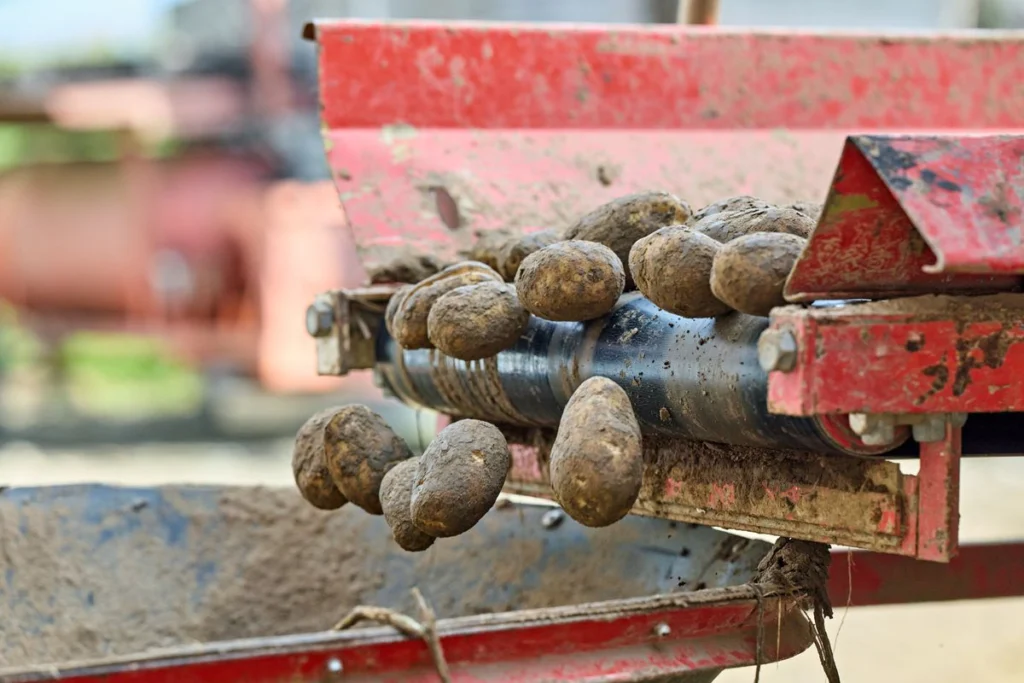
- Maturity: yellowing and wilting of the foliage, from 100 days for CIPIRA and from 2.5 to 3.5 months for UNICA and CHULU.
- Harvest in dry weather, on soil that has drained, using a fork on small areas.
- Storage: a dark, dry, ventilated room at a cool temperature. Light causes greening and solanine build-up.
7. What a hectare really earns
The MINADER fact sheet publishes a farm budget for one hectare of ware potatoes. It is an official costing, and it is far more cautious than the projections that circulate about this crop.
| Item | Amount (1 ha, first year) |
|---|---|
| Total production cost | 2 162 500 FCFA |
| Yield used | 14 000 kg |
| Revenue per cycle | 2 450 000 FCFA |
| Net profit per cycle | 262 041,67 FCFA |
Two lessons follow. First, the implicit price in this budget works out at 175 FCFA per kilo, that is 2,450,000 FCFA for 14,000 kg: any projection built on a higher price must be backed by a real marketing channel, not an assumed one.
Second, the gap between the budget yield, 14 tonnes, and the potential of the varieties recommended in the same document, 20 to 45 tonnes, is the real profitability lever. The official net margin is thin because the yield used is cautious. With a cost structure of 2,162,500 FCFA that is largely fixed, almost every additional tonne goes straight to margin. Certified seed, potassium-rich fertiliser and a reliable water supply make that difference, not renegotiating the selling price.
For a project covering several hectares, our turnkey agricultural projects team handles the feasibility study, irrigation sizing, variety selection and season-long follow-up.
Frequently asked questions
When should potatoes be planted in 2026?
In the highlands of Central Africa, in February and March in humid regions and in April and May in Sahelian regions, on sites above 1,200 m, according to the production fact sheet issued by MINADER in October 2024. In temperate climates, planting runs from March for early varieties to early June for late ones, once the risk of frost has passed.
At what altitude can potatoes be grown?
From 1,200 m according to MINADER, with temperatures of 16 to 28 °C and an optimum of 18 to 25 °C. Below that altitude, night temperatures hold back tuber formation.
How many seed potatoes are needed for one hectare?
1,200 to 1,500 kg of seed tubers per hectare for size 28 to 35 mm, and 1,500 to 2,000 kg for size 36 to 45 mm, for a density of 40,000 to 60,000 plants per hectare.
How deep should potatoes be planted?
5 to 7 cm in moist soil and 10 to 12 cm in dry soil, sprouts facing up, with 65 to 80 cm between rows and 25 to 30 cm within the row.
What is the potato yield per hectare?
The varieties recommended by MINADER in Cameroon are rated at 20 to 35 t/ha for CIPIRA, 40 t/ha for CHULU and 45 t/ha for UNICA. The official farm budget in the same document, however, uses a cautious yield of 14 tonnes per hectare, which shows the gap between varietal potential and average crop management.
Which fertiliser is best for potatoes?
A potassium-rich formula: NPK plus MgO 11 11 22 plus 5.5 at 700 kg per hectare, or 12 11 18 plus 2.7 at 300 kg per hectare, followed by 125 kg of urea per hectare at the first weeding, 30 to 40 days after planting.
Sources
- MINADER, Fiche de production et post production de la pomme de terre, Secrétariat général, Cameroun, octobre 2024
- GIZ, Les bonnes pratiques agricoles de production de pomme de terre au Cameroun, Yaoundé, juin 2019
- ISRA, Production de pomme de terre, le LNRPV forme les producteurs de semences de la zone des Niayes, février 2023
Further reading
- Chilli yield per hectare: another solanaceous crop, with a budget and gross margin costed source by source.
- Chilli crop production guide: do not follow potatoes with chilli without a long rotation.
- Vegetable farming in Africa: to see where potatoes stand among profitable crops and their costs.
Related articles



Get the full guide offline. Enter your details below.